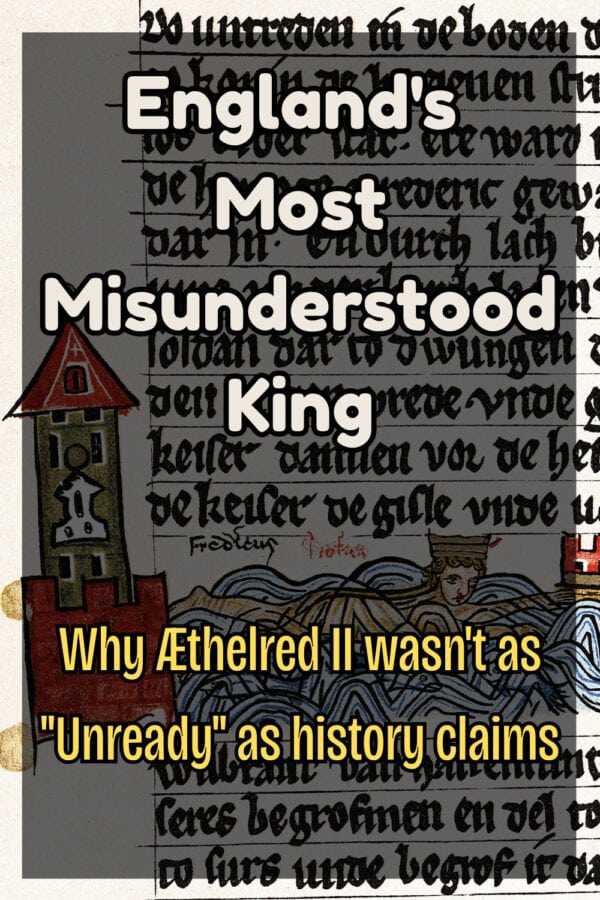
Ethelred II ‘The Unready’: The Misunderstood King Who Faced England’s Viking Storm
Few English kings have carried such an unfortunate reputation as Ethelred II ‘The Unready’. Remembered for centuries as a weak and ineffective ruler, his name has often been used as a symbol of failure. Yet the story of Æthelred II the Unready is far more complex than his famous nickname suggests.
As one of the Anglo-Saxon kings of England, Ethelred ruled during one of the most turbulent chapters in the history of Anglo-Saxon England. His reign unfolded at a time when Viking ships crossed the seas, coastal settlements lived under constant threat and England stood on the edge of a dramatic transformation.
The Viking invasions of England shaped much of Ethelred’s long reign. Facing powerful Danish armies, political rivalries and difficult choices, he became a king struggling to protect a kingdom under pressure. His story takes us deep into the world of Viking Age Britain, where battles, alliances and betrayals determined the future of England.
But was Ethelred really the ineffective ruler history remembers? Or was he a king caught in circumstances beyond his control?
Join me as we uncover the life, struggles and legacy of one of the most fascinating English kings before the Norman Conquest.

Disclosure
Timeless Travel Steps is supported by our readers. If you purchase through an affiliate link on my site, at no cost to you, I may earn a commission from qualifying purchases. Additionally, Timeless Travel Steps is a participant in the Amazon Services LLC Associates Program. As an Amazon Associate, I earn from qualifying purchases at no extra cost to you. Please read our Disclosure for further information.

Ethelred II ‘The Unready’: Quick Facts
|
Event |
When |
|---|---|
|
Born |
c. 966–968 |
|
Parents |
Edgar the Peaceful and Ælfthryth |
|
House |
House of Wessex |
|
Crowned |
4 May 979, Kingston upon Thames |
|
Reign |
978–1013 and 1014–1016 |
|
Predecessor |
Edward the Martyr (his half-brother) |
|
Successors |
Sweyn Forkbeard (1013–1014), followed by Edmund II Ironside (1016) |
|
Queens |
Ælfgifu of York and Emma of Normandy |
|
Children |
At least 10, including Edmund II Ironside and Edward the Confessor |
|
Died |
23 April 1016 (aged about 48–50) |
|
Burial |
Old St Paul’s Cathedral, London (destroyed in the Great Fire of London in 1666) |
Who Was Ethelred II ‘The Unready’? The King Behind the Legend
Born around 966, Ethelred II ‘The Unready’ became King of England in 978 during a period of growing uncertainty. He was the son of King Edgar the Peaceful, one of the most successful rulers of Anglo-Saxon England, and Queen Ælfthryth.
However, unlike his father’s peaceful reign, Ethelred inherited a kingdom facing political divisions and an increasing Viking threat.
Ethelred was still a young boy when he took the throne after the murder of his half-brother, Edward the Martyr. The young king inherited a court divided by political rivalries, religious disputes and competing interests among powerful nobles.
From the beginning of his reign, Ethelred faced the difficult task of ruling a kingdom that lacked stability.
A King Born Into a Changing England
For almost forty years, Ethelred governed England through one of the most challenging periods in the history of Anglo-Saxon England. Viking armies crossed the seas, attacked English settlements and demanded tribute from the kingdom. As one of the Anglo-Saxon kings of England, Ethelred faced choices that would shape the future of the country.
Yet history remembers him mainly for one thing — his nickname.
The word Æthelred meant “noble counsel” in Old English, a name that reflected the qualities expected of a king. However, his famous nickname Unræd, later translated as “The Unready”, told a very different story. It did not mean that Ethelred lacked preparation or courage. Instead, it suggested that he received poor advice or ruled without wise counsel.
The contrast was striking. A king named for “noble counsel” became known as the ruler who lacked it.
But behind the nickname stood a monarch facing extraordinary challenges. Ethelred did not rule in peaceful times. He ruled during the height of Viking Age Britain, when England’s shores faced repeated attacks and Scandinavian leaders sought control of the English throne.
To understand Ethelred’s story, we must look beyond the reputation left by later historians and discover the troubled world he inherited.
The Murder of Edward the Martyr: A Troubled Beginning for Ethelred II
Before Ethelred II took the throne, England faced a moment of uncertainty that would shape the young king’s future. In 978, his half-brother, King Edward the Martyr, died in mysterious circumstances at Corfe Castle in Dorset. The tragedy opened the way for Ethelred, then only around 12 years old, to become king.
The Mystery Behind Edward the Martyr’s Death
Edward’s death remains one of the most debated events in Anglo-Saxon history. Medieval chroniclers recorded that a group of nobles murdered the young king, although historians still debate the exact details and motivations behind the killing.
Some sources suggest that rival supporters of Ethelred saw an opportunity to place their preferred candidate on the throne.
Whatever the truth, Ethelred inherited more than a crown. He inherited a kingdom divided by suspicion and political tension.
Imagine the young king stepping into power at such a fragile moment. Around him, powerful nobles competed for influence, royal families struggled for control and England faced growing threats from across the North Sea.
The challenges would have tested even the most experienced ruler, let alone a boy who had barely reached his teenage years.
Corfe Castle: Where an Anglo-Saxon King Met His End
Today, visitors can still walk among the atmospheric ruins of Corfe Castle, where this dramatic chapter of England’s past began.
Rising above the Isle of Purbeck landscape, the castle connects modern travellers with the turbulent world of Anglo-Saxon kings of England, royal rivalries and the uncertain beginnings of one of England’s most controversial monarchs.
Ethelred’s childhood accession set the pattern for much of his reign. He inherited a fragile kingdom, and within a few years, a new danger would arrive on England’s shores — the return of the Vikings.

The Viking Storm Arrives: England Under Attack
When Ethelred first became king, the Viking threat had not disappeared, but it had not yet reached the scale that would later define his reign. For several years, England experienced periods of relative calm. Then, towards the end of the tenth century, the raids began to intensify.
The Return of the Viking Raiders
Long, narrow ships appeared along England’s coastline with increasing frequency. Viking warriors swept into monasteries, market towns and prosperous settlements before disappearing back to sea with their plunder. For communities living near the coast, every unfamiliar sail on the horizon brought uncertainty. No one knew where the next attack would fall.
These were no longer isolated raids carried out by small groups seeking treasure. Powerful Scandinavian leaders organised larger expeditions, determined not only to seize wealth but also to gain influence over England itself. As the attacks became more frequent and better organised, they placed enormous pressure on the young king and his advisers.
England stood at a crossroads. The kingdom that Ethelred had inherited now faced an enemy that struck quickly, moved with remarkable speed and seemed impossible to predict. Each new raid spread fear far beyond the communities that suffered the attacks, reminding people across the country that nowhere felt entirely safe.
How Did Ethelred Respond?
Ethelred refused to stand by while the raids continued. He strengthened coastal defences, raised armies and sought support from powerful nobles across the kingdom. At times, he negotiated with Viking leaders and paid large sums of money in the hope of securing peace. Some decisions brought temporary relief, while others encouraged the Vikings to return with even greater demands.
Looking back with the benefit of hindsight, it is easy to question the choices Ethelred made. Yet few rulers had faced an enemy as mobile, experienced and unpredictable as the Viking armies. England had no permanent standing army, communication across the kingdom remained slow, and local communities often had to defend themselves before royal forces could arrive.
As each new raid unfolded, the pressure on the king grew. Every decision carried risks, and every setback strengthened the reputation of the Viking leaders who challenged his authority. What had begun as scattered raids was rapidly becoming a struggle for the future of England.
For Ethelred, the greatest challenge still lay ahead. Faced with an enemy that seemed impossible to defeat, he turned to a controversial strategy that has shaped his reputation ever since — paying the Vikings to leave. The payments became known as Danegeld, and they remain one of the most debated decisions of his reign.
Quick Fact
The word Danegeld literally means “Dane tax” or “tribute paid to the Danes.”
Danegeld was a tax raised by Anglo-Saxon kings to pay Viking raiders in return for peace. Although it sometimes bought temporary relief from attacks, it often encouraged Vikings to return and demand even greater payments.
Today, Danegeld remains one of the most recognisable symbols of England’s struggle against Viking invasions.
Danegeld: Could England Buy Peace?
As the Viking invasions of England became larger and more destructive, Ethelred faced an impossible choice. Should he continue fighting an enemy that could strike almost anywhere along England’s coastline, or should he negotiate in the hope of protecting his kingdom? Whatever decision he made, the future of England hung in the balance.
What Was Danegeld?
To ease the immediate threat, Ethelred agreed to pay large sums of silver to Viking armies in return for peace. These payments became known as Danegeld, meaning “Dane money”. The aim was simple: persuade the Vikings to leave England without further bloodshed.
Paying tribute was not unique to Ethelred. Throughout medieval Europe, rulers sometimes used money instead of military force when they faced powerful enemies. While the strategy often bought valuable time, it rarely guaranteed lasting peace.
Why Did Ethelred Pay the Vikings?
Looking back more than a thousand years later, it is easy to ask why Ethelred II the Unready did not simply defeat the Vikings in battle. The reality was far more complicated.
England had no permanent standing army, and royal forces could not respond quickly to attacks across the kingdom. Viking fleets moved with remarkable speed, landing without warning before disappearing back to sea. Even when Ethelred raised armies and strengthened local defences, he could not protect every town and village at the same time.
Many historians now view Danegeld as a difficult political and military decision rather than a simple act of weakness. Faced with an experienced and highly mobile enemy, Ethelred tried to protect his people while preserving the stability of his kingdom. Some payments brought temporary peace, but others encouraged Viking leaders to return with even greater demands.
This debate continues to shape how historians answer the question, “Was Ethelred II really a bad king?” As one of the last Anglo-Saxon kings of England, he ruled during one of the most dangerous periods in the history of Anglo-Saxon England. Every choice carried consequences, and none offered an easy solution.
For a time, Danegeld bought England precious breathing space. However, it could not remove the growing fear and mistrust that had spread across the kingdom. In 1002, those tensions reached a breaking point when Ethelred made one of the most controversial decisions of his reign — an event remembered today as the St Brice’s Day Massacre.
Quick Fact
St Brice’s Day Massacre (13 November 1002) was ordered by King Æthelred II after fears of a Danish uprising in England. Although historians still debate how widespread the killings were, the event greatly worsened relations with Denmark and is believed to have helped trigger renewed Viking invasions.
St Brice’s Day Massacre: A Kingdom Divided by Fear
By the beginning of the eleventh century, England had lived under the shadow of Viking raids for many years. Fear and suspicion spread across the kingdom as attacks continued, and Ethelred faced growing pressure to protect both his people and his throne. In 1002, those tensions reached a dramatic turning point when he issued one of the most controversial orders of his reign.
Why Did Ethelred Issue the Order?
On 13 November 1002, the Feast of St Brice, Ethelred ordered the killing of Danish people living in England whom he believed posed a threat to the kingdom. His decision is recorded in a surviving royal charter, making the order itself one of the best-documented events of his reign.
Why Ethelred gave the order remains a subject of historical discussion. Many historians believe he feared a coordinated uprising by Danish settlers living within England, particularly at a time when Viking armies continued to attack from across the North Sea. Others suggest the order formed part of a broader attempt to strengthen royal authority during a period of political instability.
Whatever his reasons, Ethelred’s decision reflected the growing anxiety of a kingdom that had endured years of conflict. Fear, mistrust and uncertainty had become part of everyday life, and the line between neighbour and enemy had become increasingly difficult to distinguish.
What Really Happened on St Brice’s Day?
Although historians agree that Ethelred issued the order, many details remain uncertain. The surviving sources do not reveal exactly how widely the killings took place, how many people died or whether the order targeted all Danish settlers or only those considered a military or political threat.
Modern archaeology has added important evidence to the story. In 2008, archaeologists uncovered a mass grave at St John’s College, Oxford, containing the remains of individuals believed to have Scandinavian origins. Many scholars consider the discovery consistent with violence linked to the events of 1002, although they continue to debate exactly how the evidence should be interpreted.
The consequences of the massacre also remain the subject of discussion. Some medieval sources and later historians connect the killings with the renewed determination of the Danish king Sweyn Forkbeard to invade England. Others argue that his ambitions had already begun long before 1002 and that the massacre became one of several factors contributing to the conflict.
More than a thousand years later, the St Brice’s Day Massacre continues to divide historians. It remains one of the defining moments of Ethelred’s reign, not because every detail is known, but because it reveals the fear, uncertainty and impossible choices that shaped England during the final decades of Anglo-Saxon rule.
Rather than bringing peace, the order deepened the conflict. Within little more than a decade, England would face an even greater challenge as Sweyn Forkbeard launched his campaign to claim the English crown.
Sweyn Forkbeard and the Fall of an Anglo-Saxon Kingdom
The years following the St Brice’s Day Massacre brought little peace to England. Viking attacks continued, and one leader emerged above all others — Sweyn Forkbeard, King of Denmark. An ambitious and experienced ruler, Sweyn no longer sought occasional raids or tribute. He wanted England’s crown.
Who Was Sweyn Forkbeard?
Sweyn Forkbeard ruled Denmark for almost three decades and built one of the most powerful Viking kingdoms in Northern Europe.
During Ethelred’s reign, he launched a series of campaigns against England, taking advantage of the kingdom’s political divisions and repeated Viking successes.
Some medieval writers linked Sweyn’s determination to conquer England with the St Brice’s Day Massacre, claiming that one of the victims was his sister. Modern historians, however, continue to debate this story.
While it appears in later medieval accounts, contemporary evidence remains limited, and many scholars believe Sweyn’s ambitions reflected wider political and economic goals rather than a single act of revenge.
Whatever his motives, Sweyn recognised an opportunity. England had endured years of warfare, and confidence in Ethelred’s government had weakened.
Ethelred’s Exile and Return
In 1013, Sweyn launched a full-scale invasion that transformed the struggle for England. One by one, towns and regions submitted to the Danish king. As support for Ethelred collapsed, he fled with his family across the English Channel to Normandy.
For the first time in his reign, Ethelred lost his kingdom.
Yet the story did not end there. Only a few months later, Sweyn died unexpectedly in early 1014. His sudden death created a political vacuum and gave the English nobles an opportunity to recall Ethelred from exile.
According to the Anglo-Saxon Chronicle, the leading men of England invited Ethelred to return on the condition that he would govern more justly than before. Whether those exact words reflected the feelings of the time remains uncertain, but they suggest that many people still believed the rightful king deserved another chance.
Ethelred returned to England and reclaimed the throne, but his restoration proved short-lived. The conflict soon resumed, this time against Sweyn’s son, Cnut. Years of warfare had weakened the kingdom, and England now stood on the brink of a new era.
The final chapter of Ethelred’s reign would not end with peace, but with a struggle that changed the course of English history forever.
The End of Ethelred’s Reign and the Rise of Cnut
Although Ethelred had regained his throne, England’s troubles were far from over. Sweyn Forkbeard’s death had brought only a brief pause in the conflict. His son, Cnut, quickly returned to continue his father’s campaign and claim the English crown.
The Final Struggle for England
As Cnut gathered support, England once again became a battleground. Ethelred worked to defend his kingdom, but years of warfare had taken their toll. The kingdom remained divided, resources had dwindled and many nobles weighed their own interests as the struggle for power intensified.
In April 1016, Ethelred died after nearly thirty-eight years as king. His son, Edmund Ironside, immediately succeeded him and continued the fight against Cnut. Unlike his father, Edmund earned a reputation as a determined warrior and won several important victories. Even so, he could not drive the Danish army from England.
The two rivals finally met at the Battle of Assandun in October 1016, one of the most decisive battles in Anglo-Saxon history. Cnut emerged victorious, although Edmund survived the defeat. The two kings agreed to divide England between them, but only a few weeks later Edmund died, leaving Cnut as the undisputed ruler of all England.
A New Chapter in English History
Cnut’s victory marked the end of Ethelred’s royal line and the beginning of a new Danish dynasty. Although Anglo-Saxon customs, laws and traditions continued to shape the kingdom, England now stood under the rule of a Scandinavian king whose empire stretched across much of Northern Europe.
For many historians, Ethelred’s death symbolises more than the end of a reign. It marks the closing years of one chapter in the history of Anglo-Saxon England and the beginning of another. Fifty years later, the Norman Conquest would transform the kingdom once again, but the path towards that moment had already begun during Ethelred’s turbulent reign.
His story reminds us that history rarely changes in a single day. It unfolds through years of difficult decisions, shifting loyalties and events that no ruler can fully control. Ethelred ruled during one of those turning points, when the future of England hung in the balance and the old Anglo-Saxon world slowly gave way to a new age.

The image is a 13th-century copy of the Anglo-Saxon Chronicle, not a chronicle first written in the 13th century. The original compilation began in the late 9th century, during the reign of Alfred the Great, with later copies and continuations produced by medieval scribes over the following centuries.
Was Ethelred II ‘The Unready’ Really a Bad King?
More than a thousand years after his death, Ethelred II ‘The Unready’ remains one of the most misunderstood Anglo-Saxon kings of England. For generations, his famous nickname shaped the way people remembered him. It painted the picture of a weak and indecisive ruler who failed to defend his kingdom.
Yet the evidence tells a more complicated story.
Ethelred inherited the throne as a child after the violent death of his half-brother. Throughout his reign, he faced repeated Viking invasions of England, political divisions, changing loyalties and ambitious Scandinavian rulers determined to claim the English crown. Few monarchs ruled under such relentless pressure for so many years.
That does not mean every decision he made was successful. Historians continue to debate many of the choices he took, including the payment of Danegeld and the order that led to the St Brice’s Day Massacre. These decisions remain controversial, and opinions differ about whether they strengthened or weakened the kingdom. What is clear is that Ethelred governed during one of the most challenging periods in the history of Anglo-Saxon England, when every choice carried significant risks.
Perhaps the greatest misunderstanding lies in his nickname. The Old English word Unræd did not mean “unprepared”. Instead, it referred to poor counsel or unwise advice, creating an ironic contrast with his name, Æthelred, which means “noble counsel”. Even this famous title reminds us that history is often more complex than it first appears.
Today, many historians take a more balanced view of Ethelred’s reign. Rather than seeing him simply as an ineffective king, they recognise a ruler who faced extraordinary circumstances at a pivotal moment in Viking Age Britain. His story marks the closing years of Anglo-Saxon England before the Norman Conquest reshaped the country forever.
When you visit places such as Corfe Castle, the ancient streets of Winchester or the historic landscapes that witnessed these events, it becomes easier to imagine the uncertain world Ethelred inhabited. These places remind us that history is rarely black and white. Behind every famous name lies a human story shaped by difficult choices, unexpected events and the judgement of later generations.
Perhaps that is Ethelred’s greatest legacy. He was not simply “The Unready”. He was a king who ruled during one of England’s darkest and most uncertain chapters, leaving behind a story that still challenges historians—and visitors to England’s remarkable historic places—to look beyond the legend.
Explore England’s Anglo-Saxon Heritage Today
Although more than a thousand years have passed since Ethelred II ruled England, his story still echoes through some of the country’s most remarkable historic landscapes. Visiting these places offers more than a history lesson. It provides an opportunity to step into the world of the Anglo-Saxon kings of England and discover how their decisions helped shape the nation we know today.
Corfe Castle, Dorset
Perched high above the Isle of Purbeck, Corfe Castle stands on the site where Edward the Martyr met his tragic end in 978. Although the dramatic ruins that dominate the skyline today date mainly from the Norman period, the location remains closely connected with the events that brought the young Ethelred to the throne.
Standing here, it is easy to imagine how one act of violence changed the course of English history.
Winchester, Hampshire
For centuries, Winchester served as the political and ceremonial heart of Anglo-Saxon England. Kings gathered here to govern, celebrate religious festivals and issue royal charters.
During Ethelred’s reign, the city remained one of the kingdom’s most important centres of power, making it an essential destination for anyone interested in England’s early monarchs.
St John’s College, Oxford
Oxford preserves another important connection with Ethelred’s reign. Archaeologists discovered a mass grave at St John’s College containing individuals believed to have Scandinavian origins.
While historians continue to debate whether the remains relate directly to the St Brice’s Day Massacre, the discovery has provided valuable archaeological evidence that helps us better understand this turbulent period.
Ashingdon in Essex [Battle of Assandun]
The exact location of the Battle of Assandun remains one of the enduring mysteries of Anglo-Saxon England. Most historians associate the battlefield with Ashingdon in Essex, while others have suggested alternative locations.
Although the debate continues, the battle itself marked a decisive turning point, clearing the way for Cnut to become King of England.
Continue Exploring Britain’s Remarkable History
References & Further Reading
This article draws on a range of historical sources and modern scholarship to explore the life and reign of Ethelred II ‘The Unready’, including academic studies of Anglo-Saxon England, contemporary chronicles and archaeological research. Where historical evidence remains debated, different interpretations have been noted to reflect the ongoing discussions among historians.
For readers who would like to explore the history of Ethelred II ‘The Unready’ in greater depth, the following resources provide further insight into his reign, the Viking invasions of England, and the final centuries of Anglo-Saxon England.