
Sweyn Forkbeard: The Danish King Who Conquered England Before Cnut
More than half a century before the Norman Conquest of 1066, England had already fallen to a foreign king. In 1013, Sweyn Forkbeard, King of Denmark, launched a campaign that forced the English king Æthelred into exile and brought the kingdom under Danish rule.
Yet Sweyn’s victory is easily overshadowed. His reign as Danish king of England lasted only a matter of weeks before his sudden death in February 1014. He left behind a conquest that seemed, for a moment, as though it might unravel almost as quickly as it had been achieved.
But the Danish claim to England did not disappear with Sweyn. His son, Cnut the Great, would return and ultimately secure the English throne for himself.
In this story, we follow Sweyn Forkbeard from Danish king and Viking warrior to conqueror of England, looking at his remarkable rise, brief reign, sudden death and the legacy he left to his son, Cnut.

Who Was Sweyn Forkbeard?
Sweyn Forkbeard was a Danish king and warrior who conquered England in 1013. Born around 960, he was the son of Harald Bluetooth and later became King of Denmark. He extended his influence across Scandinavia before forcing Æthelred from the English throne. He was also the father of Cnut the Great.
Sweyn, known in Old Norse as Sveinn Haraldsson, emerged from one of the most powerful ruling families in tenth-century Scandinavia. His father, Harald Bluetooth, is remembered for uniting much of Denmark and promoting Christianity within his kingdom.
Sweyn eventually succeeded his father as King of Denmark, although the circumstances surrounding Harald’s final years and Sweyn’s rise remain debated. As king, Sweyn became deeply involved in the shifting alliances and rivalries of Scandinavia.
Following the Battle of Svolder around 1000, he was among the rulers who divided control of Norway, extending Danish influence there.
England, however, would become the setting for his most remarkable achievement. After years of campaigning, Sweyn invaded with greater force in 1013. By the end of that year, Æthelred had fled to Normandy and Sweyn had been accepted as king.
His victory made him the Danish king of England, but he had little time to establish his rule. Sweyn died suddenly on 3 February 1014, leaving his son Cnut to pursue the English crown.
Sweyn Forkbeard Facts at a Glance
- Born: c. 960
- Father: Harald Bluetooth, King of Denmark
- King of Denmark: c. 986/987–1014
- King of England: 1013–1014
- Son: Cnut the Great, later King of England
- Known for: Conquering England and forcing Æthelred the Unready into exile
- Died: 3 February 1014 at Gainsborough, Lincolnshire
- Burial: Sweyn was probably first buried at York, traditionally at York Minster. His body was later removed from England and taken to Denmark. Roskilde Cathedral is traditionally associated with his final burial, although no archaeological trace of his grave has been found.
Was Sweyn Forkbeard a Viking or a King?
Sweyn can reasonably be described as both a Viking and a king, although the distinction matters.
He participated in the warfare and overseas campaigns associated with the Viking Age, including repeated expeditions against England. But Sweyn was not simply a Viking raider seeking treasure. He was an established Scandinavian monarch commanding armies, negotiating political alliances and pursuing territorial power.
By 1013, his campaign in England had moved far beyond raiding. Sweyn was seeking — and ultimately gained — a kingdom.
Why Was He Called Forkbeard?
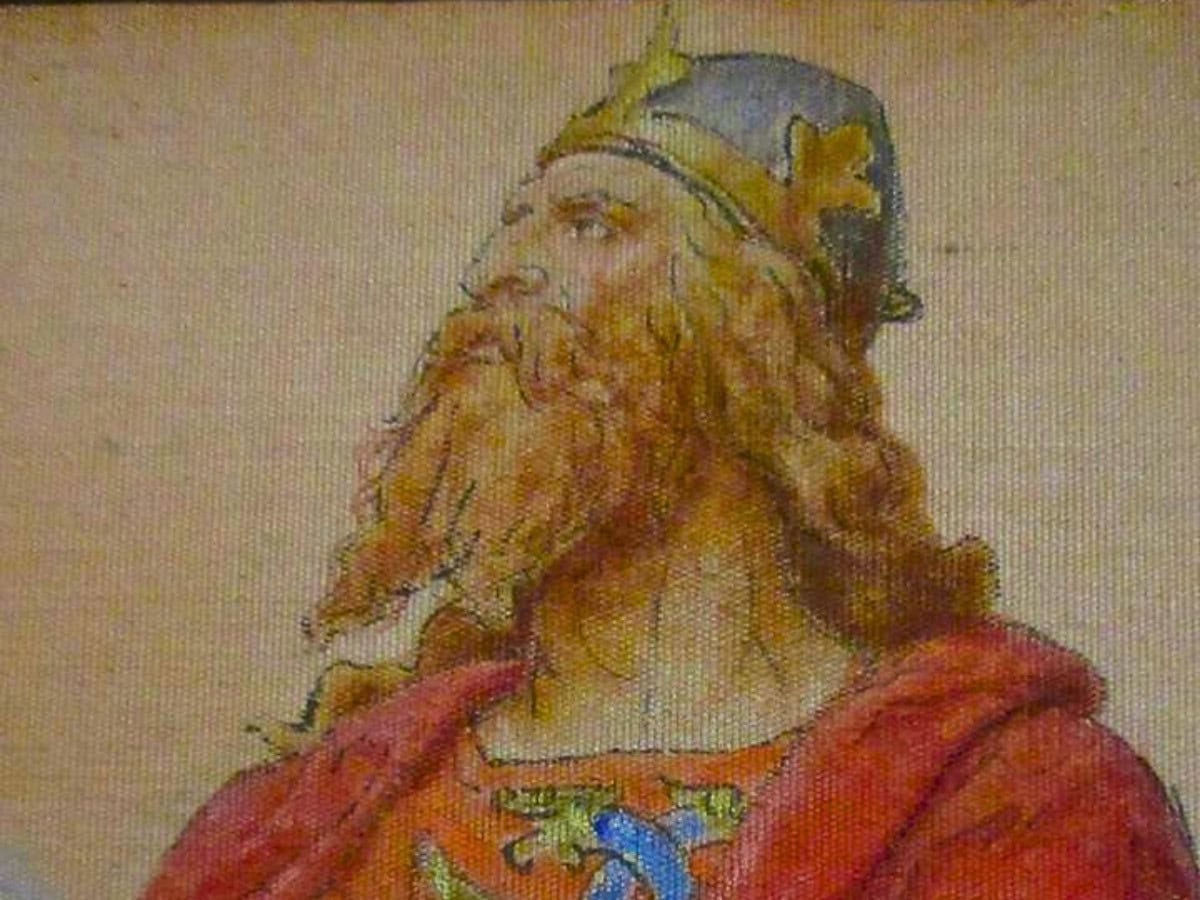
Sweyn’s distinctive nickname comes from the Old Norse Tjúguskegg, usually translated as “Forkbeard” or “forked beard”. It probably referred to the shape or styling of his facial hair, perhaps a beard divided into two points.
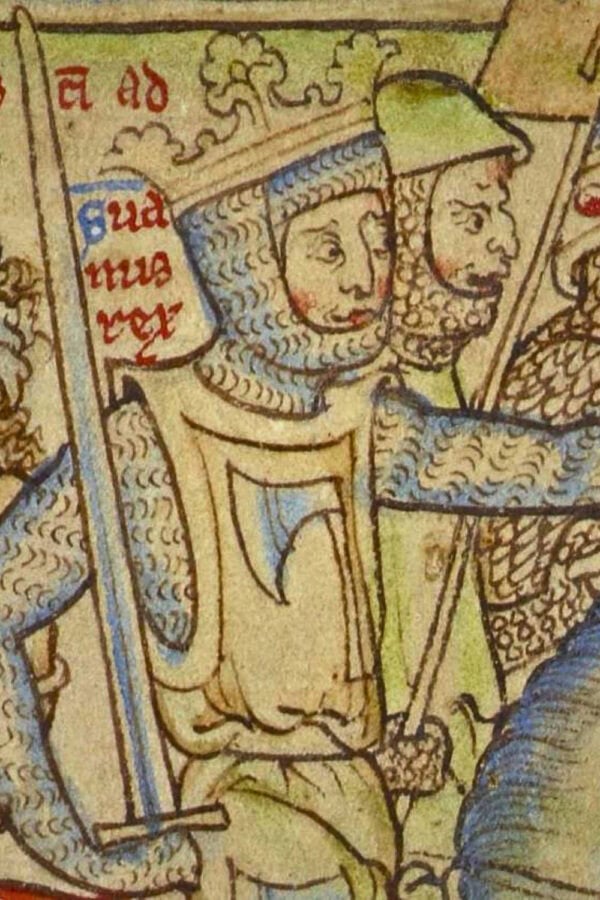
Exactly what Sweyn’s beard looked like is impossible to know. No reliable contemporary portrait survives, and familiar images of him were created long after his lifetime. The colourful name nevertheless endured, distinguishing Sweyn from other Scandinavian rulers and becoming the name by which he is best known today.
Why Did Sweyn Forkbeard Invade England?
Sweyn Forkbeard’s conquest of England did not begin suddenly in 1013. It grew from years of Scandinavian attacks, English payments for peace and Sweyn’s increasing political ambitions.
By the late tenth century, Viking fleets had returned to English waters in force. England was a wealthy kingdom, with prosperous towns, monasteries and a sophisticated system of taxation. This made it an attractive target for Scandinavian armies seeking plunder and tribute.
During the reign of Æthelred the Unready, the English crown repeatedly struggled to contain these attacks. Large payments of silver were made in attempts to persuade Scandinavian forces to leave. These payments are commonly associated with Danegeld, although the term itself was used differently in later periods.
Sweyn was already involved in campaigns against England long before his final conquest.
In 994, he joined forces with the Norwegian leader Olaf Tryggvason in an attack on London before campaigning elsewhere in southern England. attacks followed in the early eleventh century. His victory at the Battle of Svolder around 1000 also strengthened his position in Scandinavia, giving him greater freedom to campaign overseas.
The renewed Viking invasion of England therefore developed over decades rather than from a single event.
English resistance, political divisions and repeated payments did little to remove the threat. From the 990s onwards, England faced what English Heritage describes as a spiralling military and political crisis caused by Scandinavian incursions.
By 1013, Sweyn’s objective had changed. He was no longer coming simply to raid England or extract payment. This time, he came to take the kingdom.
Did the St Brice’s Day Massacre Lead to Sweyn’s Invasion?
The St Brice’s Day Massacre is often presented as the reason Sweyn invaded England, but the connection is not quite so straightforward.
On 13 November 1002, Æthelred ordered the killing of Danes living in England whom he believed posed a threat to his kingdom. Later medieval tradition claimed that Sweyn’s sister, usually called Gunnhild, was among those killed and that her death drove him to seek revenge.
The difficulty is that secure contemporary evidence does not establish that Gunnhild died in the massacre. Nor did Scandinavian attacks on England begin because of St Brice’s Day. Sweyn had already campaigned there before 1002.
The massacre may have intensified existing hostility and contributed to what followed. But Sweyn’s later campaigns are better understood within a much longer struggle for wealth, territory and political power. By 1013, that struggle had become a bid for the English crown.
How Did Sweyn Forkbeard Conquer England in 1013?
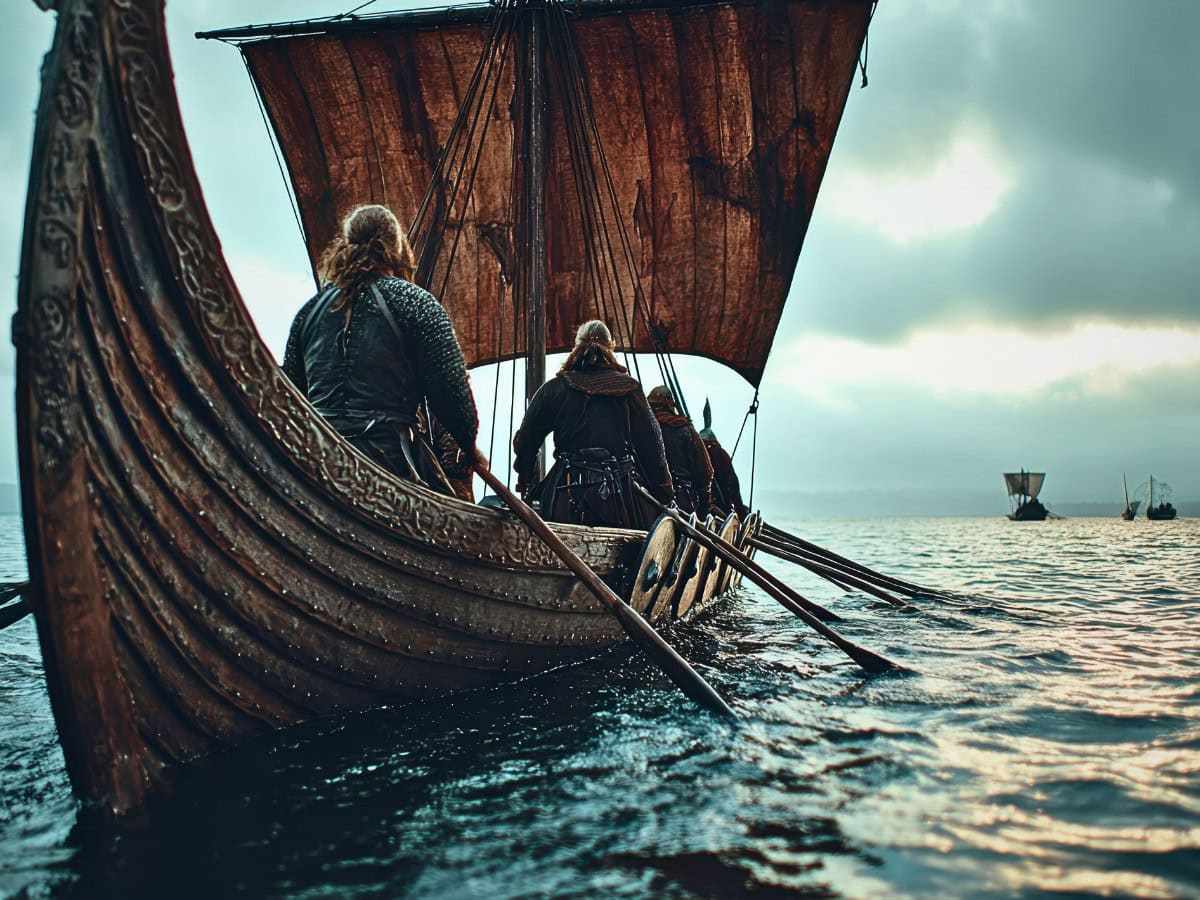
In the summer of 1013, Sweyn Forkbeard returned to England with his son Cnut and a formidable fleet. This Viking invasion of England was different from many earlier campaigns. Sweyn was no longer seeking payment to leave. He intended to take control of the kingdom.
According to the Anglo-Saxon Chronicle, Sweyn’s fleet first reached Sandwich before sailing north around East Anglia and into the Humber. From there, the Danes travelled along the River Trent to Gainsborough in Lincolnshire, which became an important base for the campaign.
Sweyn’s advance was remarkably swift. The earl of Northumbria and leading men of Lindsey submitted to him, followed by representatives of the Five Boroughs. They gave hostages as guarantees of loyalty and supplied provisions for his army. These submissions were crucial. Sweyn was gaining political recognition as well as territory.
From Gainsborough to London: Sweyn’s Path to the English Throne
Leaving his ships and hostages with Cnut at Gainsborough, Sweyn moved south. Oxford submitted to him, followed by Winchester. He then turned towards London, where Æthelred the Unready remained.
London proved far more difficult. The city resisted Sweyn, reportedly with Æthelred and the Norwegian leader Thorkell the Tall helping to organise its defence. Unable to take London immediately, Sweyn moved west, where further communities submitted and provided hostages.
As support for Æthelred collapsed, London’s position became increasingly isolated. The city eventually submitted to Sweyn too. Æthelred first sent his wife Emma and their children to Normandy before following them into exile.
Sweyn’s conquest therefore depended on more than military strength. English nobles and communities chose to recognise him, whether through fear, political calculation or dissatisfaction with Æthelred’s rule. Their submission turned a successful military campaign into a change of king.
By Christmas 1013, Æthelred had left England and Sweyn stood at the head of the kingdom he had spent years attacking.
Was Sweyn Forkbeard the First Viking King of England?
Sweyn Forkbeard is often described as the first Viking king of England, but the term needs some qualification. Earlier Scandinavian rulers had controlled substantial parts of England during the Viking Age, particularly the kingdom of York, but Sweyn succeeded in gaining recognition across the English kingdom created by the tenth-century West Saxon kings.
By the end of 1013, Sweyn had driven Æthelred from England and had been accepted as king. In that sense, he became the first Danish ruler to take the throne of a unified England.
His position was nevertheless very new. Sweyn had conquered the kingdom, but he had barely begun to rule it. His time as Danish king of England was about to be unexpectedly short.
How Long Was Sweyn Forkbeard King of England?
Sweyn Forkbeard was king of England for only a short period, from late 1013 until his death on 3 February 1014. The exact length depends on when his kingship is considered to have begun, because his authority developed through a series of submissions rather than one single coronation or accession moment.
By the end of 1013, however, Æthelred had fled to Normandy and Sweyn had been accepted as king across England. That makes his English reign one of the shortest in the country’s history.
Its brevity is also the key to understanding why Sweyn is so often overshadowed by Cnut.
Sweyn succeeded in conquering England but died before he could consolidate his rule. He had little time to establish a stable administration, secure long-term loyalty or shape the kingdom he had taken.
His achievement was therefore military and political rather than administrative. He won the English throne, but he did not live long enough to build the durable Anglo-Danish monarchy that his son would later create.
How Did Sweyn Forkbeard Die?
Sweyn Forkbeard died suddenly at Gainsborough on 3 February 1014, only weeks after becoming king of England. The exact cause of his death is unknown.
Contemporary sources record his death but do not provide a clear medical explanation. Later medieval writers added more dramatic stories, including traditions that Sweyn was struck down through divine intervention or connected his death with the English saint Edmund.
Those accounts were written long after the event and should be treated as legend rather than reliable evidence.
What can be said with greater confidence is that Sweyn died unexpectedly while his new rule was still fragile. His death immediately changed the political situation in England.
The Danish army proclaimed his son Cnut as king, but English leaders chose instead to invite Æthelred back from exile. In a matter of days, the conquest Sweyn had spent years pursuing was thrown into uncertainty.
His sudden death did not end Danish ambitions in England. It simply passed them to the next generation.
Where Was Sweyn Forkbeard Buried?
Sweyn Forkbeard’s final burial place remains uncertain. Later medieval sources place his first grave at York Minster, although contemporary accounts confirm only that he was initially buried somewhere in England.
The Encomium Emmae Reginae, written in the 1040s, tells a more unusual story. An unnamed English woman had Sweyn’s body removed from its grave, embalmed and taken by ship to Denmark. There, his sons received his remains and buried them in a monastery dedicated to the Holy Trinity that Sweyn had built for himself.
Exactly where that church stood is still debated. Roskilde and Lund have both been proposed, and Roskilde Cathedral traditionally includes Sweyn among its royal burials. However, no archaeological evidence has securely identified his grave.
More than a thousand years after his death, the final resting place of England’s brief Danish king remains unknown.

What Happened After Sweyn Forkbeard Died?
Sweyn Forkbeard’s death in February 1014 did not end the Danish struggle for England. Instead, it opened another turbulent chapter in the contest for the throne.
The Danish fleet and army supported Sweyn’s son Cnut, then still a young man, as his successor. English political leaders had other plans. They invited Æthelred the Unready to return from exile, reportedly on the condition that he would govern more justly than before.
Æthelred returned to England, and Cnut was forced to withdraw to Denmark. But the Danish claim to the English throne had not disappeared.
Cnut returned with a powerful invasion force in 1015. When Æthelred died in April 1016, his son Edmund Ironside continued the resistance. The two rivals fought a series of campaigns before Edmund’s defeat at the Battle of Assandun in October 1016.
An agreement divided England between them, but Edmund died only weeks later. Cnut was left as king of all England.
Sweyn had conquered England first, but his son achieved what he had not lived long enough to do. Cnut the Great secured the throne, established a lasting reign and transformed his father’s brief conquest into a new Anglo-Danish monarchy.
Why Is Cnut More Famous Than Sweyn Forkbeard?
Cnut is remembered more widely than Sweyn largely because he had something his father was denied: time.
Sweyn’s conquest of England was a remarkable achievement, but his sudden death left little opportunity to turn victory into lasting government. Cnut, by contrast, ruled England from 1016 until 1035. During those years, he consolidated Danish control while governing through many of England’s existing laws, institutions and political structures.
Cnut also became ruler of Denmark and Norway, creating a powerful realm spanning much of the North Sea world. His long reign left far more evidence of kingship, diplomacy and government than Sweyn’s few weeks on the English throne.
Even the famous story of Cnut and the waves helped keep his name alive in popular memory, although its original meaning is often misunderstood.
Yet Cnut’s achievement did not begin from nothing. His father had already demonstrated that a Danish ruler could conquer England and force its king into exile.
Cnut built the dynasty, but Sweyn had led the way.
Sweyn Forkbeard’s Place in English History
Sweyn Forkbeard’s reign in England lasted only weeks, but its brevity should not obscure what he achieved.
In 1013, after years of campaigning, Sweyn gained the submission of much of England and forced Æthelred the Unready into exile. The Danish warrior who had repeatedly attacked England had become its king.
His sudden death meant he had no opportunity to consolidate his rule. Cnut would return, win the kingdom again and establish the Anglo-Danish monarchy for which he is better remembered.
Sweyn’s place in English history is therefore brief but significant. He was not simply Cnut’s father or another Viking raider. He was a Danish king who successfully conquered England and, however briefly, ruled it.
Please take a moment…
Before you go, I’m excited to share some news—Timeless Travel Steps was awarded Best Slow Travel & Heritage Travel Blog 2026! Please take a moment to read our story and discover the passion behind our journeys.
Disclosure
Timeless Travel Steps is supported by our readers. If you purchase through an affiliate link on my site, at no cost to you, I may earn a commission from qualifying purchases. Additionally, Timeless Travel Steps is a participant in the Amazon Services LLC Associates Program. As an Amazon Associate, I earn from qualifying purchases at no extra cost to you. Please read our Disclosure for further information.
Continue Exploring Britain’s Royal History
If you enjoyed the story of Sweyn Forkbeard, you may also like these related guides exploring Britain’s monarchs, royal prisoners and the places where history unfolded.
Sources and Further Reading
The story of Sweyn Forkbeard and the Danish conquest of England survives through a mixture of contemporary and later medieval accounts. These sources do not always agree, so later traditions should be treated with care.


