
The Ghosts of Blickling Hall, Norfolk and Their Haunted Secrets
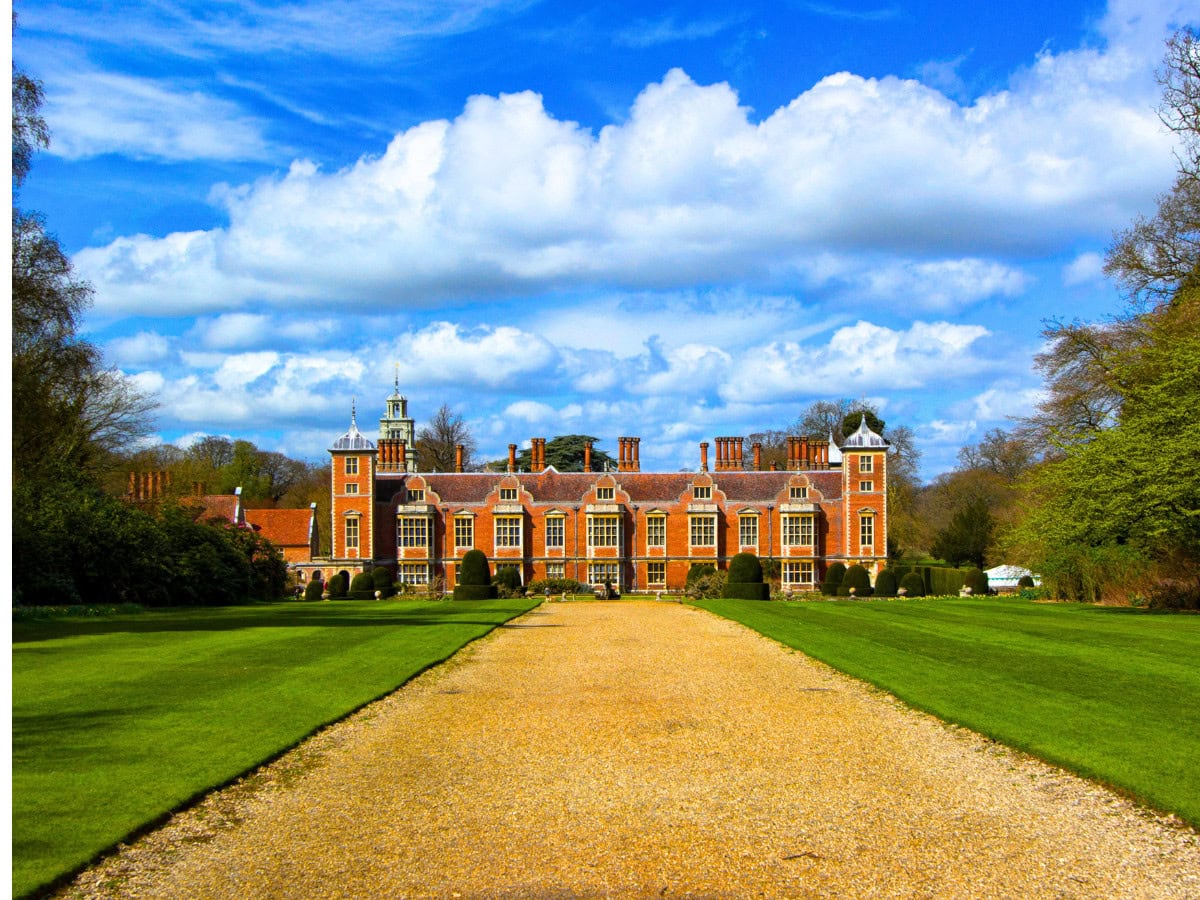
Blickling Hall, in the heart of Norfolk, is renowned for its magnificent Jacobean architecture, historic gardens and centuries of history. Yet behind its elegant red-brick façade lies another story. Blickling Hall is also associated with some of England’s most enduring ghostly legends.
The estate was once home to the Boleyn family and is thought to have been the birthplace of Anne Boleyn, Henry VIII’s second wife. Nearly five centuries after her execution, folklore maintains that Anne returns to Blickling each year on 19 May, the anniversary of her death.
Legend tells of a spectral coach, headless horses and an apparition of Anne herself roaming the estate. She is not Blickling’s only reputed ghost. Her father, Sir Thomas Boleyn, is also woven into the estate’s folklore, alongside other mysterious figures said to haunt the house and grounds.
Cared for by the National Trust since 1940, Blickling today remains one of Norfolk’s great historic estates. Its ghost stories add a darker layer to an already remarkable past — and make Blickling Hall particularly intriguing as Halloween approaches.
So, what really haunts Blickling Hall? Let’s look behind the legends, ghostly sightings and centuries-old stories associated with this historic Norfolk estate.
Updated: August 18, 2026, by Georgina
This post about the Ghosts of Blickling Hall forms a captivating part of the Boleyn series, making it an essential destination for those exploring the rich heritage and lineage of the Boleyn family.
Disclosure
Timeless Travel Steps is supported by our readers. If you purchase through an affiliate link on my site, at no cost to you, I may earn a commission from qualifying purchases. Additionally, Timeless Travel Steps is a participant in the Amazon Services LLC Associates Program. As an Amazon Associate, I earn from qualifying purchases at no extra cost to you. Please read our Disclosure for further information.

The Ghosts of Blickling Hall Norfolk
The Haunting Legacy of Anne Boleyn
Anne Boleyn, one of the most fascinating figures in Tudor history, was likely born at Blickling around 1501. Although the medieval Boleyn house was later replaced by the Jacobean mansion we see today, Anne’s connection with Blickling has endured for centuries.
So too has its most famous ghost story.
According to legend, Anne’s spirit returns to Blickling every 19 May, the anniversary of her execution at the Tower of London in 1536. The tale has become one of the best-known ghost stories associated with the estate.
In one particularly dramatic version of the legend, Anne arrives in a spectral carriage drawn by four headless horses. Dressed in white, she is said to carry her severed head before disappearing into the house.
Over generations, further stories of Anne Boleyn’s ghost have become attached to Blickling. One account from 1979 claims that an apparition believed to be Anne was seen in the library. Like many historic ghost stories, however, such sightings are difficult to verify and are best understood as part of the folklore surrounding the estate.
Whether you believe in ghosts or not, the legend has become inseparable from Blickling’s story. Nearly five centuries after Anne’s death, tales of her spectral return continue to add a darker dimension to the Boleyn family’s former Norfolk home.

Sir Thomas Boleyn’s Eternal Penitence
Anne Boleyn is not the only member of the family said to haunt Blickling. Her father, Sir Thomas Boleyn, Earl of Wiltshire, has his own particularly macabre place in the estate’s folklore.
Thomas was an ambitious Tudor courtier who rose to considerable prominence during the reign of Henry VIII. His fortunes became closely tied to those of his daughter Anne, but in May 1536, both Anne and her brother George Boleyn were executed.
According to an old Norfolk legend, Thomas was condemned to a supernatural penance for failing to prevent the deaths of his children. Every year, he must drive a ghostly coach drawn by four headless horses across twelve bridges before cockcrow, repeating the journey for 1,000 years.
Versions of the route take his spectral carriage through the Norfolk countryside around Blickling, passing bridges at places including Aylsham, Burgh, Buxton, Coltishall, Meyton, Oxnead and Wroxham.
The story becomes even more gruesome. Thomas is said to carry his severed head beneath his arm while flames pour from his mouth as the phantom carriage races through the darkness.
There is, of course, one rather large problem with the legend: Thomas Boleyn was never beheaded. He died in 1539, three years after Anne’s execution, with his head very much intact.
Yet this is no recent Halloween invention. A written account of Thomas Boleyn’s spectral journey appeared as early as 1850, showing that the legend has circulated in Norfolk for generations.
The National Trust still acknowledges the tradition today. Sir Thomas is said to haunt Blickling Great Wood and the estate grounds, where a woodland route leads towards the atmospheric Mausoleum.
History may tell us how Thomas Boleyn really died, but Norfolk folklore has given him a far more dramatic afterlife.

The Ghostly Appearances of Sir Henry Hobart
Another chilling tale associated with Blickling concerns Sir Henry Hobart, 4th Baronet, whose death followed one of the most dramatic episodes in the estate’s history.
In August 1698, Hobart fought an illegal duel with his neighbour, Oliver Le Neve of Great Witchingham, on nearby Cawston Heath. Hobart was mortally wounded and taken back to Blickling Hall, where he died the following day.
Today, the West Turret Bedroom is identified as the room where Sir Henry died from his wounds. Local legend claims that his dying groans can still be heard, adding another unsettling story to Blickling’s long tradition of hauntings.
The duel itself has not been forgotten. A monument known as the Duel Stone marks the event near Cawston, preserving the memory of the encounter more than three centuries later.
Whether Sir Henry’s final moments truly linger at Blickling is a matter of folklore. But unlike many ghost stories, this haunting begins with a very real and violent event in the estate’s past.
The Headless Coachman and His Four Headless Horses
Among the most dramatic ghosts of Blickling Hall is not a solitary apparition, but an entire spectral procession. The legend of the headless coachman and four headless horses forms part of the famous story surrounding Anne Boleyn’s return to Blickling.
According to the tale, on 19 May, the anniversary of Anne’s execution, a phantom coach approaches Blickling Hall. It is traditionally described as being drawn by four headless horses, with a headless coachman guiding them towards the house.
Inside sits Anne Boleyn, herself headless and carrying her severed head. When the spectral carriage reaches Blickling, legend says that the coach and horses vanish, leaving Anne’s ghost to enter the hall.
The image of the headless carriage is not a recent addition to Blickling’s haunted reputation. In 1893, folklorist Thomas Firminger Thiselton-Dyer recorded the Blickling story in The Ghost World, describing Anne’s annual spectral procession through Blickling Park in a coach drawn by four headless horses and accompanied by headless attendants.
This Victorian account shows that the haunting was already part of Blickling folklore more than 130 years ago. The story has survived through generations, becoming one of the most enduring and macabre legends associated with the estate.
The headless coach also appears in folklore surrounding Anne’s father, Sir Thomas Boleyn, making the phantom carriage a recurring and memorable motif in the ghost stories of Blickling Hall.

Other Ghostly Sightings at Blickling Hall
Anne Boleyn and her spectral carriage may dominate the ghost stories of Blickling Hall, but they are not the only supernatural tales associated with the estate.
The Grey Lady of Blickling Hall
One of the apparitions associated with Blickling is the Grey Lady, a mysterious female figure said to wander the estate. Rather than being an entirely separate ghost, National Trust tradition identifies the Grey Lady as another manifestation of Anne Boleyn’s restless spirit.
The story adds another dimension to Anne’s haunting. Beyond the dramatic tale of the headless carriage on 19 May, folklore also imagines her as a quieter presence lingering around her family’s former Norfolk home.
Black Shuck: Blickling’s Mysterious Black Dog
Perhaps more unexpected is the story of a mysterious black dog said to haunt Blickling Hall.
Black Shuck is part of a much wider tradition of supernatural black dogs found throughout East Anglian folklore. At Blickling, however, the story has an intriguing historical trail.
A handwritten account preserved by the Norfolk Record Office and dating from around 1860 records a contemporary tale of a black dog haunting Blickling’s drawing room. Another account describes a woman in the house becoming convinced that she had seen a black dog run across the room and disappear behind a tapestry.
Whether this was Blickling’s own version of the legendary Black Shuck or simply another ghost story attached to the house is impossible to know. What the surviving record does show is that tales of supernatural happenings at Blickling were circulating during the Victorian period.
Alongside Anne Boleyn, headless horses and phantom carriages, the mysterious black dog adds another distinctly Norfolk strand to the haunted history of Blickling Hall.
From Blickling Hall to Hever Castle: Following Anne Boleyn’s Ghost
The ghosts of Blickling Hall form only one chapter in the extraordinary folklore surrounding Anne Boleyn.
While Blickling is thought to have been her birthplace, Hever Castle in Kent became Anne’s childhood home. Today, both historic houses are associated with stories of her restless spirit.
At Blickling, legend places Anne in a phantom coach on the anniversary of her execution. At Hever, different traditions have grown around the queen who once walked its rooms and grounds.
These are not the only places where Anne is said to appear. Nearly five centuries after her death, ghost stories follow her across several locations connected with her life and execution.
Curious about where else she is said to haunt? Follow the stories in my guide to Anne Boleyn’s ghosts and the historic places where her spirit is said to appear.
For more eerie history and places to explore during spooky season, see my guide to Halloween in London.


An Overview of Blickling Estate, Norfolk
Behind the ghosts of Blickling Hall lies a history stretching back almost a thousand years. Long before the Boleyns arrived, an 11th-century manor at Blickling belonged to Harold Godwinson, who became Harold II, the last Anglo-Saxon king of England.
By the 15th century, Blickling was owned by Sir John Fastolf, the wealthy soldier who made his fortune during the Hundred Years’ War. In 1452, Geoffrey Boleyn, Anne Boleyn’s great-grandfather, acquired the estate. Blickling later passed to his grandson, Thomas Boleyn, in 1505.
It is likely that Anne Boleyn was born at Blickling around 1501, while her parents, Thomas Boleyn and Elizabeth Howard, were associated with the estate. The house Anne would have known, however, was not the magnificent Jacobean Blickling Hall we see today.
From the Boleyns to the Jacobean Blickling Hall
After the Boleyn era, Blickling eventually passed to their relative Edward Clere and fell into decline. In 1616, Sir Henry Hobart, 1st Baronet and Lord Chief Justice of the Common Pleas, purchased the estate.
Hobart employed architect Robert Lyminge to create an ambitious new country house on the remains of the Boleyn property. Rather than sweeping everything away, elements of the earlier Tudor building were incorporated into the new design, while the medieval moat was retained.
The result was the magnificent red-brick Jacobean Blickling Hall that dominates the estate today.
From the Hobarts to the National Trust
Blickling remained connected with generations of the Hobart family before eventually passing through inheritance to the Kerr family, Marquesses of Lothian.
Its last private owner was Philip Kerr, 11th Marquess of Lothian, a politician and diplomat who played an important role in developing the National Trust’s Country Houses Scheme.
When Lord Lothian died in 1940, the entire Blickling Estate passed to the National Trust, helping to secure its future.

How to Visit Blickling Hall, Blickling Estate, Norfolk
Blickling Hall, its formal gardens and the surrounding parkland form the Blickling Estate, cared for by the National Trust. With a historic house, 55 acres of gardens and more than 4,600 acres of woodland, parkland and farmland, there is considerably more here than the hall alone.
If you have only one day, allow plenty of time to explore the house and gardens before heading into the wider estate. Opening hours vary by season, so always check the National Trust’s current Blickling Estate opening times before travelling.
- Address: Blickling Estate, Aylsham, Norfolk, NR11 6NF.
Getting to Blickling Hall Without a Car
Travelling to Blickling without a car takes a little planning, but it is possible. The National Trust currently offers 20% off admission for visitors arriving car-free, encouraging more sustainable journeys to the estate.
- By train: Take a mainline train to Hoveton & Wroxham, then travel on the heritage Bure Valley Railway to Aylsham. Blickling Estate is approximately 2 miles from Aylsham. Plan your Train Journeys Here.
- By bus: Sanders Coaches services 43, 44, 44A and X44 operate between Norwich and Aylsham. From Aylsham, Blickling is around 2 miles away.
- A limited Sunbeam 1B bus also runs directly between Aylsham Market Place and Blickling Estate on Mondays and Fridays, excluding bank holidays. As rural bus timetables can change, check the latest service before travelling.
- On foot: Blickling lies on the Weavers’ Way, with the estate approximately 2 miles on foot from Aylsham.
- Cycling is another option, with routes including the Rebellion Way, Bure Valley cycle route and Weavers’ Way cycle route connecting the surrounding Norfolk countryside with Aylsham and Blickling.
Getting to Blickling Hall by Car
Blickling Estate lies north-west of Aylsham on Blickling Road (C593, formerly the B1354) and is signposted from the A140 between Norwich and Cromer.
Parking is available across the estate. National Trust members can register their membership for free parking, while non-members pay the current parking charge.
Opening Times and Tickets
The house, gardens and parkland operate on different opening hours. The park is generally accessible from dawn until dusk, while the house and formal gardens have shorter seasonal opening times.
Admission to the house and gardens is free for National Trust members. Non-members pay admission, with family and child tickets available.
Because opening times, admission prices and individual attractions can change throughout the year, check the National Trust website before setting out, particularly if you are travelling a long distance.
Places to Stay Near Blickling Hall
Staying overnight gives you more time to experience Blickling’s house, gardens and extensive parkland without rushing your visit.
There are accommodation options around Aylsham and the Norfolk countryside, as well as characterful National Trust holiday cottages on the wider Blickling Estate.
Browse the map below to find places to stay near Blickling Hall and Aylsham, and choose the best location to suit your itinerary.
Before We Leave Blickling Behind…
There is something wonderfully intriguing about Blickling Hall. By daylight, its grand Jacobean façade, peaceful gardens and sweeping Norfolk parkland tell the story of centuries of English history. Yet, as evening draws in, another Blickling emerges through the stories that have been passed from one generation to the next.
Perhaps that is why the ghosts of Blickling Hall remain so fascinating.
Anne Boleyn returning in a phantom carriage. Four headless horses appearing on the anniversary of her execution. Sir Thomas Boleyn condemned to his endless journey across Norfolk. Sir Henry Hobart’s tragic final hours. And somewhere among these centuries-old tales, even the mysterious shadow of a black dog.
Whether you believe in ghosts or simply enjoy the folklore surrounding historic places, these stories have become part of Blickling’s remarkable heritage. Some can be traced through old written accounts; others survive through legend. Together, they offer a glimpse into how generations before us remembered the people who once inhabited these walls.
And perhaps that is the real magic of Blickling. The people are long gone, but their stories have never quite left.
I hope you’ve enjoyed uncovering the haunted secrets and history of Blickling Hall with me. If you visit, take time to wander beyond the house into the gardens and wider estate — and perhaps, as you walk through the Norfolk landscape, remember some of the extraordinary tales that have travelled through these grounds for centuries.
And if you happen to be at Blickling as dusk begins to fall… keep an eye on the road. You never know when a carriage might appear.
Please take a moment…
Before you go, I’m excited to share some news—Timeless Travel Steps was awarded Best Slow Travel & Heritage Travel Blog 2026! Please take a moment to read our story and discover the passion behind our journeys.
For more travel insights and tips, consider following Georgina from Timeless Travel Steps on BlueSky, Instagram, Facebook and Pinterest. Don’t miss out on her latest adventures and expert advice. Subscribe to stay updated and join a community of fellow travel enthusiasts eager to explore the world.
Continue Exploring Tudor History & Haunted Britain
If the ghosts of Blickling Hall have left you curious about Anne Boleyn, the Boleyn family and the places connected with their remarkable story, you may enjoy continuing your journey through these articles.
Anne Boleyn, the Boleyn Family & Tudor England
- Anne Boleyn: The Most Magnetic and Enduring of Tudor Queens
- The Boleyn Descendants Today
- The Boleyn Family After Anne’s Death
- May 1536: Events and Historical Sites to Visit in England
- Interesting Books About the Boleyns
Follow Anne Boleyn Through Historic England
- Hever Castle: Anne Boleyn’s Childhood Home
- Tower of London
- Three Royal Prisoners at the Queen’s House
More Ghost Stories & Haunted Places
The Ghosts of Blickling Hall was first published on March 7, 2021, by Timeless Travel Steps. Republished on August 03, 2024, and recently updated on August 18, 2026, by Georgina.


Who doesn’t love a good ghost story indeed!! 🙂
Sadly Norwich is, from Bristol one of the hardest areas of the country to reach. By heck, who does not like a ghost story or the legends of ghosts especially when it results from such important parts of our history. I have enjoyed discovering in lockdown how many my home town is said to have I never knew.
🙂
Hi Lorrie, so glad to hear from you and super happy that you enjoyed the article on Blickling Hall. Sure hope that you shall visit us in the UK one day and explore these beautiful castles and stately homes. Thank you so much for sharing your thoughts and hope you are well too. xoxo
Loved this post, Georgina! You got me at “Castle” but there is so much more. Would love to one day be able to tour here…and many castles! Hope you are well…stay safe <3