
The Plot Against Anne Boleyn: Was Her Downfall Planned?
The Anne Boleyn downfall unfolded with astonishing speed in May 1536. On 1 May, she was still Queen of England. Within days, she would be arrested, imprisoned and tried. By 19 May, she was dead. I have followed those seventeen extraordinary days separately in my account of May 1536.
The charges were devastating. Anne was accused of adultery with several men, including her own brother, George Boleyn, and of conspiring against the King’s life. She denied the accusations.
Yet the speed of her destruction raises a much bigger question.
Did evidence against Anne suddenly emerge in the spring of 1536? Or was a case being constructed to remove a queen Henry VIII no longer wanted?
Thomas Cromwell would play a central role in the investigation that brought Anne down. But he was not the only person whose interests became entangled in her fate.
There was Henry VIII himself. Anne’s powerful uncle, Thomas Howard, Duke of Norfolk. Jane Seymour and those promoting her at court. There were also supporters of the late Catherine of Aragon and Princess Mary, alongside courtiers with political, religious and personal reasons for opposing Anne.
Not all of them were conspirators.
To understand whether there really was a plot against Anne Boleyn, we need to separate those who disliked her from those who benefited from her fall — and those who actually had the power to bring it about.

Was There Really a Plot to Bring Anne Boleyn Down?
The difficulty is that the evidence does not reveal one simple, clear sequence of events.
No group of conspirators left behind a record of a plan to destroy Anne Boleyn. Nor is there one moment when we can confidently say that a plot against her began.
Instead, Anne’s downfall emerged from a dangerous mixture of royal marriage, Tudor politics, court rivalries and personal interests.
By the spring of 1536, Anne’s position had become increasingly precarious. She had not given Henry VIII a surviving son, and her latest pregnancy had ended in miscarriage in January. Henry’s attention was turning towards Jane Seymour. Anne had opponents at court, while her once useful political relationship with Thomas Cromwell had deteriorated.
None of these circumstances, taken alone, proves that a plot existed. Taken together, however, they raise the possibility that Anne’s downfall was already taking shape before the formal accusations against her emerged. What is much harder to establish is when that process began — and who was driving it.
Nor should everyone who disliked Anne be treated as a conspirator. The Tudor court revolved around competing families, patronage, religious divisions and access to the King. Alliances could shift, and Anne’s removal could benefit people who had played no part in engineering it.
What happened next, however, went far beyond court rivalry.
An investigation was undertaken. Men within the royal circle were questioned and arrested. Accusations concerning the Queen’s sexual conduct were transformed into a prosecution for adultery, incest and treason.
The surviving legal papers show the machinery of Tudor government moving against Anne.
But that leaves the central question unanswered.
Who wanted Anne Boleyn removed, who had the power to make it happen — and who merely stood to benefit when she was gone?
The Key Players in Anne Boleyn’s Downfall
To understand what happened, we need to look at the people surrounding Anne — what each wanted, what each stood to gain or lose, and, crucially, what the surviving evidence tells us about the part they actually played.
Henry VIII — The King at the Centre
Any investigation into Anne Boleyn’s downfall has to begin with Henry VIII.
By early 1536, their marriage had produced one surviving child, Princess Elizabeth, but no living son. Anne’s final known pregnancy ended in miscarriage on 29 January 1536.
The loss mattered enormously.
Henry’s determination to secure the Tudor succession had shaped the end of his first marriage and his marriage to Anne. Yet almost three years after Anne became queen, the male heir he expected from their marriage had still not arrived.
At the same time, Henry had become interested in Jane Seymour, one of Anne’s ladies.
It is tempting to draw a straight line between Anne’s miscarriage, Henry’s attraction to Jane and Anne’s execution four months later.
The evidence is not that simple.
We do not possess an instruction written by Henry in January 1536 ordering Anne’s destruction. A failed pregnancy does not, by itself, prove that he had already decided to remove her.
But Henry’s role cannot be pushed into the background.
The case against an anointed Queen of England could not simply proceed without royal authority. The surviving trial records show the machinery of government acting with Henry’s authorisation. He appointed Anne’s uncle, the Duke of Norfolk, to preside over her trial as Lord High Steward.
The National Archives describes the outcome these documents were intended to achieve as one that could only have been agreed by Henry and set in motion by Cromwell.
The important question, therefore, is not whether Henry was involved.
It is when Henry decided that his marriage to Anne had to end — and what he expected Cromwell to do about it.

Thomas Cromwell — The Man Who Built the Case
If Henry possessed the authority, Thomas Cromwell possessed something equally important: the machinery of Tudor government.
Cromwell and Anne had not always been enemies.
Both had supported the break with Rome, although their religious and political priorities were not identical. By 1536, however, the uneasy alliance between them had broken down.
One area of disagreement concerned the wealth released by the dissolution of the monasteries. Anne favoured using some former monastic resources for charitable and educational purposes rather than allowing the proceeds to flow entirely to the Crown.
How important this disagreement was in Cromwell’s eventual move against Anne remains open to interpretation.
What is much clearer is Cromwell’s central role once the case against her began.
The investigation expanded to include men within the royal household. Mark Smeaton confessed to adultery with the Queen. Henry Norris, Francis Weston, William Brereton and Anne’s brother George Boleyn were also accused.
The allegations became charges involving adultery, incest and treason.
The surviving records of Anne’s trial are particularly revealing. They show an elaborate legal process being assembled around accusations that would ultimately remove a crowned queen.
Cromwell’s reported account of his own involvement is also important.
Writing after Anne’s death, the Imperial ambassador Eustace Chapuys reported that Cromwell had told him he had been authorised by Henry to pursue the proceedings and had taken considerable trouble in devising the affair.
But there is an important qualification.
Those are not Cromwell’s words preserved in his own account. We know of the conversation through Chapuys, who was reporting it to Emperor Charles V.
Cromwell left us no written explanation establishing precisely when the plan began, whether the original initiative came from Henry, or how far his own political interests influenced what followed.
That leaves us with one of the central questions surrounding Anne’s downfall:
Did Cromwell devise a plot to destroy Anne Boleyn — or did he devise the means of removing a queen Henry VIII had already decided he no longer wanted?

Katherine of Aragon and Princess Mary — The Opposition Anne Could Not Escape
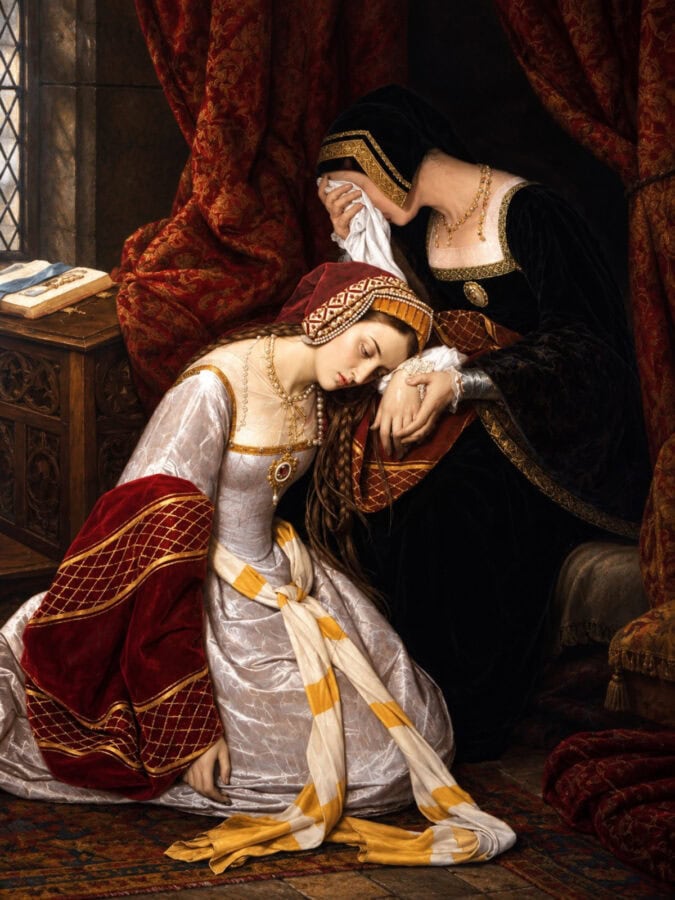
Katherine of Aragon was no longer alive when the case against Anne Boleyn began. She died at Kimbolton Castle on 7 January 1536.
But the opposition associated with Katherine and her daughter, Princess Mary, did not disappear with her.
For years, Anne had been inseparable from one of the most bitter disputes of Henry VIII’s reign. Henry’s determination to end his marriage to Katherine had divided the royal family, challenged papal authority and transformed Mary’s position.
Mary refused to accept that her parents’ marriage had been invalid. Nor would she accept her resulting illegitimacy. To those who remained loyal to Katherine and Mary, Anne was closely associated with both women’s displacement.
Katherine’s death therefore changed the political landscape, but it did not remove the divisions surrounding Anne.
Indeed, it created a curious moment in January 1536. With Katherine dead, one major obstacle to the recognition of Henry’s marriage to Anne had disappeared. Yet within weeks, Anne’s own position began to deteriorate.
Mary remained a particularly important figure.
She had supporters at court and abroad, including the Imperial ambassador Eustace Chapuys. His diplomatic reports provide some of our most valuable contemporary evidence for Anne’s final months. They also require careful reading.
Chapuys was not a neutral observer. He consistently supported Katherine and Mary and was deeply hostile towards Anne. He frequently referred to her not as queen, but as “the concubine.”
His reports nevertheless reveal something important about the atmosphere surrounding Anne. There were people at court who wanted Mary restored to Henry’s favour and who would have welcomed Anne’s removal.
Some of those interests overlapped with the emerging support for Jane Seymour.
That does not mean Katherine plotted Anne’s downfall. She was dead before the investigation began. Nor is there evidence that Mary helped construct the accusations that destroyed Anne.
But their supporters formed part of the political world in which Anne’s fall took place.
Katherine was gone. Mary was still excluded from the succession. And Anne remained, for their supporters, closely associated with the upheaval that had displaced them both.
Once Henry’s commitment to Anne began to weaken, those old loyalties mattered again.

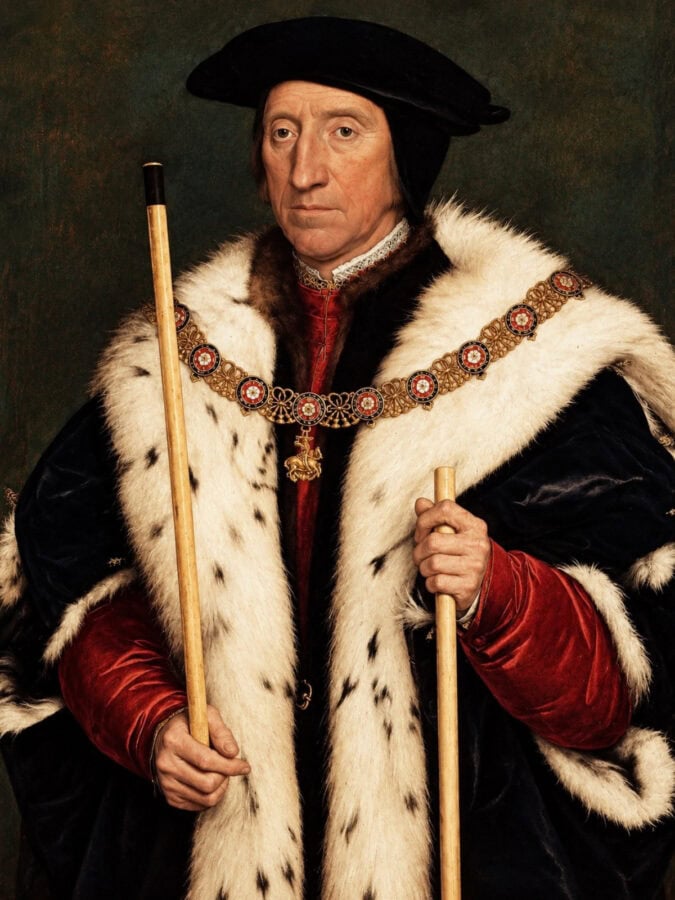
Thomas Howard, Duke of Norfolk — Anne’s Own Uncle
One of the more uncomfortable figures in Anne Boleyn’s final story was a member of her own family.
Thomas Howard, 3rd Duke of Norfolk, was Anne’s maternal uncle. Her mother, Elizabeth Howard, was his sister.
Norfolk was also one of the most powerful noblemen in Tudor England.
Family connection, however, did not guarantee political loyalty.
Anne and Norfolk could find themselves on different sides of the religious and political tensions at Henry’s court. Anne was associated with evangelical reform, while Norfolk was generally identified with the more conservative establishment.
Yet we need to be careful about turning those differences into evidence of conspiracy.
There is no secure evidence that Norfolk devised the accusations against his niece or worked with Cromwell to manufacture the case against her.
What we can document is his striking role once the prosecution was underway.
Henry appointed Norfolk Lord High Steward for the trials of Anne and her brother, George Boleyn. On 15 May 1536, Anne therefore faced a court presided over by her own uncle.
The surviving commission required Norfolk to receive the indictments, summon the peers who would judge Anne and George, and preside over the proceedings.
It is an extraordinary image: one of the most powerful men in England sitting in judgement upon his own niece and nephew.
But Norfolk’s participation in the trial does not prove that he helped engineer their downfall.
What it does reveal is the limits of Anne’s family connections once the Crown moved against her.
Whatever Norfolk’s personal feelings towards his niece, his official role placed him at the centre of the proceedings that condemned her.
That makes Norfolk important to our investigation — but not necessarily part of the plot.
Anne’s powerful family connections could not protect her once royal power had turned against her.
Jane Seymour and Her Supporters — A Queen in Waiting?
By the spring of 1536, there was another woman in Henry VIII’s life.
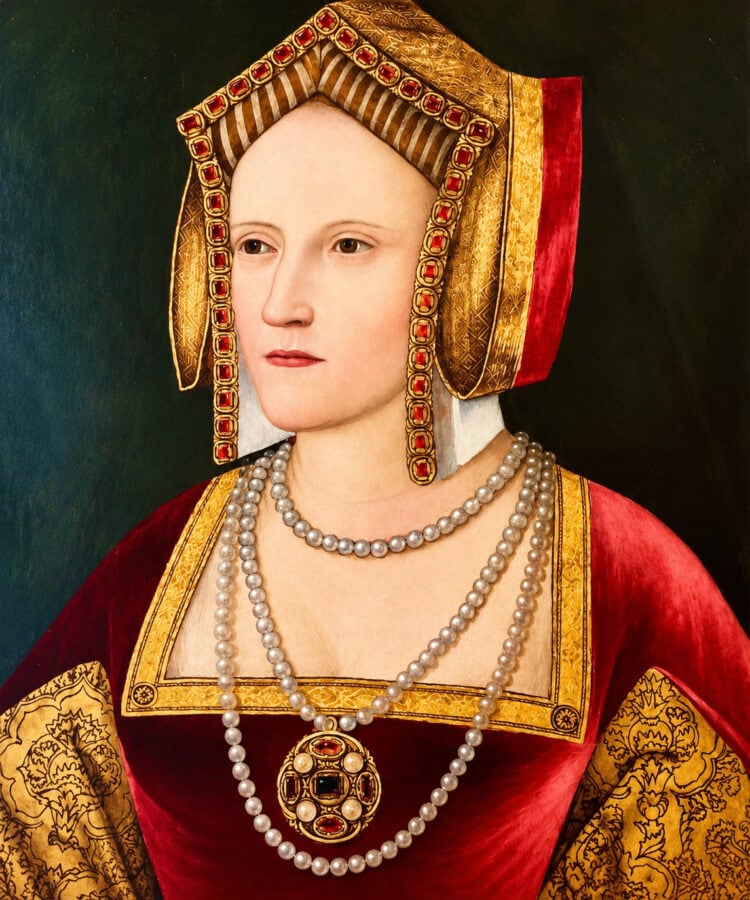
Jane Seymour had served Catherine of Aragon before joining Anne Boleyn’s household. Exactly when Henry became seriously interested in Jane is uncertain. By March 1536, however, his interest was becoming increasingly apparent.
According to Eustace Chapuys, Henry sent Jane a letter and a purse of money. Jane returned them, declaring that her honour mattered more than riches.
Whether this was genuine reluctance or careful court strategy remains uncertain.
What is clearer is that Jane was not operating entirely alone. Courtiers who opposed Anne recognised the opportunity created by Henry’s growing interest in her. Sir Nicholas Carew was among those associated with encouraging Jane’s position.
Jane also had the support of members of her own family.
None of this proves that Jane Seymour participated in a plot to destroy Anne Boleyn. We have no reliable evidence that she helped devise the charges later brought against the Queen.
But her presence mattered.
Henry no longer had to imagine life after Anne without another potential wife in sight. Jane offered an alternative — and one that appealed to some of Anne’s opponents.
The speed with which events followed is striking. Henry and Jane were formally betrothed on 20 May 1536, the day after Anne’s execution. They married on 30 May.
Jane undoubtedly benefited from Anne’s fall.
But benefiting from Anne’s removal is not the same as plotting it.

Anne Boleyn’s Enemies at the Tudor Court
Anne Boleyn’s opponents extended beyond those who remained loyal to Katherine of Aragon and Princess Mary.
The Tudor court was a world of competing families, religious divisions and political patronage. Access to the King could bring influence and advancement. Losing that access could be equally significant.
Anne herself was a formidable presence within that world.
She had spent important formative years at the court of Margaret of Austria and later in France. She returned to England educated, accomplished and familiar with sophisticated European court culture.
Anne was also intellectually curious and interested in religious reform. She supported reform-minded clergy and scholars and participated in networks of patronage surrounding the new religious ideas entering England.
She could also express strong opinions.
Those qualities had helped distinguish Anne during Henry’s long pursuit of her. But the qualities admired in a woman being courted by a king did not necessarily sit as comfortably with expectations of a queen.
Anne’s involvement in religious, political and patronage matters could bring her into conflict with powerful people.
Yet contemporary descriptions of her personality need careful handling.
Some observers portrayed Anne as proud, sharp-tempered or discourteous. But some of the most vivid descriptions came from people openly hostile towards her. Eustace Chapuys, in particular, supported Katherine and Mary and frequently refused to acknowledge Anne as queen.
That does not mean every hostile report about Anne should be dismissed.
It means we need to ask who was describing her, why they were writing and what interests they represented.
Anne certainly had opponents by 1536. Some objected to her religious influence. Others had lost influence during the rise of the Boleyn family. Some remained loyal to Katherine and Mary, while others saw opportunities emerging around Jane Seymour.
But an enemy is not necessarily a conspirator.
Religious disagreement, personal resentment or support for Jane did not automatically make someone part of a plot against Anne.
What those divisions created was a court in which Anne’s position could become dangerously exposed once the King’s support began to disappear.
There were people around Henry who had little reason to save Anne — and some who had much to gain from her fall.
So, Was There a Plot Against Anne Boleyn? What Does the Evidence Tell Us?
We have established that Anne Boleyn had enemies. We know that Jane Seymour offered Henry an alternative wife. We also know that Thomas Cromwell played a central role in what followed.
But none of that, by itself, proves a plot.
To look for stronger evidence, we need to turn away from personalities and examine the case constructed against Anne.
When did the legal process begin? Where did the accusations come from? Who supplied them? And, perhaps most importantly, do the charges themselves withstand scrutiny?
How Did the Investigation Against Anne Begin?
This is where the chronology becomes particularly interesting.
On 24 April 1536, before Anne had been arrested and before Mark Smeaton had confessed, special commissions of oyer and terminer were issued for Middlesex and Kent.
Such commissions authorised named officials to hear and determine serious criminal offences, including treason. The surviving records show that these commissions were subsequently used in the proceedings against Anne and the men accused with her.
That date matters.
Mark Smeaton was not arrested until 30 April. Anne and her brother George Boleyn were arrested on 2 May.
The legal machinery that would later be used against them was therefore already in existence.
But we need to be careful.
The commissions themselves do not name Anne as their intended target. Historians have disagreed over whether they prove that a case against her was already being prepared.
Eric Ives regarded their timing as highly significant. G. W. Bernard has challenged that interpretation, arguing that their existence does not establish that they were originally created specifically to prosecute Anne.
What the documents establish is narrower, but still important: a legal mechanism capable of investigating serious offences in the counties where Anne’s alleged crimes would later be placed had been established before the first arrest.
Within days, events accelerated.
Smeaton was questioned by Cromwell. Henry Norris was questioned by the King. Anne was arrested. George Boleyn followed her to the Tower. Francis Weston and William Brereton were subsequently taken into custody.
What had begun as rumours and allegations was becoming a prosecution.

What Was Anne Boleyn Actually Accused Of?
The surviving indictments are extraordinary documents.
Anne was accused of sexual relations with five men: Henry Norris, William Brereton, Francis Weston, Mark Smeaton and her own brother, George Boleyn, Lord Rochford.
The charges did not merely allege adultery.
They portrayed Anne as actively enticing the men through words, kisses, gifts and physical intimacy. In George’s case, the allegations became incest.
The prosecution then moved beyond sexual misconduct.
Anne and the men were accused of conspiring against Henry VIII’s life. The indictment alleged that Anne had said she would marry one of them after the King’s death and that the discovery of her behaviour had caused Henry such distress that his health had suffered.
This mattered legally.
Adultery by a queen was not, by itself, explicitly defined as high treason under the 1351 Treason Act. The case therefore connected Anne’s alleged sexual conduct with threats to the King, his succession and ultimately his life.
The accusations had been transformed into treason.
But where had they come from?
Who Accused Anne and George Boleyn of Incest?
The accusation that Anne had sexual relations with her own brother was the most sensational charge of all.
For centuries, one woman has frequently been blamed: George Boleyn’s wife, Jane, Lady Rochford.
The evidence for making Jane the source of the incest allegation is remarkably weak.
Indeed, while George was imprisoned in the Tower, Jane sent him a message indicating that she would petition the King on his behalf. That does not sit comfortably with the familiar image of a wife deliberately destroying her husband.
Another woman appears more prominently in the contemporary evidence.
Elizabeth, Countess of Worcester, one of Anne’s ladies, was identified shortly after the executions as an important source of accusations against the Queen.
On 24 May 1536, John Husee wrote to Lady Lisle about Anne’s accusers. He named Lady Worcester first, followed by a woman called Nan Cobham and another unnamed maid. Crucially, he described Lady Worcester as the “first ground”.
There is another source.
Lancelot de Carles, who was connected to the French embassy in England, produced a contemporary account of Anne’s fall. In his version, a woman at court, challenged about her own sexual behaviour, responded by accusing the Queen of far worse conduct. Her allegations included relations with Mark Smeaton and, most shockingly, Anne’s own brother.
Historian G. W. Bernard has argued that this woman can be identified as the Countess of Worcester and that her accusations may have helped trigger the investigation.
Other historians have been much more cautious about treating de Carles’s literary account as straightforward testimony.
So we cannot confidently write that Elizabeth, Countess of Worcester invented the incest charge.
But neither can we say that its origins are completely unknown.
Contemporary evidence points towards accusations circulating among women around Anne, with Lady Worcester later identified as a principal source.
Somewhere between those reports and Cromwell’s investigation, an allegation of incest became a formal charge carrying Anne and George towards death.
Mark Smeaton’s Confession — The Evidence Cromwell Needed?
Mark Smeaton is crucial because he was different from the other accused men.
He confessed.
Smeaton was a musician attached to the royal household. He was arrested on 30 April and questioned at Cromwell’s house.
What happened during that questioning remains one of the most disputed parts of the story.
A later account known as the Spanish Chronicle describes Smeaton being tortured with a knotted rope tightened around his head until he confessed.
It is a dramatic story.
It is not secure evidence.
The Spanish Chronicle contains significant inaccuracies, and its detailed torture story is not independently confirmed.
There was, however, contemporary talk that Smeaton had been badly treated. George Constantine, a servant of Henry Norris, later wrote that it was being said that Smeaton had been grievously racked — but importantly added that he could never establish whether this was true.
Another contemporary account, by Lancelot de Carles, stated that Smeaton confessed without torture.
We therefore cannot responsibly state as fact that Mark Smeaton was tortured.
What we can establish is that he was questioned, confessed to sexual relations with Anne and maintained that plea during the legal proceedings.
The surviving court record shows that when Smeaton, Norris, Weston and Brereton were tried on 12 May, Smeaton pleaded guilty. The other three pleaded not guilty.
All four were convicted.
That makes Smeaton’s confession enormously important.
Whether it represented truth, coercion, fear or something else is impossible to establish from the surviving evidence.
But once one man had confessed to adultery with the Queen, Cromwell possessed something far more powerful than court gossip.
He had an admission.

Do the Dates in Anne Boleyn’s Indictments Add Up?
This is perhaps the most troubling part of the case.
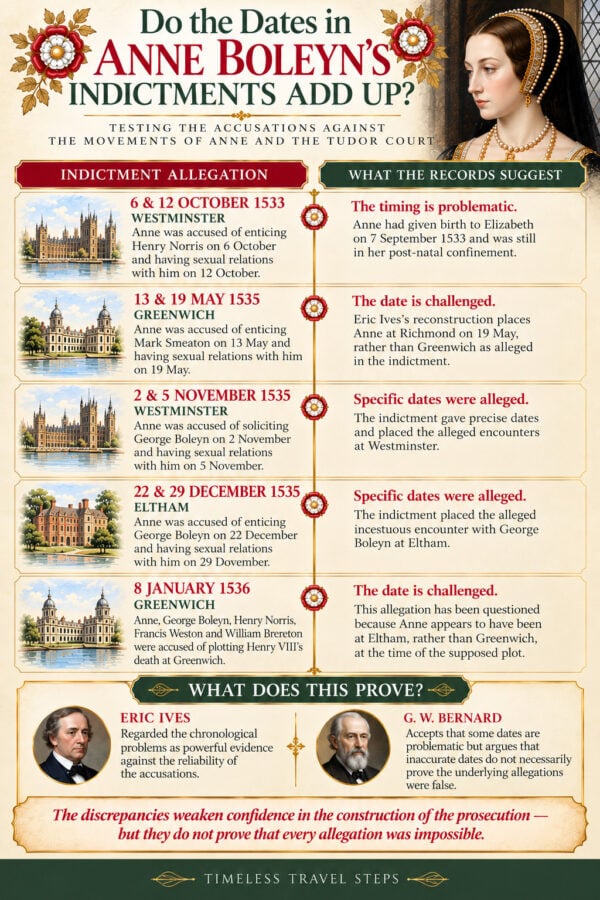
The indictments did not simply accuse Anne of adultery in general terms. They supplied dates, places and alleged partners.
Anne was accused, for example, of enticing Henry Norris at Westminster in October 1533. Other alleged encounters were placed at Westminster, Greenwich, Hampton Court and Eltham.
The incest accusations were similarly specific. Anne was accused of soliciting George at Westminster on 2 November 1535 and having sexual relations with him there on 5 November. A further alleged encounter was placed at Eltham in December.
That specificity appears impressive.
Until the dates are tested.
Historian Eric Ives compared the allegations with surviving evidence about the movements of Anne and the court. He concluded that a substantial number of the specific accusations could not have happened as described because either Anne or the man concerned was elsewhere.
One alleged encounter with Smeaton was placed at Greenwich when evidence puts Anne at Richmond. Another allegation placed Anne at Westminster when other evidence indicates she was at Windsor. An accusation that Anne and several men plotted Henry’s death at Greenwich in January 1536 has also been challenged because Anne appears to have been at Eltham.
Even the earliest accusations raise difficulties. Anne had given birth to Elizabeth on 7 September 1533, yet the indictment placed alleged encounters with Norris at Westminster only weeks later, during a period when the royal court was elsewhere and Anne was still emerging from her post-natal confinement.
We should nevertheless resist the tempting conclusion that every date has been disproved.
They have not.
Some alleged encounters cannot now be tested conclusively. The indictments also used broad wording covering other occasions before and after the specified dates.
There is also a genuine disagreement among historians about what the defective chronology proves.
For Ives, the problems with the dates formed powerful evidence that the accusations had been manufactured.
Bernard has argued differently. He accepts that some dates are problematic but questions whether inaccurate dates necessarily demonstrate that the underlying allegations were false. Witnesses remembering sexual misconduct would not necessarily remember precisely when it occurred.
That is a reasonable caution.
But it leaves an uncomfortable question.
If investigators possessed reliable evidence of repeated adultery by the Queen, why were some of the specific examples placed at times and locations that surviving records appear to contradict?
At the very least, the discrepancies weaken confidence in the construction of the prosecution.
Was the Case Against Anne Boleyn Constructed?
Here we need to distinguish two different meanings of the word constructed.
Every prosecution has to be constructed in a legal sense. Allegations are investigated, evidence assembled and charges drafted.
That certainly happened to Anne.
But was the case constructed in the more disturbing sense — were accusations selected, expanded or manipulated to achieve a predetermined result?
There are reasons to take that possibility seriously.
Legal commissions later used in the proceedings were already dated 24 April.
Within days, Smeaton had been questioned and had confessed. Other men were arrested. Allegations circulating around Anne’s household were gathered into an investigation.
The eventual indictments transformed those allegations into an extraordinary portrait of a queen conducting numerous affairs, including incest with her brother, while conspiring with her lovers against her husband’s life.
Some of the specific dates can be challenged using surviving evidence.
Only Smeaton pleaded guilty. Norris, Weston and Brereton denied the charges. Anne and George also maintained their innocence.
Most importantly, the surviving King’s Bench papers show how rapidly and efficiently the machinery of Tudor government was assembled around the prosecution.
The National Archives’ own examination of these documents reaches a striking conclusion: although the paperwork followed recognised legal procedures, the outcome it was intended to achieve was personal and political and could only have been agreed by Henry VIII and set in motion by Thomas Cromwell.
That does not tell us that every allegation was invented.
Nor does it allow us to identify one secret meeting at which Henry and Cromwell agreed to destroy Anne.
But by the time the case reached the courts, this was no longer simply an investigation into rumours surrounding a queen.
The power of the Tudor state had been mobilised against her.
And that brings us back to the question with which we began.
So, Who Was Behind Anne Boleyn’s Downfall?
The surviving evidence does not point convincingly towards a large conspiracy involving everyone who disliked Anne.
It points much more clearly towards the actions of Henry VIII and Thomas Cromwell.
Henry possessed the authority. Cromwell possessed the administrative and legal machinery.
The most revealing evidence comes from Cromwell himself — although, characteristically, it reaches us through Eustace Chapuys.
After Anne’s death, Chapuys reported a conversation in which Cromwell said that he had been authorised and commissioned by the King to pursue the proceedings against Anne and had taken considerable trouble over the affair. Chapuys then described Cromwell as having set himself to devise and bring about the matter.
That passage has sometimes been used as evidence that Cromwell independently plotted Anne’s destruction.
But the first part matters just as much as the second.
According to Chapuys, Cromwell said he was acting with Henry’s authority.
That makes it difficult to reduce Anne’s downfall to a minister secretly manipulating an unsuspecting king.
Cromwell may have designed the method. He may have exploited accusations already circulating at court. His own political interests may also have been served by Anne’s removal.
But Henry was not a spectator.
Other people played supporting roles. Lady Worcester and other women appear to have supplied accusations. Anne’s opponents welcomed her fall. Jane Seymour’s supporters recognised their opportunity. Norfolk presided over the final trial.
Yet involvement, opposition and benefit are not the same as authorship.
The documentary trail leads repeatedly back to the same two men.
Cromwell built the case. Henry possessed the power that allowed it to proceed.
Was the Downfall of Anne Boleyn Planned?
There is no surviving document headed The Plot Against Anne Boleyn. We cannot identify a single day when Henry VIII ordered Thomas Cromwell to manufacture evidence against his wife.
But neither does the surviving evidence resemble the spontaneous discovery of a few unfortunate rumours.
Legal machinery was in place before the first arrest. Accusations were gathered and developed. Smeaton was interrogated and confessed. A series of extraordinary allegations was converted into detailed indictments, some containing dates that surviving evidence appears to contradict. Within weeks, a Queen of England and five men were dead.
So was there a plot?
I think the evidence points strongly towards Anne Boleyn’s removal being deliberately engineered. so, yes, there was a plot.
What remains uncertain is when that decision was made, whether every allegation was fabricated, and precisely how the first accusations became the case Cromwell eventually prosecuted.
Perhaps that distinction matters most.
We may never find the beginning of the plot.
But we can still see the machinery that brought Anne Boleyn down.
More Tudor Stories, People and Places
Continue your journey through Tudor England with more stories of the people, families and historic places that shaped this remarkable period of English history.
Please take a moment…
Before you go, I’m excited to share some news—Timeless Travel Steps was awarded Best Slow Travel & Heritage Travel Blog 2026! Please take a moment to read our story and discover the passion behind our journeys.
For more travel insights and tips, consider following Georgina from Timeless Travel Steps on BlueSky, Instagram, Facebook and Pinterest. Don’t miss out on her latest adventures and expert advice. Subscribe to stay updated and join a community of fellow travel enthusiasts eager to explore the world.
Research Note: Evidence and Historical Uncertainty
The circumstances surrounding Anne Boleyn’s downfall remain disputed nearly five centuries later. This article therefore distinguishes between what can be established from surviving documents and what remains historical interpretation.
The principal documentary evidence includes the surviving King’s Bench records relating to Anne and George Boleyn, preserved at The National Archives as KB 8/9, alongside contemporary correspondence and diplomatic reports from 1536.
These records document the legal machinery used against Anne, including the indictments, commissions, juries and arrangements for the trials. Contemporary correspondence provides additional evidence about how accusations circulated at court, although such accounts must be read with an awareness of the writers’ loyalties and prejudices.
Particular caution is necessary with Eustace Chapuys, whose reports are invaluable but openly hostile towards Anne, and with later accounts such as the Spanish Chronicle. Similarly, historians including Eric Ives and G. W. Bernard have sometimes reached different conclusions from the same surviving evidence, particularly concerning the indictments and the origins of the accusations.
For that reason, this article does not present disputed claims — including the alleged torture of Mark Smeaton, the precise origin of the incest accusation, or the significance of every questionable indictment date — as established fact.
The surviving evidence allows us to reconstruct much of how Anne Boleyn was brought down. It does not allow us to claim certainty about every person, motive or conversation behind it.
References and Further Reading
The following documentary sources and historical studies informed this article. Contemporary accounts have been considered alongside modern scholarship, particularly where historians disagree over how the surviving evidence should be interpreted.


