
Emma of Normandy: Queen of Two Dynasties and Mother of Two Kings
Emma of Normandy lived through one of the most turbulent periods in England’s history. A Norman princess who crossed the Channel to marry an Anglo-Saxon king, she would witness Viking invasion, the collapse of one royal dynasty and the rise of another. Yet while kings fought, kingdoms changed hands and rival heirs competed for the throne, Emma remained remarkably close to the centre of power.
Emma is remembered in history as queen to two kings and mother of two kings, yet her story is far from simple. She faced bitter political rivalry and fled England with her children for the safety of Normandy. She returned, only to be widowed and later marry the man whose conquest had swept aside her first husband’s dynasty.
There was still more turmoil to come. Emma would endure the brutal death of one son, the loss of wealth and influence, and exile for a second time. Yet, remarkably, she returned again to the heart of English royal politics.
Few medieval queens stood at the meeting point of so many competing worlds: Norman, Anglo-Saxon and Danish.
This is Emma of Normandy’s extraordinary story — one that began across the Channel, in Normandy, before she sailed for England in 1002.
Disclosure
Timeless Travel Steps is supported by our readers. If you purchase through an affiliate link on my site, at no cost to you, I may earn a commission from qualifying purchases. Additionally, Timeless Travel Steps is a participant in the Amazon Services LLC Associates Program. As an Amazon Associate, I earn from qualifying purchases at no extra cost to you. Please read our Disclosure for further information.
Who Was Emma of Normandy?
Emma of Normandy was born around 985 into the powerful ruling family of Normandy. She was the daughter of Richard I, Duke of Normandy, and Gunnor, and the sister of Richard II, who succeeded their father as duke. Her family connections would eventually carry her across the Channel and into the heart of English royal politics.
In 1002, Emma married the Anglo-Saxon king Æthelred II and became Queen of England. In England she was also known by the English name Ælfgifu. The couple had three children who survived infancy: Edward, Alfred and Godgifu. Their lives would become closely entwined with the struggles for the English throne.
After Æthelred’s death and the Danish conquest of England, Emma’s position changed dramatically. In 1017, she married Cnut the Great, beginning her second queenship under the dynasty that had displaced the first. Their children included Harthacnut and Gunhilda.
Two of Emma’s sons would eventually become kings of England: Harthacnut, her son by Cnut, and Edward the Confessor, her son by Æthelred. Through them, Emma became a remarkable link between two successive royal dynasties.
She died in 1052 and was buried at Winchester, a place closely associated with her life, queenship and memory.
Emma of Normandy at a Glance
- Born: c. 985, Normandy
- Parents: Richard I, Duke of Normandy, and Gunnor
- First husband: Æthelred II
- Second husband: Cnut the Great
- Children: Edward, Alfred, Godgifu, Harthacnut and Gunhilda
- Sons who became kings: Harthacnut and Edward the Confessor
- Died: 1052
- Buried: Winchester
Emma’s Early Life in Normandy
Long before Emma became Queen of England, her world lay across the Channel in Normandy. The duchy she knew had itself grown from an earlier age of Viking expansion. In 911, the Scandinavian leader Rollo had reached an agreement with the West Frankish King Charles the Simple, establishing the beginnings of what became Normandy.
By Emma’s lifetime, Rollo’s descendants had transformed themselves from Scandinavian settlers into a powerful ruling dynasty. They had adopted Christianity, established themselves within Frankish aristocratic society and built a duchy whose position across the Channel mattered greatly to England.
Emma belonged to this remarkable family. Through her father’s line, she was a descendant of Rollo. There is a fascinating symmetry here. The woman who would become queen first within an Anglo-Saxon dynasty and later within a Danish one carried Scandinavian ancestry of her own.
Little survives to tell us what Emma’s childhood was actually like. We cannot reconstruct her personality, education or expectations with any certainty. What we do know is that her birth into Normandy’s ruling house gave her considerable dynastic value. As relations between England, Normandy and Scandinavian raiders became increasingly entangled, that value would soon take Emma across the Channel.
Why Was Emma Sent to England?
Emma’s journey to England in 1002 was part of a political marriage arranged during a troubled period for the English kingdom. Scandinavian attacks had intensified, while relations with Normandy were strained by the use of Norman ports and support networks by Viking fleets.
A marriage between Emma and Æthelred II offered a way to strengthen ties between the two sides of the Channel.
So when Emma sailed for England in 1002, she was not simply travelling to meet a future husband. The young Norman princess was crossing the Channel as part of an international alliance — and stepping into a kingdom already under growing pressure from Viking attack.
Emma of Normandy and Æthelred the Unready
When Emma arrived in England in 1002, she was entering a kingdom very different from the Normandy she had left behind. Her marriage to Æthelred II, better known to history as Æthelred the Unready, made the young Norman princess Queen of England.
This was a political marriage, intended to strengthen relations between England and Normandy at a time when Viking attacks were placing increasing pressure on Æthelred’s kingdom. Yet for Emma, it also marked the beginning of a new identity. In England, she was known as Ælfgifu, an English royal name that appears in contemporary records. For clarity, however, we shall continue to know her as Emma.
What was Emma’s position as Æthelred’s queen?
The surviving evidence gives us glimpses rather than a complete picture. Emma appears as a witness to royal charters and received lands associated with her position as queen. Her marriage also gave Æthelred something politically valuable: a direct connection to Normandy’s ruling family.
Yet we should be careful about describing Emma as politically powerful from the beginning. Medieval queens could possess wealth, patronage and access to the king without exercising political authority in the way we understand it today. Emma’s influence would become more visible as her extraordinary life unfolded.
What she undoubtedly possessed was dynastic importance. Her marriage had joined the Norman ducal family to the House of Wessex. With the birth of her children, those ties became even stronger.

Emma’s Children with Æthelred
Emma and Æthelred had three children who survived infancy: Edward, Alfred and Godgifu.
Edward would eventually become Edward the Confessor, King of England. Alfred Ætheling’s life would end very differently, in one of the darkest episodes of Emma’s story. Their sister Godgifu, sometimes known as Goda, would make important marriages on the Continent.
But Emma’s children were not Æthelred’s only heirs.
The king already had several sons and daughters from his first marriage, including Æthelstan Ætheling and Edmund Ironside. Emma had therefore married into an established royal family in which her own sons were not automatically first in line for the throne.
For the moment, this may have seemed little more than the complicated reality of a medieval royal household. In time, however, questions of birth, marriage and succession would dominate Emma’s life — and determine the futures of her children.

A Queen in a Kingdom Under Attack
Emma had arrived in England during a dangerous period. Viking attacks were not new, but during Æthelred’s reign they became increasingly destructive. Large Scandinavian armies crossed into England, towns were attacked and enormous payments of Danegeld were made in attempts to persuade invading forces to leave.
The situation became still more dangerous after the St Brice’s Day massacre of 1002, when Æthelred ordered the killing of Danes in England. The precise extent of the massacre remains uncertain, as does its relationship to the invasions that followed. What is clear is that Scandinavian pressure on England continued.
Among the most formidable of Æthelred’s enemies was Sweyn Forkbeard, King of Denmark.
By 1013, Sweyn launched an invasion that Æthelred could no longer withstand. Much of England submitted to the Danish king, and the royal family was forced to abandon the kingdom.
For Emma, the political alliance that had brought her across the Channel now offered something equally valuable: a place of refuge.
Emma Flees England
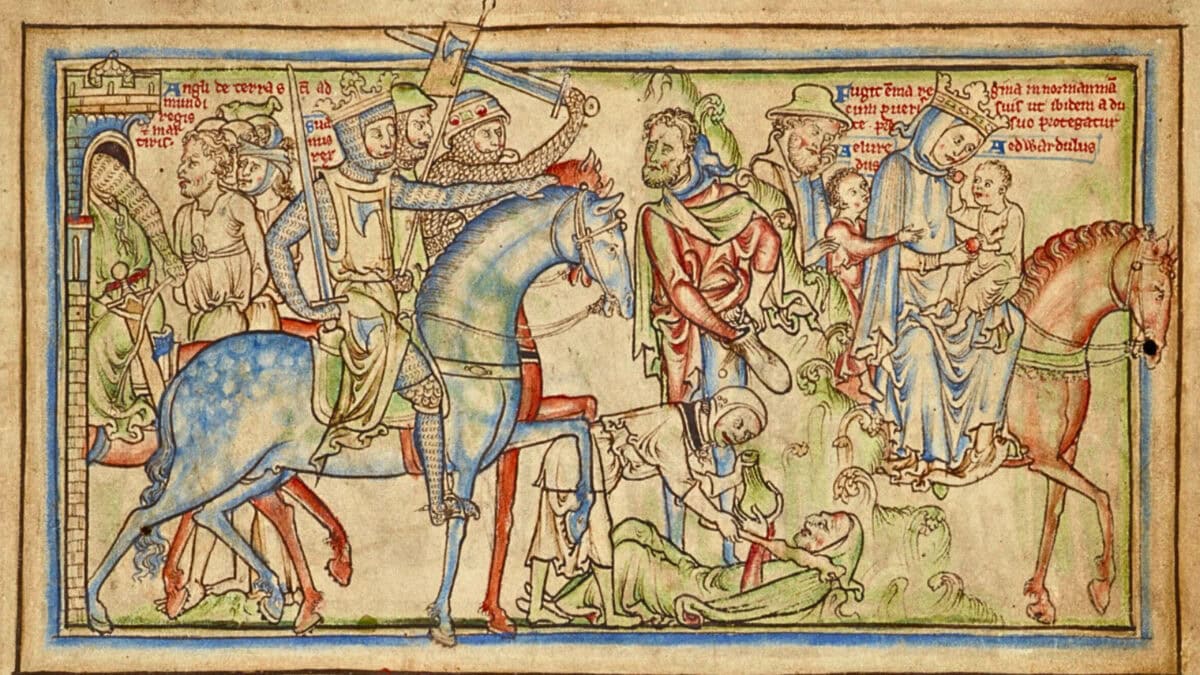
Emma left England with her children and sought safety with her family in Normandy. Æthelred followed them into exile.
It might have appeared that Emma’s first queenship was over.
Then, in February 1014, Sweyn Forkbeard died unexpectedly. English leaders invited Æthelred to return, and Emma came back to England with him. But their restoration would prove brief.
Æthelred died in April 1016. His son Edmund Ironside continued the struggle against Sweyn’s son, Cnut, dividing England with him after months of warfare. When Edmund died later that year, Cnut was left as King of England.
Within a few turbulent years, Emma had been a queen, a refugee, a queen once more and finally the widow of a defeated royal dynasty.
What happened next transformed Emma’s position — and made her story unlike that of almost any other medieval English queen.
Why Did Emma of Normandy Marry Cnut?
In 1017, barely a year after Æthelred’s death, Emma of Normandy married Cnut. It was an extraordinary reversal. The widow of an Anglo-Saxon king was now to become queen beside the Danish ruler whose conquest had brought her first husband’s dynasty to an end.
Why did Emma of Normandy marry Cnut?
We cannot know how Emma felt about the marriage, or how much choice she had in making it. What we can see is that the union offered important political advantages to both sides.
For Cnut, conquest had won him the English throne, but marriage to Æthelred’s widow could help strengthen his position within the kingdom he now ruled. Emma had already been crowned queen and was closely associated with the previous royal house. By marrying her, Cnut connected his new Danish regime with the dynasty it had displaced.
Emma brought something else of considerable value: Normandy. Her family ruled the powerful duchy across the Channel, where her sons by Æthelred were living in exile. Marriage to Emma could strengthen Cnut’s relationship with Normandy while making it more difficult for the duchy to become a base for challenges to his rule.
The marriage also transformed Emma’s fortunes.
Instead of remaining the widowed queen of a defeated dynasty, she became Queen of England once again. The marriage restored her to the royal court and offered security in a kingdom now controlled by its Danish conquerors. It would eventually place Emma at the centre of a new ruling family.
There was, however, a complication that would return with enormous consequences.
Cnut already had two sons, Swein and Harold, by Ælfgifu of Northampton. Emma, meanwhile, had Edward and Alfred from her marriage to Æthelred. Any children born to Emma and Cnut would therefore enter a royal family in which several sons could potentially lay claim to power.
A Remarkable Marriage Agreement
Our most striking account of the marriage arrangements comes from the Encomium Emmae Reginae, the work later commissioned in Emma’s interests. It claims that Emma would not agree to marry Cnut unless he promised that a son born to them would take precedence over sons he already had by another woman.
The claim needs caution. The Encomium was written years later and had a clear interest in defending Emma and the claims of her children. We cannot simply treat its account as the surviving text of a formal marriage contract.
Yet the emphasis is revealing. Emma’s future children with Cnut were expected to occupy a privileged dynastic position.
Their son Harthacnut was born soon afterwards. With his birth, Emma was no longer simply the Norman widow connecting Cnut to England’s former royal house. She was now the mother of a potential heir to the new Danish dynasty.
Once again, Emma had crossed a dynastic divide — and this time, the future of the English throne could depend upon her children.
Emma and Cnut — Queen at the Heart of a New Regime
Emma’s second queenship left a stronger impression in the surviving record than her first. During Cnut’s reign, she appears in royal charters, was associated with substantial estates and joined the king in generous patronage of the Church. These traces do not allow us to measure precisely how much political influence Emma exercised, but they show a queen with wealth, status and a visible place within the new royal regime.
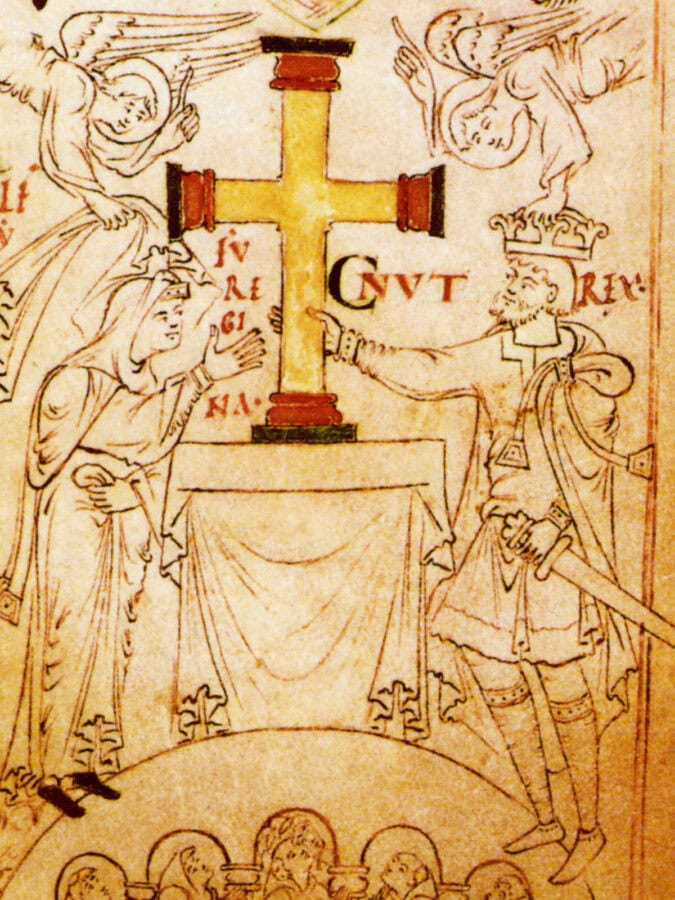
One of the most striking glimpses of Emma of Normandy and Cnut survives in an eleventh-century manuscript associated with the New Minster at Winchester. In its famous frontispiece, Cnut and Emma appear together presenting a great gold cross to the church, while angels above them place crowns upon their heads.
The image is rich in religious meaning. It presents the royal couple as Christian rulers and generous patrons of the Church. For Cnut, whose kingship had been won through conquest, such patronage helped reinforce the image of a legitimate Christian king. Emma appears beside him as his queen and benefactor in her own right.
Winchester was particularly important. It was one of the great centres of royal and ecclesiastical life in England, and Emma developed a close association with the city that would continue long after Cnut’s death.
Queen of Cnut’s North Sea World
Emma was now queen within a realm far larger than England alone.
Cnut also became king of Denmark and later Norway, creating what is often described today as a North Sea empire. His authority stretched across several kingdoms, although these lands should not be imagined as a single unified state in the modern sense.
Cnut travelled between his territories, leaving Emma at times in England. Her prominence in English charters and her close connections with Winchester suggest that she remained an important figure at the English royal court.
For Emma, it was another remarkable transformation. The Norman princess who had once fled a Danish invasion now occupied a prominent place within the Scandinavian dynasty ruling England.
Emma’s Children with Cnut
Emma and Cnut had two children: Harthacnut and Gunhilda.
Harthacnut would eventually inherit Denmark and later England. Gunhilda’s future would also carry Emma’s family connections far beyond England when she married Henry, son of the future Holy Roman Emperor Conrad II.
Emma’s children now belonged to two different royal families. Edward, Alfred and Godgifu were children of the House of Wessex; Harthacnut and Gunhilda belonged to Cnut’s Danish dynasty.
Few medieval queens could have found themselves in such an extraordinary position. Emma was connected by motherhood to both the dynasty that had lost England and the dynasty that now ruled it.
While Cnut lived, those competing branches of Emma’s family could remain beneath the authority of one powerful king.
His death would change everything.
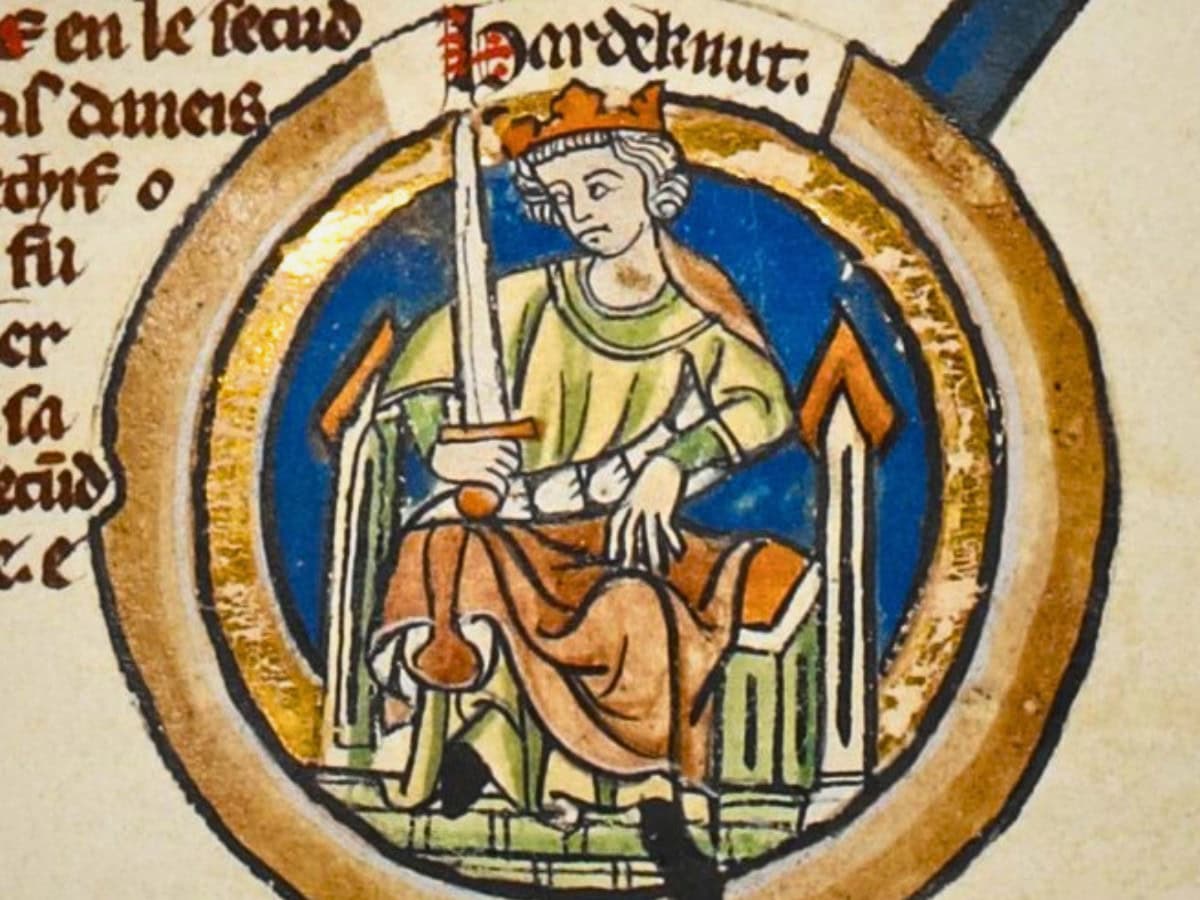
When Cnut Died — A Royal Family Divided
When Cnut died in November 1035, the stability that had held Emma’s complicated family together disappeared with him. England now faced a difficult question: who should succeed Cnut as king?
For Emma, the answer was Harthacnut.
As the son of Emma of Normandy and Cnut, Harthacnut had the status his mother had worked to secure for him. He was already closely associated with Denmark and appears to have been the intended successor to his father’s kingdoms.
Yet at the very moment when Emma needed her son in England, Harthacnut was across the North Sea, occupied with defending his position in Denmark against threats from Norway.
His absence created an opportunity for his half-brother Harold Harefoot.
Harold was Cnut’s son by Ælfgifu of Northampton and had the advantage of being in England. He also attracted powerful English support. The succession quickly developed into something more complicated than a simple question of which son Cnut had intended to follow him.
Emma did not retreat quietly from the struggle. She remained at Winchester, where she held Cnut’s royal treasure and maintained a household on behalf of Harthacnut. For a time, England appears to have settled into an uneasy division of authority. Harold exercised power north of the Thames, while Emma maintained Harthacnut’s interests in Wessex.
It placed the widowed queen in an extraordinary position. Emma was no longer standing beside a king. She was defending the claim of an absent son.
But Harthacnut did not come.
As the months passed, Harold’s position strengthened. What had begun as a disputed succession gradually moved in his favour, and by 1037 he was recognised as king throughout England.
For Emma, the consequences were profound. The queenship that had restored her to prominence under Cnut could no longer protect her. Her wealth, her household and even her place in England were becoming vulnerable.
The struggle for Cnut’s throne had become a struggle for Emma’s own political survival.
Emma and Ælfgifu of Northampton — Two Mothers, Two Dynasties
Behind the competing claims of Harthacnut and Harold stood two remarkable women: Emma of Normandy and Ælfgifu of Northampton.
Their stories had become intertwined through Cnut, but they came from very different backgrounds. Emma was a Norman duke’s daughter, twice crowned Queen of England and mother of children from two royal dynasties. Ælfgifu belonged to a prominent English family and had been Cnut’s partner before his marriage to Emma. Her sons, Swein and Harold, had been born before Emma’s children with Cnut.
It is tempting to turn Emma and Ælfgifu into personal rivals. The surviving evidence does not allow us to reconstruct their private relationship so neatly. What we can see are two politically significant mothers whose positions were closely connected to the fortunes of their sons.
Both women understood the importance of dynasty.
Ælfgifu had already played a prominent role in Norway alongside her son Swein. After Cnut’s death, Harold’s growing authority in England strengthened her family’s position. Emma, meanwhile, remained at Winchester and worked to preserve Harthacnut’s claim.
There was another curious connection between them: their names.
Emma had been known in England as Ælfgifu after her marriage to Æthelred. Cnut’s earlier partner was Ælfgifu of Northampton. Two women at the centre of the same royal family therefore appear in the historical record under the same name.
For clarity, we know them as Emma of Normandy and Ælfgifu of Northampton.
Their importance reaches beyond that shared name. At a time when kingship was overwhelmingly male, both women demonstrate how royal mothers could exercise influence through family connections, wealth, political networks and the claims of their sons.
The battle for Cnut’s legacy was being fought by men — but two mothers stood remarkably close to its centre.
Why Was Emma of Normandy Also Known as Ælfgifu?
When Emma married Æthelred in 1002, she was given the English name Ælfgifu, a name already familiar among Anglo-Saxon royal women. Contemporary records sometimes refer to her by this name, although history remembers her more commonly as Emma of Normandy. It should not be confused with Ælfgifu of Northampton, Cnut’s earlier partner and the mother of Harold Harefoot.
Alfred Ætheling — The Murder of Emma’s Son
While Emma struggled to protect Harthacnut’s position, another branch of her family returned to England.
In 1036, her sons by Æthelred, Edward and Alfred Ætheling, attempted to return from their long exile in Normandy. Exactly what they hoped to achieve remains uncertain. England was unsettled after Cnut’s death, Harthacnut was absent and Harold Harefoot’s position was still developing.
Alfred’s journey ended in tragedy.
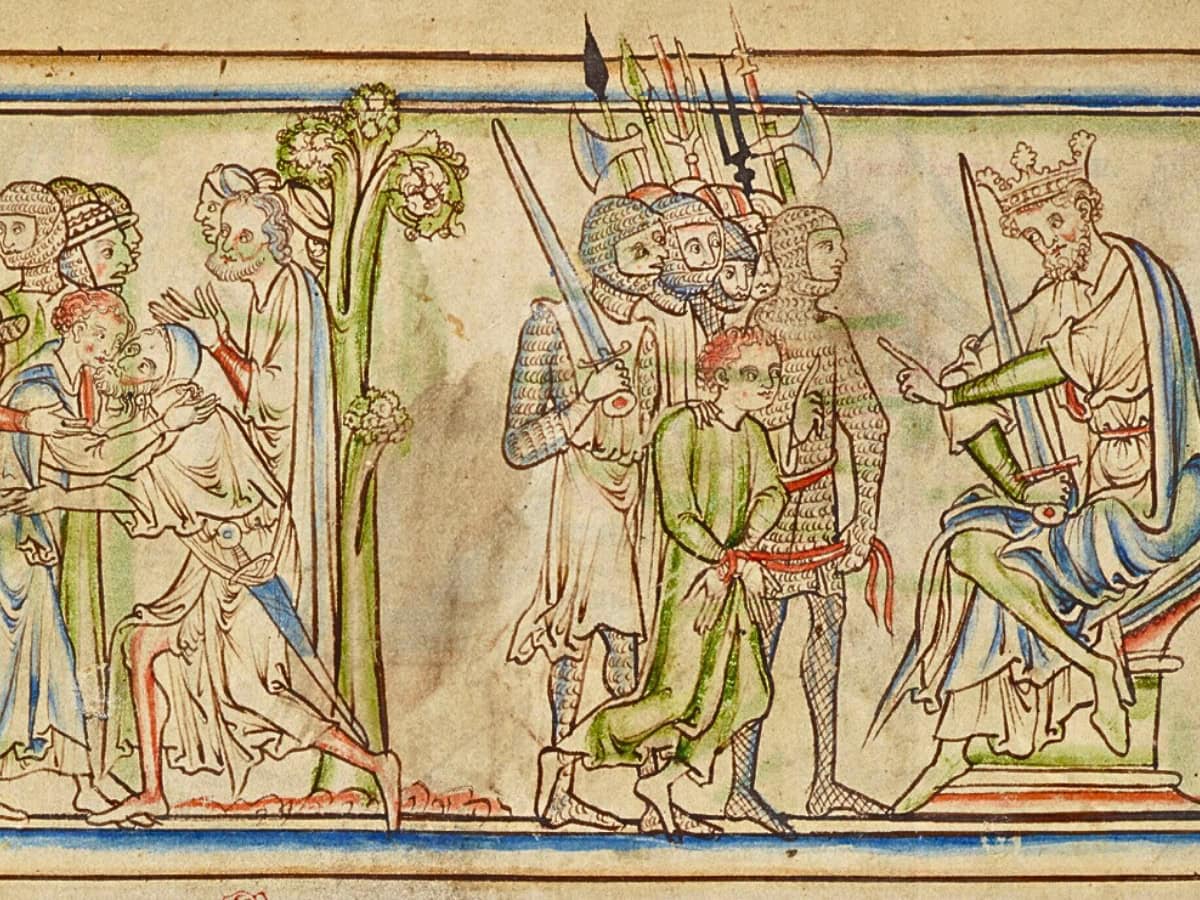
After landing in England, he encountered Earl Godwin of Wessex, one of the kingdom’s most powerful nobles. Alfred was seized, many of his companions were killed or mutilated, and the young ætheling was brutally blinded. He was taken to Ely, where he died from his injuries.
For Emma, it was the loss of a son. Politically, Alfred’s death also removed one of Æthelred’s surviving male heirs.
Yet one uncomfortable question hangs over this episode: why had Alfred returned to England at all?
Later sources offer conflicting explanations, and some traditions raise the possibility that the brothers believed they were responding to a summons from their mother. This has led to speculation about Emma’s role in bringing Alfred back into a dangerously unstable England. We should be very cautious, however. There is no secure evidence that Emma knowingly drew her son into a trap or intended him harm.
Emma’s own version of events is particularly revealing.
The Encomium Emmae Reginae, commissioned in her interests a few years later, places responsibility for Alfred’s fate firmly on Harold Harefoot and portrays Emma and her sons sympathetically. Earl Godwin’s role, and the wider circumstances surrounding Alfred’s return, remain more difficult to untangle.
That does not make the Encomium worthless. Quite the opposite. It gives us an extraordinary glimpse of how Emma wanted these events to be understood.
But it also leaves us with a question we cannot completely resolve.
Emma had survived conquest, widowhood and political upheaval. In 1036, those struggles reached directly into her own family — and one of her sons paid with his life.
Emma in Exile — Again
By 1037, Harold Harefoot had secured recognition as King of England. For Emma, his triumph meant more than the defeat of Harthacnut’s immediate claim. Her own position in the kingdom had become increasingly precarious.
Once again, Emma left England.
This time she did not return to her childhood home in Normandy. Instead, she crossed the Channel to Flanders, where Count Baldwin V received her. Emma established herself at Bruges and gathered a household around her while she waited for the political situation to change.
The circumstances carried an extraordinary echo of her earlier life.
More than twenty years before, Emma had fled England when Sweyn Forkbeard’s Danish invasion drove Æthelred and his family from the throne. Now she was leaving England again — but this time the king forcing her into exile was the son of her Danish husband.
Emma was no longer a young Norman princess seeking the protection of her family. She was an experienced dowager queen who had lived at the centre of English politics for more than three decades.
And exile did not mean political silence.
From Flanders, Emma remained connected with Harthacnut. Her household at Bruges became a place from which she could maintain her interests while her son prepared to challenge Harold’s position in England.
It was also within this Flemish world that the work later known as the Encomium Emmae Reginae would emerge — a remarkable account designed to present Emma, Cnut and her sons in a carefully constructed dynastic story.
Then, in March 1040, news arrived that changed everything.
For the second time in Emma’s life, exile was about to end with a return to England.
Harthacnut — Emma’s First Son to Become King
Harold Harefoot died in March 1040, and the balance of power shifted almost immediately.
For Emma, the moment she had waited for had finally arrived.
Her son Harthacnut, the child of her marriage to Cnut, crossed to England and was accepted as king. Emma returned with him, ending another period of exile and restoring herself to the royal world she had once lost.
The change in her fortunes was dramatic. Only a few years earlier, Emma had been forced from England while Harold strengthened his hold on the throne. Now she returned as the mother of the new king.
Harthacnut’s reign was brief and troubled, marked by heavy taxation, unrest and resentment. His wider story belongs elsewhere, but for Emma one development mattered enormously: during his reign, Edward, her surviving son by Æthelred, returned to England after many years in Normandy.
The exact nature of the arrangement between Harthacnut and Edward remains uncertain. Later tradition presents Edward as being welcomed back and perhaps even recognised as a future successor. What is clear is that Emma now found herself in a remarkable position.
Under one roof, or at least within the same political world, were sons from both of her marriages: Harthacnut from the Danish dynasty and Edward from the House of Wessex.
The division that had shaped Emma’s life had, for a moment, narrowed.
Her first son to become king sat on the English throne, while another son — born into the dynasty that Cnut had displaced — was once again present in England.
The next transition would come sooner than anyone expected.
Edward the Confessor — Emma’s Second Son Becomes King
Harthacnut died suddenly in June 1042, leaving no heir.
Once again, England faced a change of dynasty.
This time the crown passed to Edward the Confessor, Emma’s son by Æthelred. After decades of Danish rule, the House of Wessex returned to the throne. For Emma, the moment was extraordinary. One son from her marriage to Cnut had ruled England, and now another son from her earlier marriage to Æthelred had become king.
Few royal mothers could claim such a place within two successive dynasties.
Yet Edward’s accession did not bring Emma the secure final chapter she might have expected.
The relationship between mother and son appears to have been complicated. Edward had spent much of his life in Normandy, while Emma had remained closely tied to the Danish dynasty and had worked hard to secure Harthacnut’s position. Whatever affection existed between them, political interests had not always drawn them in the same direction.
That tension became unmistakable in 1043.
Why Did Edward Turn Against His Mother?
In November 1043, Edward the Confessor moved against Emma at Winchester. He was accompanied by some of the most powerful men in the kingdom, including Earl Godwin, Earl Leofric and Earl Siward. Emma was deprived of much of her land, treasure and movable wealth.
The reason is not entirely clear.
The Anglo-Saxon Chronicle suggests that Edward believed his mother had given him too little support during earlier struggles for the throne. There may also have been broader political concerns. Emma still possessed substantial wealth, a respected royal household and deep associations with the previous Danish regime. For a newly established king, such resources could represent influence — and perhaps risk.
We should therefore be careful not to reduce the episode to a simple family quarrel.
Edward was still consolidating his kingship. Emma, meanwhile, was no ordinary dowager queen. She had been queen twice, mother of Harthacnut, widow of Cnut and a political figure with decades of experience.
Her position was reduced, but she was not entirely cast aside. Emma later regained some property and appears to have been reconciled sufficiently with Edward to remain in England.
Even so, the events of 1043 marked a turning point.
The woman who had spent much of her adult life close to the throne would never again occupy quite the same political position.
Emma had lived to see her second son become King of England.
But becoming the mother of two kings had not guaranteed her lasting power.
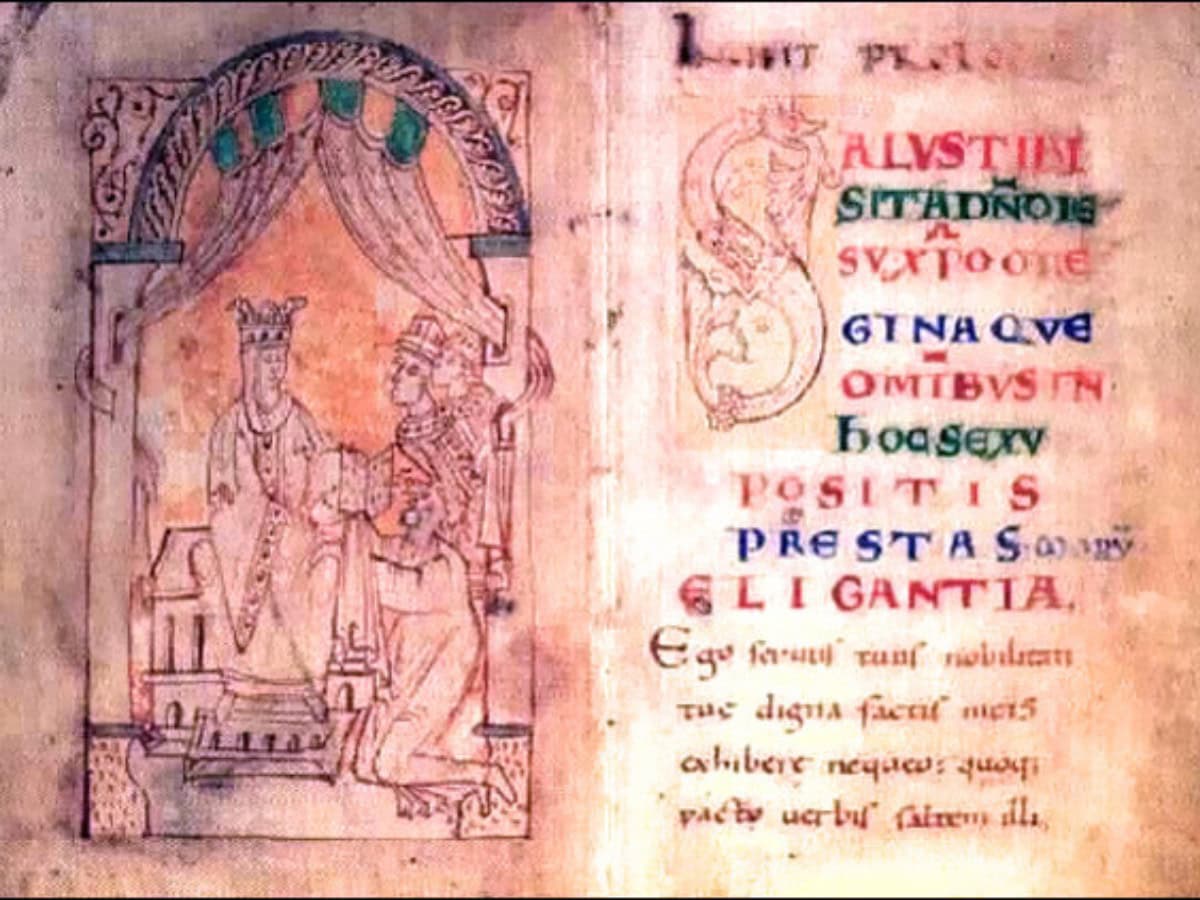
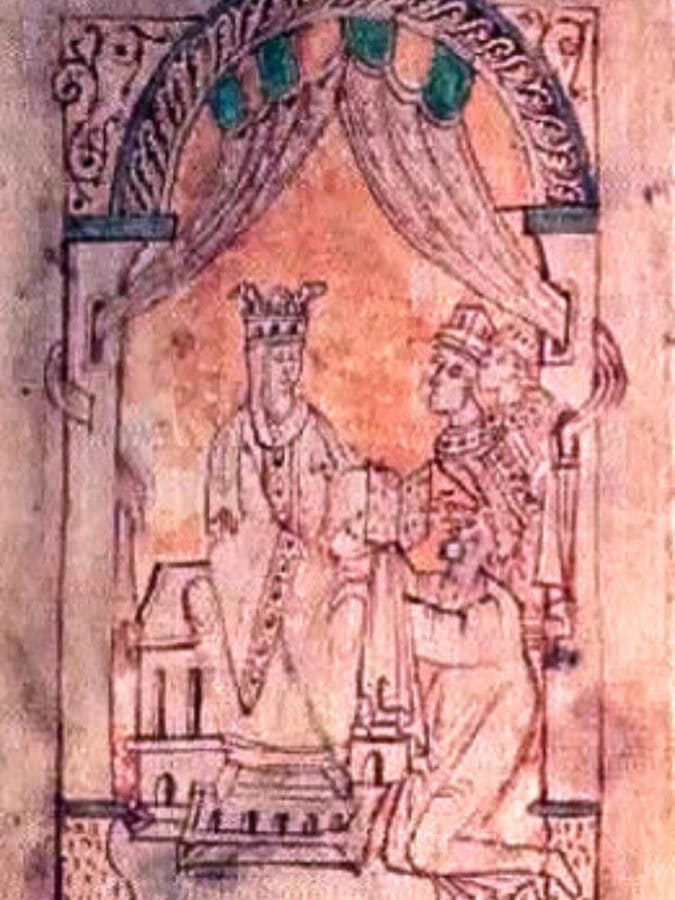
The Encomium Emmae Reginae — The Queen’s Version of Her Story
Among the surviving traces of Emma of Normandy’s remarkable life, one source brings us unusually close to the world she wanted remembered.
The Encomium Emmae Reginae — In Praise of Queen Emma — was written by an anonymous monk of Saint-Bertin in Flanders and commissioned by Emma herself.
Composed around 1041–42, when Harthacnut was king and Edward had returned to England, it tells the story of Cnut, Emma and the turbulent events surrounding the succession to the English throne.
That alone makes it extraordinary. Medieval queens rarely left us anything resembling an account of their lives shaped so directly in their own interests.
But the Encomium is not a biography in the modern sense. Nor was it written simply to record events for future historians. It was a work of praise produced in a highly charged political world, when the legitimacy and relationships of Emma’s sons still mattered enormously.
To read it, therefore, is to encounter both history and the careful construction of memory.
What Emma Wanted History to Remember
The Encomium presents Cnut as a great and legitimate ruler and Emma as his distinguished queen. It gives particular importance to their marriage and to Harthacnut’s right to succeed his father.
Yet what it leaves in the shadows can be just as revealing as what it celebrates.
Emma’s first husband, Æthelred, is strikingly marginal to the story. That presented an obvious difficulty. Emma needed to honour her marriage to Cnut while also accommodating Edward, her surviving son from the dynasty Cnut had displaced.
Alfred’s brutal death posed another problem. The Encomium places blame upon Harold Harefoot and presents Emma and her sons sympathetically. It does not resolve the uncomfortable questions surrounding Alfred’s return to England — including whether Emma had summoned her sons home.
The work was also revised so that Edward could be incorporated more positively into its dynastic message. Emma’s two families, once divided by conquest, could now be presented as part of a more harmonious story.
Can We Trust Emma’s Story?
The answer requires us to look beyond the story Emma wanted to tell.
The value of the Encomium Emmae Reginae lies partly in its bias. It tells us about events, people and political relationships, but it also reveals what Emma considered important enough to defend, emphasise or quietly pass over.
That distinction matters.
Emma did not commission a detached chronicle of her life. She commissioned a version of the past written at a moment when the past could still influence the present.
Nearly a thousand years later, that makes the Encomium more, rather than less, fascinating.
It reminds us that history reaches us through people who made choices about what should be recorded, what should be celebrated and what might best be forgotten.
Emma of Normandy understood something remarkably enduring: there was power not only in surviving history, but also in shaping how that history would be told.
How Powerful Was Emma of Normandy?
After following Emma through two marriages, two queenships, competing dynasties and repeated exile, it is tempting to describe her simply as one of the most powerful women of eleventh-century England.
The reality is more interesting.
Emma never ruled England in her own right. Her formal position depended upon her relationships with kings: first as wife, later as widow and, crucially, as mother. Yet within those boundaries, Emma of Normandy accumulated something perhaps more enduring than a single political office — wealth, land, dynastic connections and remarkable proximity to the throne.
Her Norman birth gave her influential connections across the Channel. Marriage to Æthelred placed her within the House of Wessex. Marriage to Cnut carried her into the Danish dynasty that replaced it.
As queen, she possessed estates and participated in royal and religious patronage. As a royal mother, she worked to protect the interests of her children, most clearly during the struggle over Harthacnut’s succession after Cnut’s death.
Emma also understood the importance of networks. Winchester provided a centre for her wealth and household, while Normandy and later Flanders offered connections beyond England when political circumstances turned against her.
But influence had limits.
Emma was driven into exile twice. Harold Harefoot was able to overcome the political position she maintained for Harthacnut. Later, Edward the Confessor stripped his mother of much of her wealth and property. Being queen — even twice — did not make Emma politically untouchable.
Perhaps the best measure of Emma’s power, therefore, is not whether she ever “ruled” England.
She did not need to.
Her influence lay in her unusual ability to remain politically significant as England moved between rival royal houses. She was wife to kings, mother to heirs, patron, landholder and a dynastic connection between Normandy, Anglo-Saxon England and Cnut’s Scandinavian world.
And through the Encomium Emmae Reginae, Emma attempted something still more unusual: to influence how that extraordinary life would be remembered.
Her power changed with circumstance. Her influence endured because she repeatedly found ways to adapt to it.
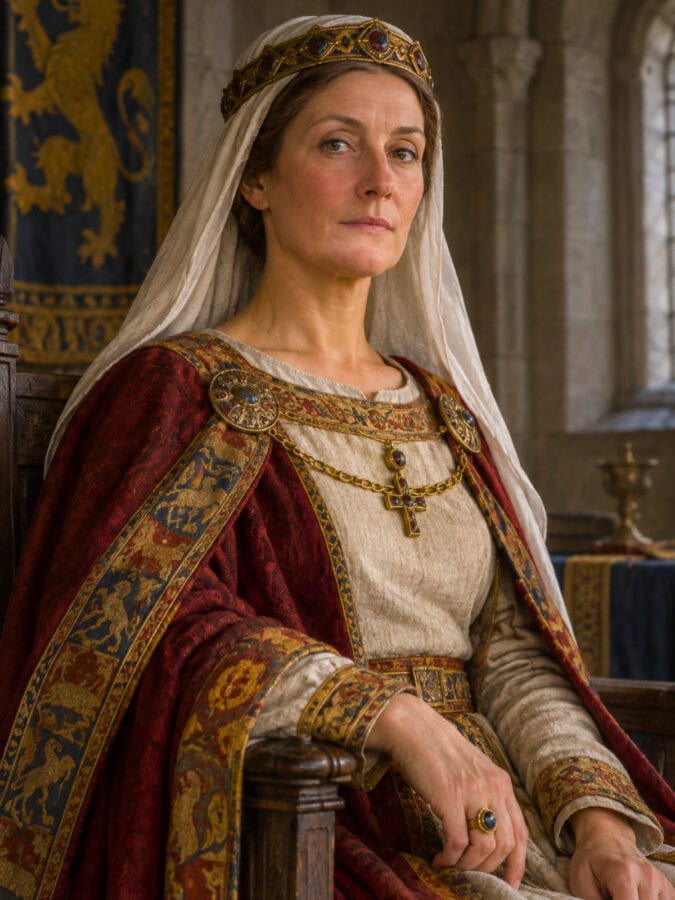
Emma of Normandy and Winchester
For all the kingdoms, dynasties and journeys that shaped Emma’s life, one English city remained particularly closely connected with her story: Winchester.
In the eleventh century, Winchester was far more than an ancient city. It was one of the great centres of English royal and religious life, closely associated with the kings of Wessex and home to the Old Minster and New Minster. Royal ceremony, worship and burial placed the city at the heart of the kingdom Emma had entered as a young Norman princess.
Winchester became important during both of her queenships. Emma and Cnut were benefactors of the New Minster, and it is from a manuscript associated with that religious community that we have the remarkable contemporary image of the couple presenting a cross at the altar.
The city mattered politically too. After Cnut’s death, Emma established herself at Winchester while defending Harthacnut’s interests. It was here that she held royal treasure and maintained her position during the uncertain struggle for the throne. Years later, Winchester would also provide the setting for one of the sharpest reversals of her life, when Edward moved against his mother and deprived her of much of her wealth in 1043.
Today, the medieval landscape Emma knew has changed profoundly. The Old Minster beside which generations of English royalty were buried has disappeared, its site lying beside the present Winchester Cathedral.
Yet Emma’s connection with the city has not disappeared with it.
To stand within Winchester’s cathedral precinct is to come unusually close to the world her story inhabited — a place where Anglo-Saxon, Danish and later Norman histories overlap.
The woman who sailed from Normandy for England in 1002 belongs to all three of those worlds. In Winchester, more than a thousand years later, their stories still meet.
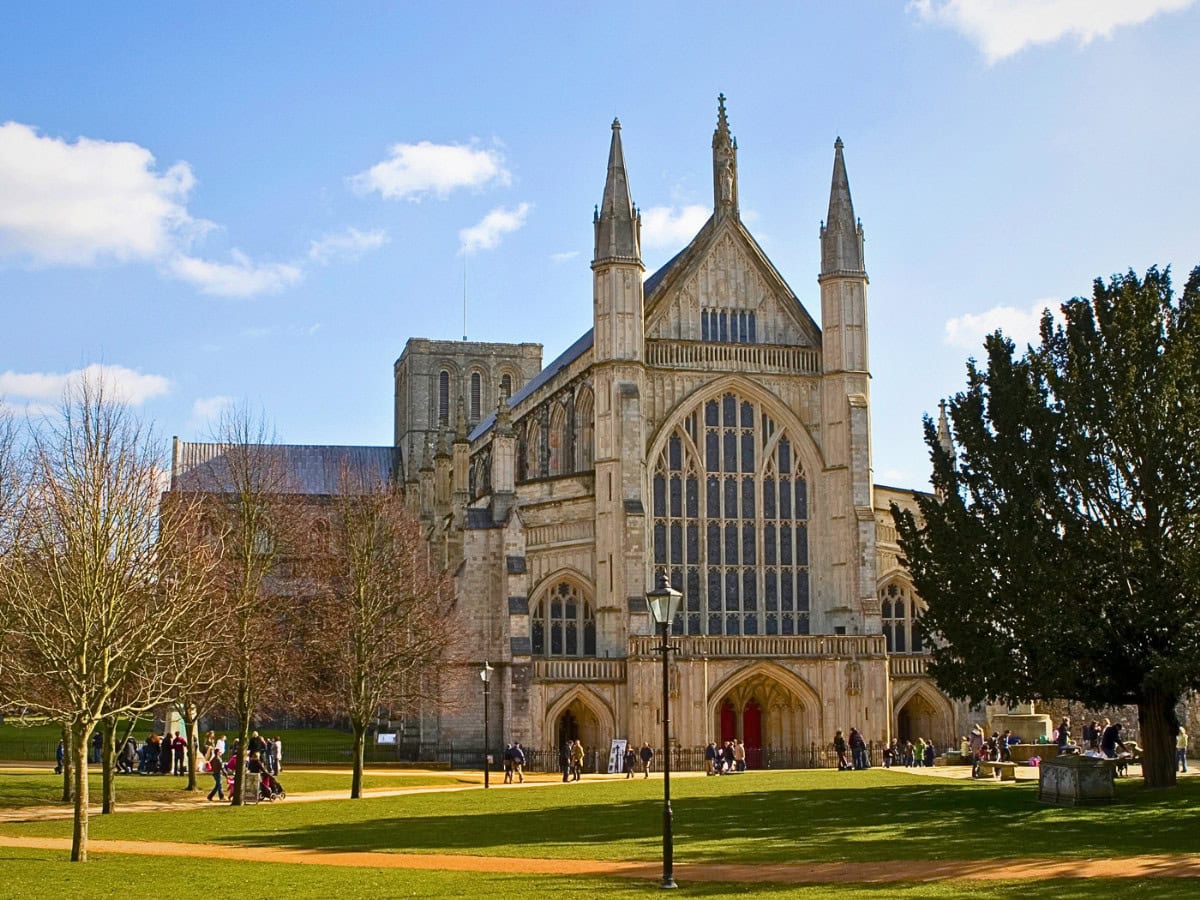
Emma’s Death — The End of an Extraordinary Life
Emma of Normandy died on 6 March 1052, after almost half a century bound to the English royal world.
The England she left behind was scarcely the kingdom she had encountered when she sailed across the Channel in 1002.
Emma had arrived as the bride of Æthelred II while Viking armies threatened England. She had seen Sweyn Forkbeard seize the kingdom, Æthelred restored and Cnut establish a new Danish dynasty. She lived through the disputed succession of Harold Harefoot, saw Harthacnut become king and, finally, witnessed the restoration of the House of Wessex through her son Edward the Confessor.
Few lives offer such a remarkable window onto the upheavals of early eleventh-century England.
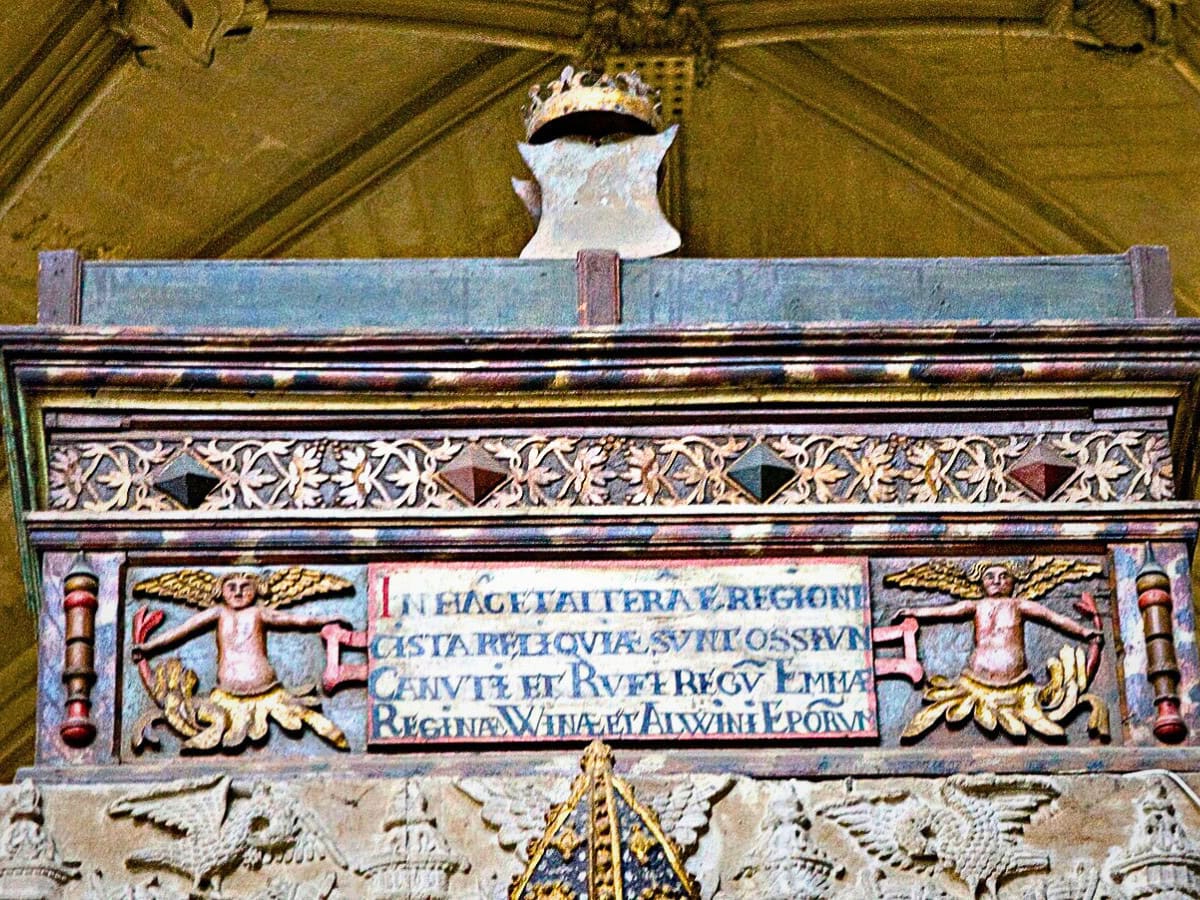
Emma was buried at Winchester beside Cnut, bringing the two together in death as they had once been in queenship and kingship. Their remains were later moved as Winchester’s medieval cathedral developed and earlier royal burials were reorganised.
But their resting place did not remain undisturbed.
In 1642, during the English Civil War, Parliamentary soldiers ransacked Winchester Cathedral. The royal mortuary chests were pulled down and bones belonging to generations of early English kings, queens and bishops were scattered. Some were lost, while others were later gathered and returned to the surviving and replacement chests.
For centuries, this upheaval left a tantalising mystery over the identities of the remains.
Today, Emma is one of the early medieval royals commemorated in Winchester Cathedral’s mortuary chests. Modern scientific research is now revealing far more about the people whose bones survived within them — and has brought us closer to Emma herself than earlier generations could have imagined.
More than a thousand years after her death, Emma’s connection with Winchester continues.
Could Queen Emma’s Bones Have Been Identified at Winchester?
For centuries, the royal bones at Winchester Cathedral presented historians and archaeologists with an extraordinary puzzle.
When Parliamentary soldiers ransacked the Cathedral in 1642, mortuary chests containing the remains of early English royalty were broken open and their contents scattered. The surviving bones were later gathered together, but individual identities had become difficult to establish.
Since 2012, Winchester Cathedral’s Mortuary Chests Project has brought together archaeology, historical research and modern scientific analysis to study the remains.
The research has included examination of the bones, radiocarbon dating and genetic analysis. Rather than relying simply upon the names painted on the historic chests, researchers have been working to establish the age, sex and date of the individuals represented by the surviving remains.
In September 2026, Winchester Cathedral announced plans for two new mortuary chests to hold the remains of nine early medieval individuals. Significantly, the Cathedral states that these will include the bones of Queen Emma of Normandy.
There is still reason for scholarly caution. The Cathedral itself explains that identifying individuals with absolute certainty remains difficult, and further academic findings from the project are expected.
Nevertheless, the research represents a remarkable development in Emma’s story.
A queen who died almost a thousand years ago, whose bones were moved, scattered and mixed through centuries of upheaval, may now be emerging once again as an identifiable individual within Winchester’s extraordinary collection of royal remains.
Emma of Normandy’s Legacy — Did Her Story Lead Towards 1066?
Emma of Normandy died fourteen years before the Norman Conquest. It would therefore be misleading to suggest that she caused, or even paved the way for, William the Conqueror’s invasion of England.
Her life reveals something more interesting.
Long before 1066, England, Normandy and Scandinavia were already connected by marriage, warfare, trade, exile and competing royal ambitions. Emma stood at the meeting point of these worlds, and her family history shows just how closely their ruling dynasties had become intertwined.
Her Norman connections were particularly significant. When Danish conquest threatened the House of Wessex, Normandy became a place of refuge for Emma and her children. Her sons Edward and Alfred spent many years there, and Edward’s long exile created relationships that remained important after he became Edward the Confessor.
There was also a direct family connection to the man who would eventually invade England. Emma was the great-aunt of William, Duke of Normandy, later William the Conqueror. But that relationship did not give William an automatic right to the English throne. His eventual claim formed part of a far more complicated succession crisis following Edward’s death in January 1066.
Emma’s importance to the story of 1066 lies elsewhere.
Her life shows us that the English Channel was not a barrier separating two isolated political worlds. Kings, queens, exiles and armies had been crossing it for generations. Across the North Sea, Scandinavian rulers had also transformed the English crown, leaving England connected to an even wider network of dynastic ambitions.
So when we look towards 1066 from Emma’s lifetime, we should not see the Norman Conquest as the inevitable conclusion to her story.
Instead, her life helps us understand the interconnected world in which 1066 eventually became possible.
Queen of Two Dynasties
Emma of Normandy arrived in England in 1002 as a young Norman princess entering an uncertain Anglo-Saxon kingdom. By the end of her life, she had been queen to two kings from opposing dynasties and mother to two kings who would each inherit the English throne.
Yet those remarkable connections tell only part of her story.
Emma lived through conquest, exile, widowhood and bitter struggles over succession. She lost a son to violence, saw her wealth and influence taken from her and twice found herself forced from England. Each time circumstances changed around her, she found a way to remain connected to the royal world that had shaped most of her life.
Her influence had limits, as we have seen. But Emma’s significance lies partly in her ability to navigate a political landscape in which queens rarely possessed power independently of the men around them.
Perhaps the most intriguing glimpse of Emma comes towards the end of her story.
By commissioning the Encomium Emmae Reginae, she left behind more than a record of turbulent events. She helped shape the version of those events that she wanted others to remember.
That does not give us Emma’s story exactly as it happened. Instead, it leaves us something equally fascinating: a glimpse of how one medieval queen understood her own place in history.
More than a thousand years later, Emma of Normandy remains a woman whose life connects two dynasties — and whose carefully shaped story still invites us to question how history itself is remembered.
Continue Exploring Britain’s Royal History
If Emma of Normandy’s remarkable story has drawn you deeper into the turbulent world of eleventh-century England, continue with these related stories of the kings, royal families and rival dynasties that shaped her life — and the struggles for the English throne that unfolded around her.
Please take a moment…
Before you go, I’m excited to share some news—Timeless Travel Steps was awarded Best Slow Travel & Heritage Travel Blog 2026! Please take a moment to read our story and discover the passion behind our journeys.
For more travel insights and tips, consider following Georgina from Timeless Travel Steps on BlueSky, Instagram, Facebook and Pinterest. Don’t miss out on her latest adventures and expert advice. Subscribe to stay updated and join a community of fellow travel enthusiasts eager to explore the world.
Resources and Further Reading
The life of Emma of Normandy survives through medieval chronicles, royal records and, most unusually, a work commissioned in Emma’s own interests. Modern historians continue to examine these sources to understand her queenship, family relationships and political influence.


