
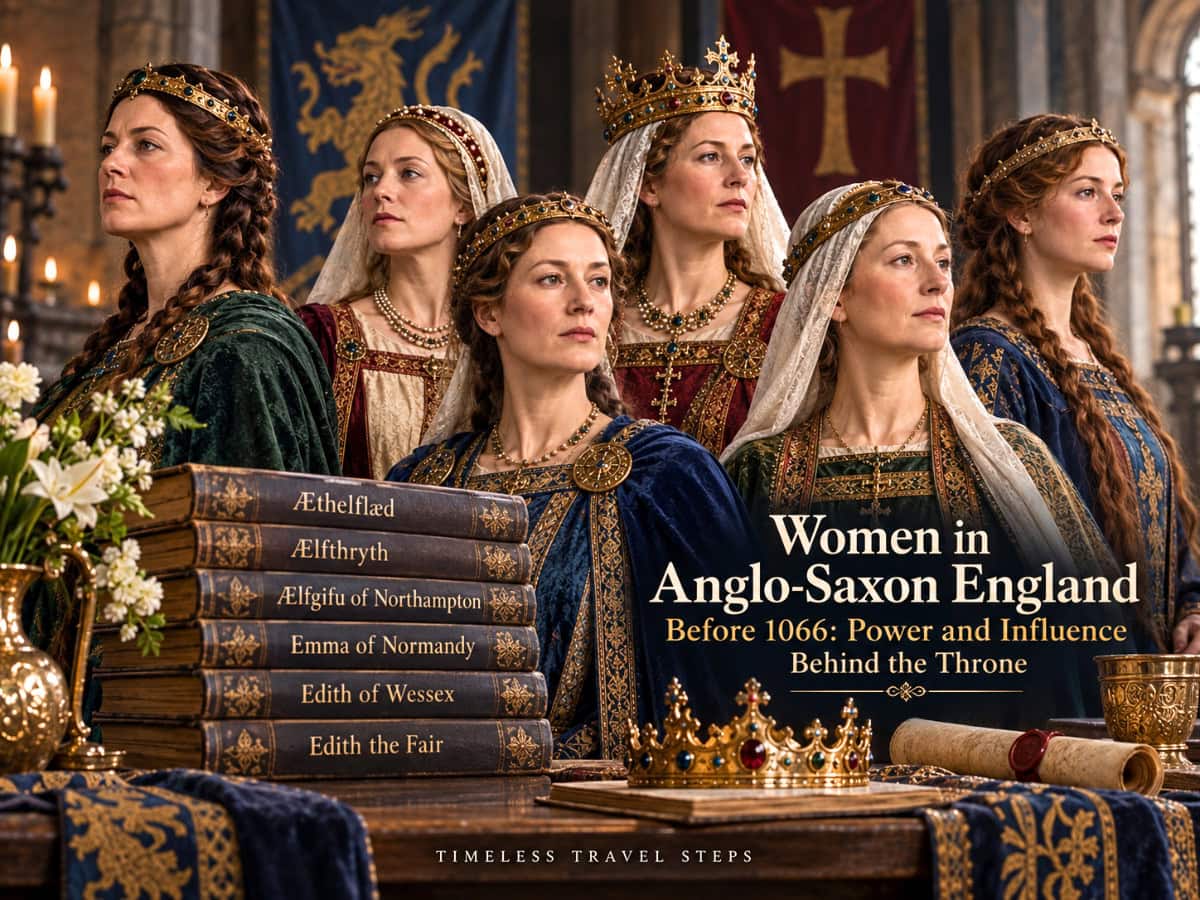
Women in Anglo-Saxon England Before 1066: Power and Influence Behind the Throne
When we think of the Anglo-Saxon throne, it is usually the kings whose names come first. Alfred the Great, Æthelstan, Æthelred the Unready, Edward the Confessor and Harold Godwinson dominate the familiar story of England before 1066.
Yet kings did not shape that story alone.
Behind the succession of rulers were women whose marriages, families and political choices could influence who came close to the throne — and sometimes who inherited it.
The story of women in Anglo-Saxon England is not simply one of queens standing quietly beside their husbands. Some held considerable land and wealth. Some became powerful mothers of kings. One governed Mercia and helped drive back Scandinavian power. Others survived conquest, exile and the fall of the very dynasties into which they had married.
Their influence was rarely straightforward, and it did not remain the same as England changed.
Æthelflæd, Lady of the Mercians, belonged to a world in which a single kingdom of England was still taking shape. A century later, Emma of Normandy would live through the fall of an Anglo-Saxon king, marry his Danish successor and see sons from both dynasties occupy the English throne.
Then came Edith of Wessex, caught between her husband, Edward the Confessor, and the increasingly powerful Godwin family into which she had been born.
By January 1066, marriage, bloodline, family loyalty and royal succession had converged around an English throne without a king’s son to inherit it.
Nine months later, that world would be changed forever at Hastings.
This is the story of some of the remarkable women who stood close to the Anglo-Saxon throne — Æthelflæd, Ælfthryth, Ælfgifu of Northampton, Emma of Normandy, Edith of Wessex and Edith the Fair — sometimes beside it, sometimes behind it and, in one remarkable case, ruling for herself — as England moved towards 1066.
Disclosure
Timeless Travel Steps is supported by our readers. If you purchase through an affiliate link on my site, at no cost to you, I may earn a commission from qualifying purchases. Additionally, Timeless Travel Steps is a participant in the Amazon Services LLC Associates Program. As an Amazon Associate, I earn from qualifying purchases at no extra cost to you. Please read our Disclosure for further information.
The Power Women at the Heart of Our Story
|
Women |
Her position |
Source of her power, position and influence |
Best known for |
|---|---|---|---|
|
Æthelflæd |
Lady of the Mercians |
Royal birth, marriage and her own political authority |
Ruled Mercia and helped recover territory from Scandinavian control |
|
Ælfthryth |
Queen of King Edgar |
Aristocratic birth, queenship, land, wealth and motherhood |
First English-born queen known to have been formally crowned and anointed; mother of Æthelred the Unready |
|
Ælfgifu of Northampton |
Cnut’s partner; mother of Harold Harefoot |
Aristocratic family, relationship with Cnut, motherhood and political connections |
Governed in Norway with her son Svein; mother of a future King of England |
|
Emma of Normandy |
Queen of Æthelred II and Cnut |
Ducal birth, two royal marriages, wealth, queenship and motherhood |
Queen to two kings and mother of two kings of England |
|
Edith of Wessex |
Queen of Edward the Confessor |
Godwin family, marriage, extensive estates, wealth and patronage |
Queen caught between Edward the Confessor and the powerful Godwin family |
|
Edith the Fair |
Harold Godwinson’s long-term companion |
Her long relationship with Harold |
Remembered particularly through the later tradition that she identified Harold’s body after Hastings |
Along the way, we will also meet Gytha Thorkelsdóttir, mother of Queen Edith, Harold Godwinson and Tostig, whose powerful family became inseparable from the fate of the Anglo-Saxon throne.
The Women Behind the Anglo-Saxon Throne
For women in Anglo-Saxon England, access to power could come through birth, wealth, land, marriage and family connections. For those born into royal and aristocratic families, marriage to a ruler or motherhood of a possible heir could place them remarkably close to the politics of the throne.
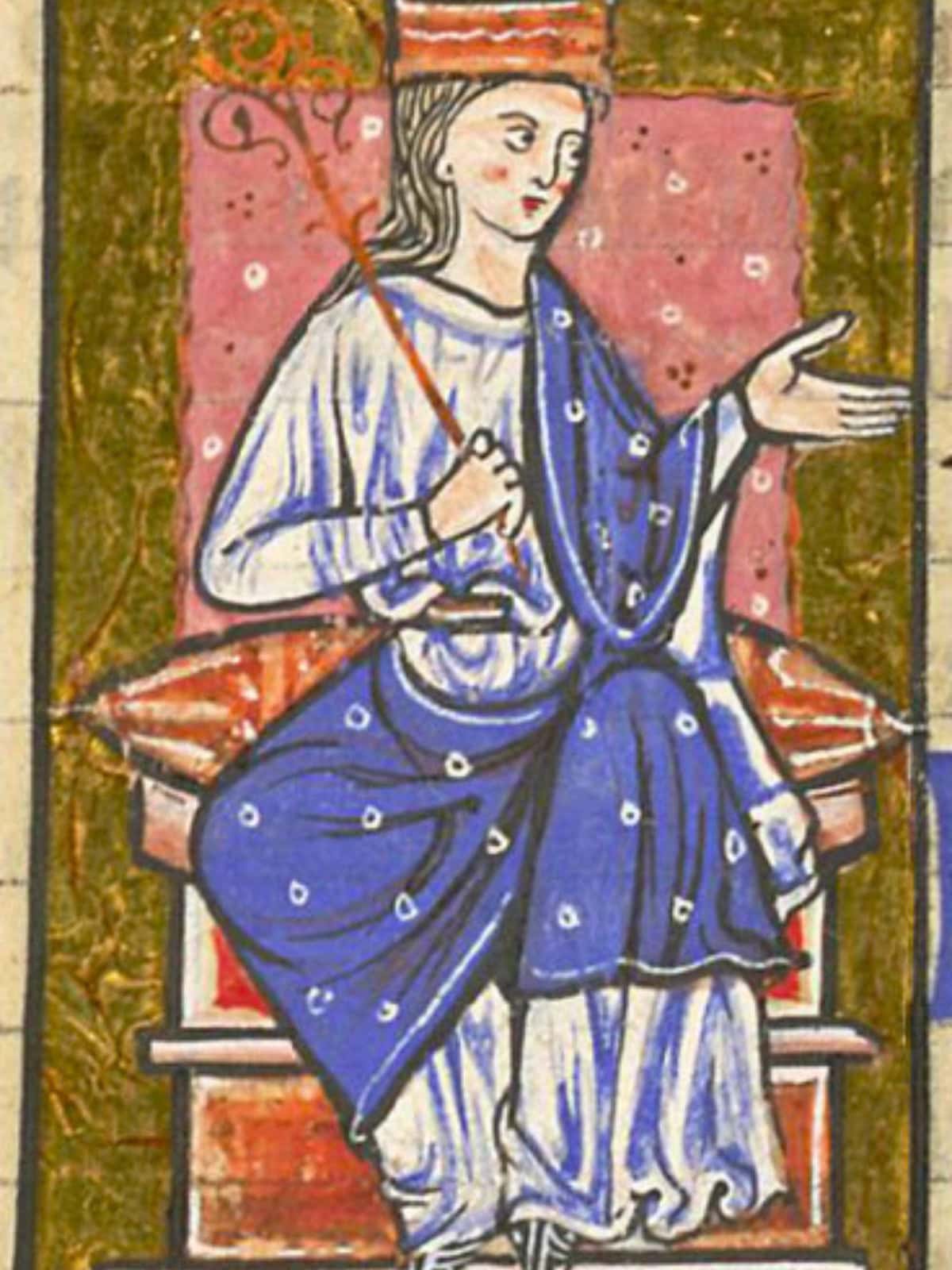
Take Æthelflæd, for instance. She was the daughter of Alfred the Great and wife of Æthelred, ruler of Mercia. Royal birth and marriage placed her close to power, but she would eventually go much further and govern Mercia herself.
Ælfthryth became the crowned queen of King Edgar and mother of Æthelred the Unready. Emma of Normandy, daughter of the Duke of Normandy, crossed the Channel to marry Æthelred and later Cnut, placing her at the heart of two rival dynasties. Then came Edith of Wessex, daughter of the powerful Earl Godwin, wife of Edward the Confessor and sister of Harold Godwinson.
Their stories reveal different kinds of power behind the Anglo-Saxon throne. Sometimes it meant ruling. Sometimes it came through marriage, motherhood, wealth or the ability to promote a family’s interests. And sometimes the women closest to these kings reveal something less political but equally important — the human relationships behind the names we find in chronicles and lists of rulers.
That is where Edith the Fair, Harold Godwinson’s long-term companion, enters our story. Her political influence is far harder to establish, but a later tradition places her beside Harold even in death, after the Battle of Hastings.
Together, these women take us from Alfred the Great’s divided England to the final days of Anglo-Saxon rule.
And our story begins with his daughter, Æthelflæd.

Æthelflæd: When a Woman Ruled Mercia
Æthelflæd was born into a world in which England did not yet exist as the single kingdom we recognise today.
Her father, Alfred the Great, ruled Wessex while Scandinavian armies controlled large parts of the country. Mercia, once one of the great Anglo-Saxon kingdoms, had also been transformed by decades of conflict.
Sometime during the 880s, Alfred’s eldest daughter married Æthelred, Lord of the Mercians. It was a marriage with clear political value. Wessex and Mercia needed one another as they resisted Scandinavian expansion, and the union strengthened the relationship between their ruling houses.
Yet Æthelflæd did not remain simply Alfred’s daughter or Æthelred’s wife.
She appears alongside her husband in charters and shared in the patronage of religious houses. As Æthelred’s health appears to have declined, Æthelflæd may have taken an increasingly prominent role in Mercian affairs.
Then, in 911, Æthelred died.
Æthelflæd remained.
Rather than Mercia passing immediately into the hands of another male ruler, she became known as Myrcna hlæfdige — the Lady of the Mercians.
The daughter of Alfred the Great was now ruling Mercia.
The Lady of the Mercians
For the next seven years, Æthelflæd governed Mercia while her brother, Edward the Elder, ruled Wessex.
These were years when the struggle against Scandinavian power was still reshaping the country. Æthelflæd strengthened a network of fortified settlements, or burhs, across Mercia, protecting important routes and communities. Tamworth, Stafford and Warwick were among the places connected to this defensive programme.
But Æthelflæd was not simply defending the territory she had inherited.
In 917, Mercian forces captured Derby, one of the Five Boroughs of the Danelaw. The following year, Leicester submitted to her without a fight. According to the Anglo-Saxon Chronicle, the people of York also promised to submit to her shortly before her death.
It was an extraordinary position for a woman in early tenth-century England.
Her royal birth had given her status. Marriage had brought her into the Mercian ruling house. Widowhood then left her in circumstances where the relationships, authority and political standing she had already built could be exercised in her own name.
Æthelflæd’s power was therefore unusual, but it was not accidental. Mercian leaders were prepared to accept her authority, and for seven years she helped direct the struggle that was steadily pushing Scandinavian rule back.
She would not live to see where that struggle ultimately led.
What Happened to Female Rule After Æthelflæd?
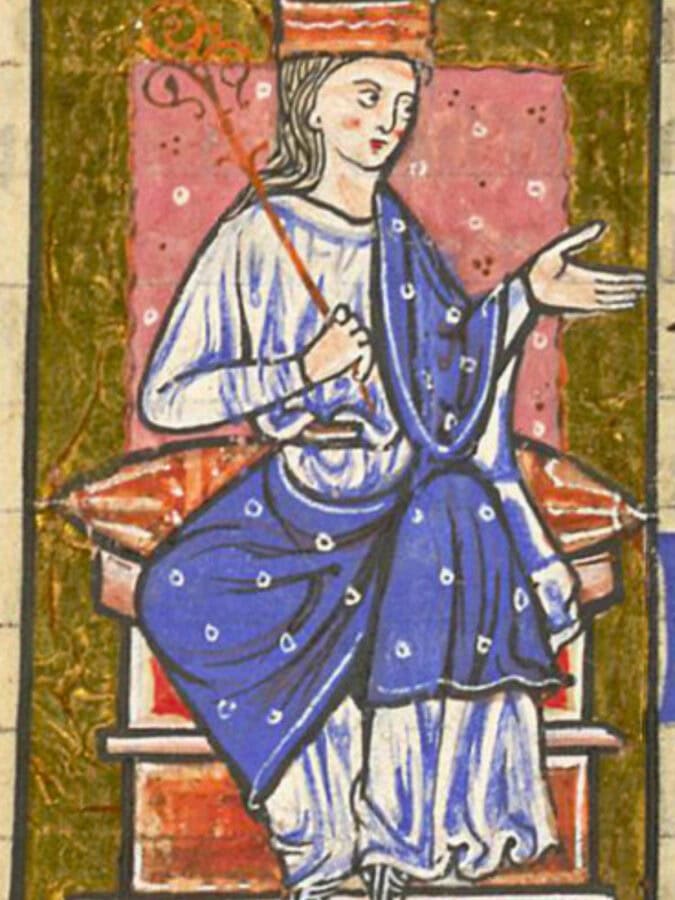
Æthelflæd died at Tamworth on 12 June 918 and was buried at Gloucester, in the church of St Oswald that she and Æthelred had helped establish.
Her daughter, Ælfwynn, succeeded her.
For a brief moment, the possibility opened of something even more remarkable: female rule passing from mother to daughter.
It did not last.
Later that year, Edward the Elder deprived Ælfwynn of authority in Mercia and took her into Wessex. After that, she largely disappears from the historical record.
We cannot know exactly what Ælfwynn might have achieved had she remained in power. What we do know is that her removal brought Mercia more firmly under Edward’s control.
The political landscape was changing.
Under Edward and then his son Æthelstan, the territories that Æthelflæd’s generation had fought to defend and recover moved towards a single kingdom of England. By 927, Æthelstan had taken York and established a level of authority over England that no previous West Saxon king had achieved.
As kingship became more consolidated, we encounter fewer women exercising the kind of direct territorial authority Æthelflæd had held.
But women did not disappear from the story of the throne.
Their influence increasingly appears within the royal household itself — through queenship, marriage, motherhood and the uncertain question of which son should become king.
And several decades after Æthelflæd’s death, that question would surround another formidable woman.
Ælfthryth.
Ælfthryth: Queenship, Motherhood and the Fight for Succession
The Making of a Crowned Anglo-Saxon Queen
By the time Ælfthryth entered the royal household in the tenth century, England was very different from the fragmented world into which Æthelflæd had been born. The descendants of Alfred the Great had extended their authority across the kingdom, and power was becoming increasingly centred on the English crown.
For women in Anglo-Saxon England, that changing political landscape created different routes to influence.
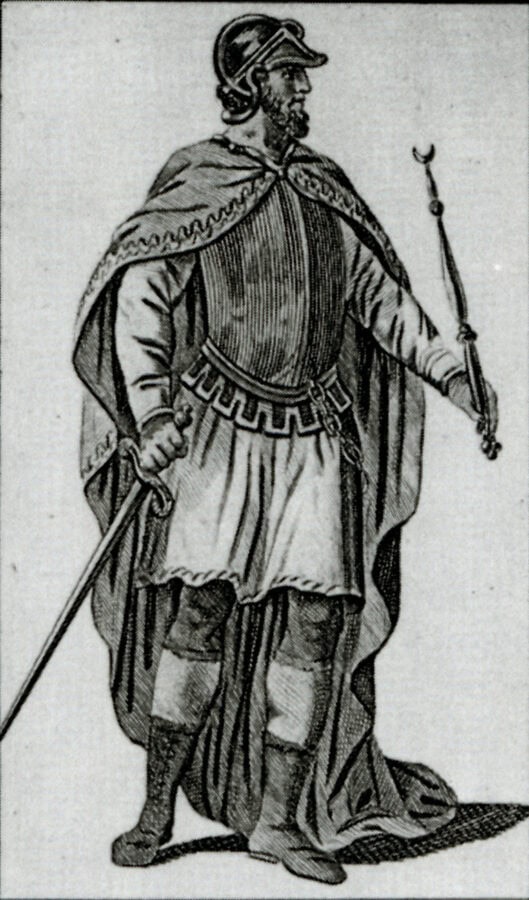
Ælfthryth was born into a powerful aristocratic family. Her father, Ordgar, became ealdorman of Devon, while Ælfthryth’s first marriage was to Æthelwold, an important nobleman.
Later stories turned the beginning of her relationship with King Edgar into something far more dramatic.
According to one tale, Æthelwold concealed Ælfthryth’s beauty from Edgar and married her himself, only for the king to discover the deception and have him killed.
It is a wonderful piece of medieval storytelling.
But it was written down long after the people involved had died, and we should be careful not to confuse a memorable story with reliable evidence.
What we know is that after Æthelwold’s death, Ælfthryth married Edgar, probably in the 960s. The daughter of an ealdorman was now wife to the king.
Her position became even more remarkable in 973.
At Bath, Edgar underwent an elaborate royal consecration. Beside him, Ælfthryth was also crowned and anointed. She is generally regarded as the first known wife of an English king to receive a formal coronation and anointing as queen.
This was more than a splendid ceremony.
It gave Ælfthryth a highly visible place within English kingship. She witnessed royal charters, possessed substantial estates and supported religious communities. The power we saw exercised directly by Æthelflæd in Mercia now looked very different.
Ælfthryth stood beside the throne.
And she was the mother of a son who might one day inherit it.
Edward the Martyr, Æthelred and a Contested Succession
When Edgar died in 975, the security of his reign gave way to uncertainty.
He left two surviving sons. Edward, his son from an earlier union, was the elder. Ælfthryth’s son, Æthelred, was younger.
Powerful figures within the kingdom disagreed over the succession, but Edward was accepted as king.
For Ælfthryth, the outcome mattered deeply. She was a crowned queen and the king’s widow, but the boy who now occupied the throne was not her son.
Then, in 978, Edward was killed at Corfe in Dorset while visiting the household where Ælfthryth and the young Æthelred were staying.
His death has cast a long shadow over her reputation.
Later medieval writers told a darker story: Edward arriving at Corfe, being offered a drink and then being murdered on the orders of his stepmother so that her own son could take the crown.
The motive appears almost too perfect.
Edward died. Æthelred became king. Ælfthryth became the king’s mother.
But motive is not proof.
Contemporary sources do not establish that Ælfthryth ordered Edward’s murder. The detailed accusations against her developed later, as the dead king became venerated as Edward the Martyr.
What we can say is that his violent death transformed the succession.
Æthelred was probably only around twelve when he became king. Ælfthryth now occupied a position of considerable importance as queen mother, appearing prominently in charters during the early part of his reign.
Her son had reached the Anglo-Saxon throne.
Whether his mother had anything to do with clearing the path remains one of the darker uncertainties of the period.
Æthelred the Unready: Follow the turbulent reign of Æthelred the Unready and the events that brought England closer to Danish conquest.
Power, Reputation and the Dangerous Memory of a Queen
Ælfthryth remained wealthy and influential. She held substantial estates, supported religious foundations and had close connections with leading churchmen associated with the Benedictine reform movement.
Yet the stories that gathered around her after Edward’s death reveal something else about powerful Anglo-Saxon women.
Influence could make a queen visible. It could also make her suspect.
Ælfthryth was a wealthy king’s widow whose own son benefited directly from the murder of his half-brother. For later storytellers, she made a compelling villain. Over time, the politically connected queen became increasingly difficult to separate from the murderous stepmother of legend.
The historical Ælfthryth is more complicated.
She did not rule as Æthelflæd had done. Her influence came through birth, queenship, property and, above all, motherhood. Her son’s claim tied her directly to the future of the dynasty.
But becoming king was one thing.
Keeping the kingdom secure was another.
Æthelred’s long reign would be overshadowed by renewed Scandinavian attacks, enormous payments of tribute and, eventually, a struggle for England itself.
That struggle would bring new families — and new women — into the story of the English throne.
One was Emma of Normandy, who arrived in England in 1002 to marry Æthelred and strengthen his connection with Normandy.
But before Emma became wife to the Danish king who would eventually conquer England, another woman already had a place in Cnut’s life.
Her name was Ælfgifu of Northampton.
She would become the mother of one of Cnut’s sons — and that son would become King of England.
Ælfgifu of Northampton: Mother of a King and the Struggle for the Throne
Before Emma of Normandy became Cnut’s queen, another woman already occupied an important place in his life.
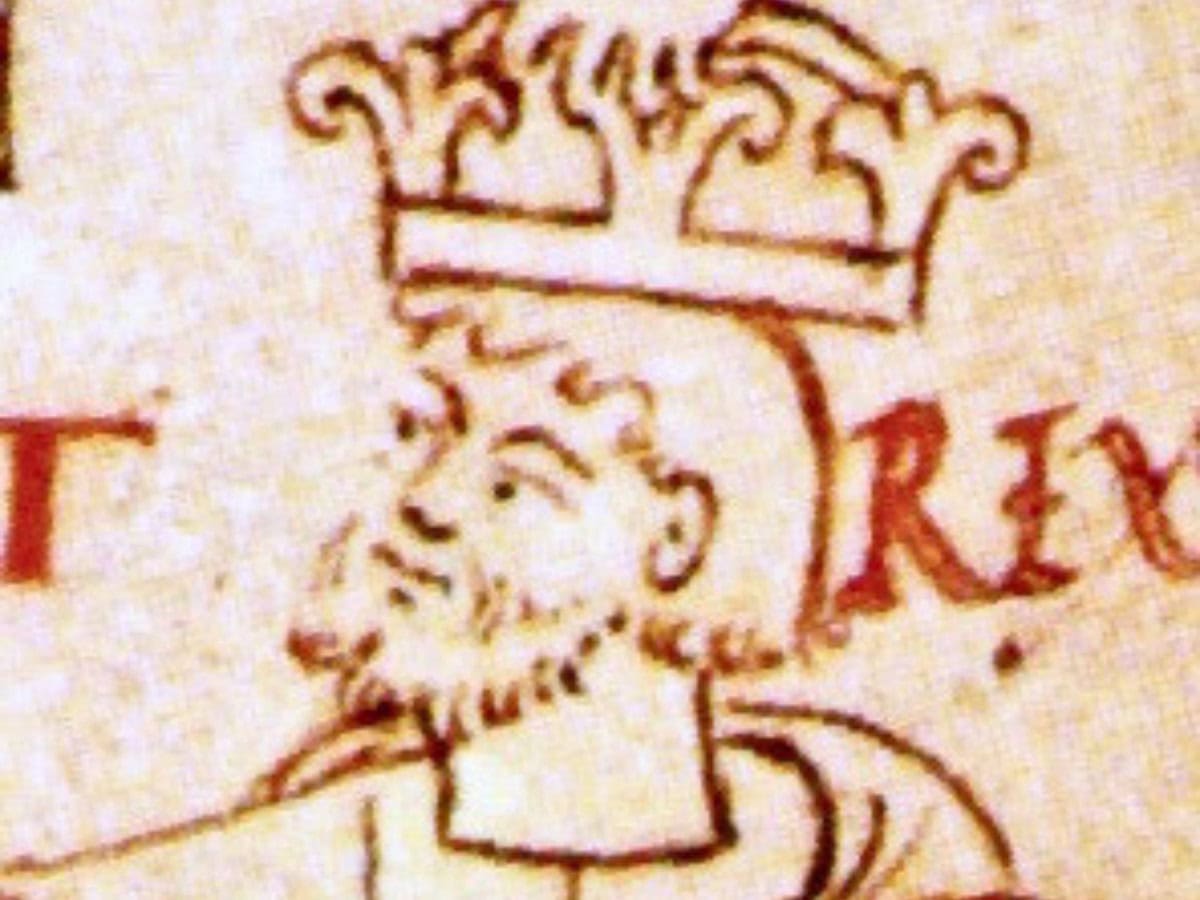
Ælfgifu of Northampton came from a prominent English family with strong connections in the Midlands. Her father, Ælfhelm, had been ealdorman of southern Northumbria before he was killed in 1006 during the reign of Æthelred the Unready.
Ælfgifu later became Cnut’s partner, probably during the years when the Danish conquest of England was still unfolding. Together they had two sons, Svein and Harold, later known as Harold Harefoot.
Exactly how we should understand Ælfgifu’s relationship with Cnut is less straightforward. It is often described as a marriage according to Scandinavian custom rather than a Christian marriage recognised by the Church. What is clear is that Ælfgifu was considerably more than a passing mistress.
Even after Cnut married Emma of Normandy in 1017, Ælfgifu remained part of the political world surrounding his dynasty.
Cnut the Great: Meet Cnut the Great, the Danish conqueror who became King of England and ruled a powerful North Sea empire.
From England to Power in Norway
In the early 1030s, Cnut sent Ælfgifu and their son Svein to Norway, where they governed in his interests.
For a woman in the eleventh century, this was an extraordinary political position.
Their government proved deeply unpopular. New laws, taxation and attempts to strengthen Danish control contributed to growing opposition, and Ælfgifu and Svein were eventually forced to leave Norway.
But Ælfgifu’s political story was not over.
When Cnut died in 1035, the question of who should rule England opened another struggle for succession.
Emma’s son Harthacnut was Cnut’s intended successor in his Scandinavian empire but remained in Denmark, where he faced challenges of his own. Ælfgifu’s surviving son, Harold Harefoot, was in England.
Ælfgifu now appears closely connected with the efforts to secure Harold’s position.
Harold initially gained control north of the Thames. By 1037, he had secured the whole kingdom, and Emma was driven into exile.
Ælfgifu’s son was now King of England.
Like Ælfthryth before her, Ælfgifu shows how motherhood could bring a woman directly into the politics of royal succession. Her position had survived Cnut’s marriage to another queen, an unsuccessful period of government in Norway and the death of Cnut himself.
But Harold’s reign was brief.
He died in 1040, and the English throne passed to the man whose interests Ælfgifu and Harold had opposed.
Harthacnut — the son of Emma of Normandy.
And with his arrival in England, the other woman at the heart of Cnut’s complicated dynasty returned to the centre of our story.
Emma.
Emma of Normandy: A Queen Between Anglo-Saxon and Danish England
To understand how Emma came to occupy such an extraordinary position in 1040, we need to return to 1002, when a young Norman noblewoman arrived in England to marry Æthelred the Unready.
Emma was the daughter of Richard I, Duke of Normandy, and the marriage gave the English king a valuable connection across the Channel.
But Emma would become far more than the Norman wife of an Anglo-Saxon king.
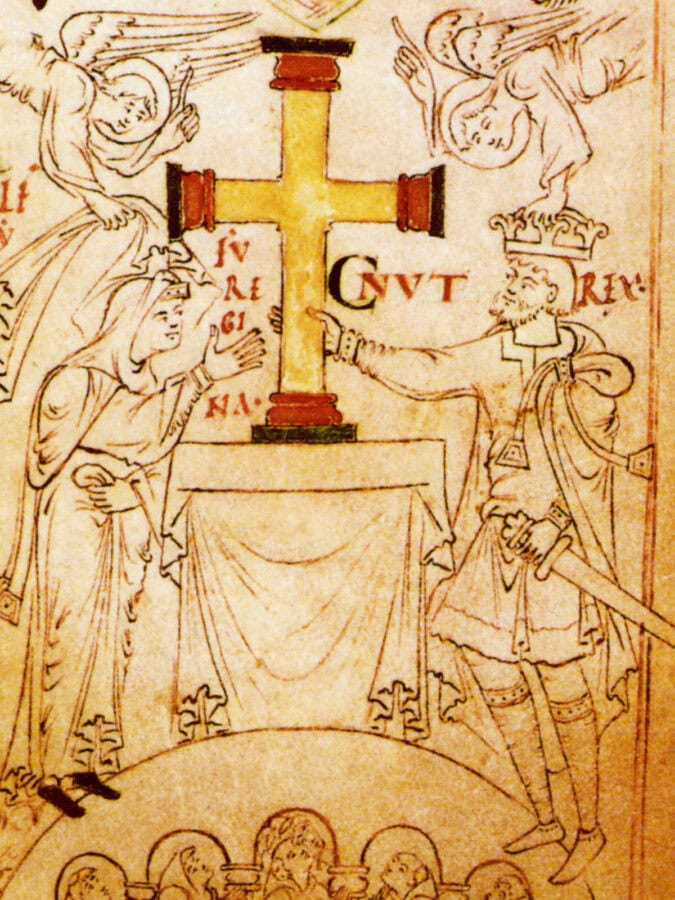
When Æthelred died in 1016 and Cnut secured the English throne, Emma did something remarkable: she married the Danish king who had replaced her husband’s dynasty.
The queen of the defeated royal house had found a place beside its conqueror.
That second marriage placed Emma in an extraordinary dynastic position. Her sons Edward and Alfred, from her marriage to Æthelred, belonged to the old royal house descended from Alfred the Great. Her son Harthacnut, born to Cnut, belonged to the new Anglo-Danish ruling dynasty.
Emma stood between them.
Harthacnut: Read the story of Harthacnut, son of Cnut and Emma of Normandy, and his brief reign as King of England.
A Queen Mother and the Struggle for the Throne
After Cnut died in 1035, Emma’s position as queen mother became increasingly important.
As we have seen, she was not the only mother with a son’s future tied to the English throne. Ælfgifu of Northampton stood behind Harold Harefoot, while Emma’s dynastic interests centred upon Harthacnut, her son by Cnut.
For Emma, motherhood had become inseparable from politics.
Her influence did not prevent Harold from gaining control of England. By 1037, Emma had been forced into exile, while Harthacnut remained in Denmark.
But dynastic fortunes could change quickly.
Harold died in 1040, Harthacnut became king, and Emma returned to England once more.
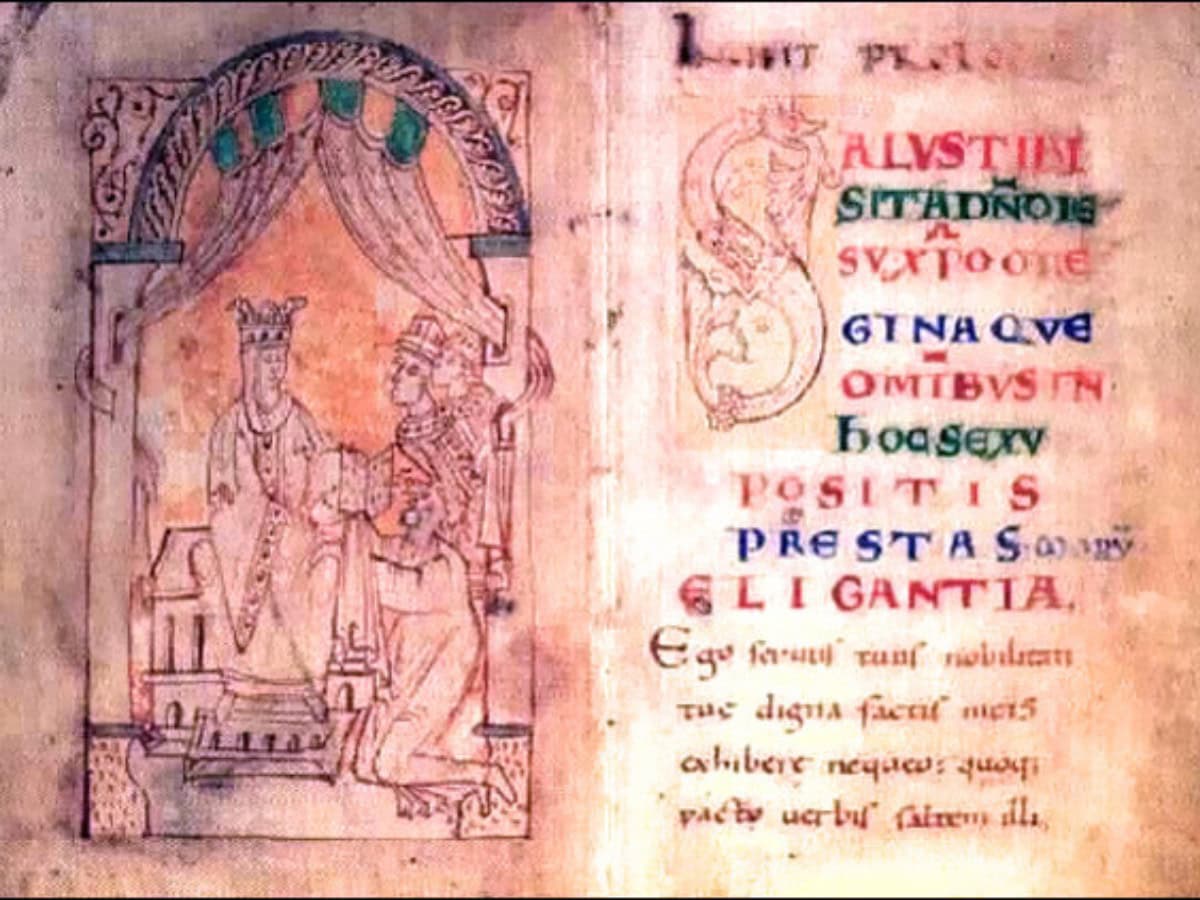
Around this period, she commissioned the Encomium Emmae Reginae — In Praise of Queen Emma. It was hardly an impartial account of recent history. The work presented events in ways that supported Emma and promoted the legitimacy of her children.
And that makes it particularly revealing.
Emma was not simply living through the struggle for the throne. She was helping shape the story of who had the right to occupy it.
Then, in 1042, Harthacnut died without an heir.
The crown passed to Edward the Confessor, Emma’s surviving son by Æthelred.
One son from her marriage to Cnut had become king. Now a son from her marriage to Æthelred followed him.
We should be careful not to imagine Emma quietly planning every turn across four turbulent decades. The evidence does not allow us to go that far. But she repeatedly used the advantages available to her — queenship, wealth, political connections and motherhood — to protect her position and promote her family’s dynastic interests.
Surviving evidence also shows Emma intervening with Cnut on behalf of the archbishop of Canterbury, giving us a glimpse of the influence she could exercise while she was queen.
Among the Anglo-Saxon queens in our story, Emma occupied an exceptional position. She had been queen to rulers from two competing dynasties and became mother to kings from both.
Yet Edward’s accession did not return Emma permanently to the centre of power. Their relationship was complicated, and her influence declined during his reign.
Another family was now rising around the throne.
The Godwins.
And at Edward’s side stood Edith of Wessex — his queen, Earl Godwin’s daughter and sister of the man who would become England’s last Anglo-Saxon king.
Read the full story: Emma of Normandy: Queen of Two Dynasties and Mother of Two Kings
Were Emma and Ælfgifu Rivals?
Emma and Ælfgifu of Northampton were both connected to Cnut, and both were mothers of sons who became kings of England. After Cnut’s death, their dynastic interests lay on opposing sides: Ælfgifu’s son Harold Harefoot gained the throne first, followed by Emma’s son Harthacnut.
The Encomium Emmae Reginae, presents Ælfgifu and Harold unfavourably while promoting Emma and her children. That gives us evidence of competing dynastic narratives, but not necessarily of a personal feud between the two women.
What we can see is something central to the story of women in Anglo-Saxon England: motherhood could place women remarkably close to the struggle for succession — and in this case, sons of both women became kings.
Edith of Wessex: Queen at the Heart of the Godwin Dynasty
When Edith of Wessex married Edward the Confessor in 1045, another powerful family moved closer to the Anglo-Saxon throne.
Edith was the daughter of Godwin, Earl of Wessex, one of the most powerful men in England, and Gytha Thorkelsdóttir, who came from a prominent Danish family. Among Edith’s brothers were Harold and Tostig Godwinson.
Marriage now placed her between two worlds.
She was Edward’s queen. But she was also a Godwin.
And as the relationship between the king and her family changed, Edith would discover both the advantages and the limits of standing so close to power.
Edward the Confessor’s Queen
Edith had been well educated, probably at Wilton, before her marriage to Edward. As queen, she held extensive estates, witnessed royal charters and became an important patron in her own right.
Her wealth matters to our story.
Land gave an Anglo-Saxon queen more than status. It supported her household and patronage and gave her resources that did not depend entirely upon the king standing beside her.
Edith also appears to have understood the value of how a royal family was remembered. She is closely associated with the commissioning of the Vita Ædwardi Regis, the Life of King Edward, a work that celebrated her husband while also presenting the Godwin family from a sympathetic perspective.
There is an interesting echo here of Emma and her Encomium. Once again, a queen close to the English throne was not simply appearing in someone else’s history. She was helping shape the story that would survive.
But Edith lacked something that had been central to the influence of both Ælfthryth and Emma.
She had no child.
A Queen Without an Heir
Edward and Edith’s marriage remained childless.
Later writers tried to explain why, including traditions that Edward chose a celibate marriage. We cannot know with certainty what happened within their private lives.
For the throne, however, the consequence was anything but private.
There was no son of Edward and Edith waiting to succeed his father.
Edith therefore could not exercise power in quite the same way as the royal mothers who came before her. There was no child’s claim for her to protect or promote.
Instead, her position rested on queenship, land, wealth and family.
And that family was becoming extraordinarily powerful.
The Godwins held extensive territories and influence across England. Edith’s marriage had brought them into the king’s immediate family, but closeness did not mean harmony.
In 1051, the relationship between Edward and Earl Godwin finally broke apart.
Edward the Confessor: Discover the story of Edward the Confessor, whose childless reign set the stage for the succession crisis of 1066.
The Godwins, Exile and the Return to Power
The crisis forced Godwin and his sons from England.
Edith paid a price too.
She was removed from Edward’s court and sent away, probably to the royal nunnery at Wherwell, although the sources differ over precisely where she stayed.
It was a striking reversal.
The woman who had sat beside Edward as queen was separated from him when her family fell from favour. Whatever personal authority Edith had acquired, her position remained closely tied to the fortunes of the Godwins.
But their exile lasted barely a year.
In 1052, Godwin and his sons returned with armed support. Edward was forced into a settlement, the family’s lands and positions were restored — and Edith returned to her place beside the king.
When Earl Godwin died the following year, Harold Godwinson inherited the earldom of Wessex. Over the years that followed, Harold became increasingly important in the government and defence of England.
Edith now occupied an extraordinary place within the royal family.
She was wife to the king and sister to the most powerful earl in the kingdom.
Yet Edward still had no son.
As the king grew older, that absence mattered more and more. The question was no longer simply whether the Godwins could remain close to the throne.
It was becoming a question of who would sit on it next.
Gytha Thorkelsdóttir: The Mother Behind the Godwin Dynasty
Behind Edith and her brothers stood their mother, Gytha Thorkelsdóttir.
Gytha was not a queen. Yet through marriage and motherhood she stood at the centre of one of the most powerful families in late Anglo-Saxon England.
She was the wife of Earl Godwin and mother of children whose lives became inseparable from the fate of the English crown: Edith became queen, Harold became king, and Tostig would play a fateful part in the events of 1066.
Gytha gives us another glimpse of power behind the throne. Hers was rooted not in queenship, but in aristocratic rank, wealth and family — a family whose rise would ultimately carry one of her sons to the crown.
By the closing days of Edward the Confessor’s reign, two of Gytha’s children stood extraordinarily close to the throne.
One was the queen beside it.
The other was about to become king.
The Succession Crisis of 1066: When Dynastic Power Reached Breaking Point
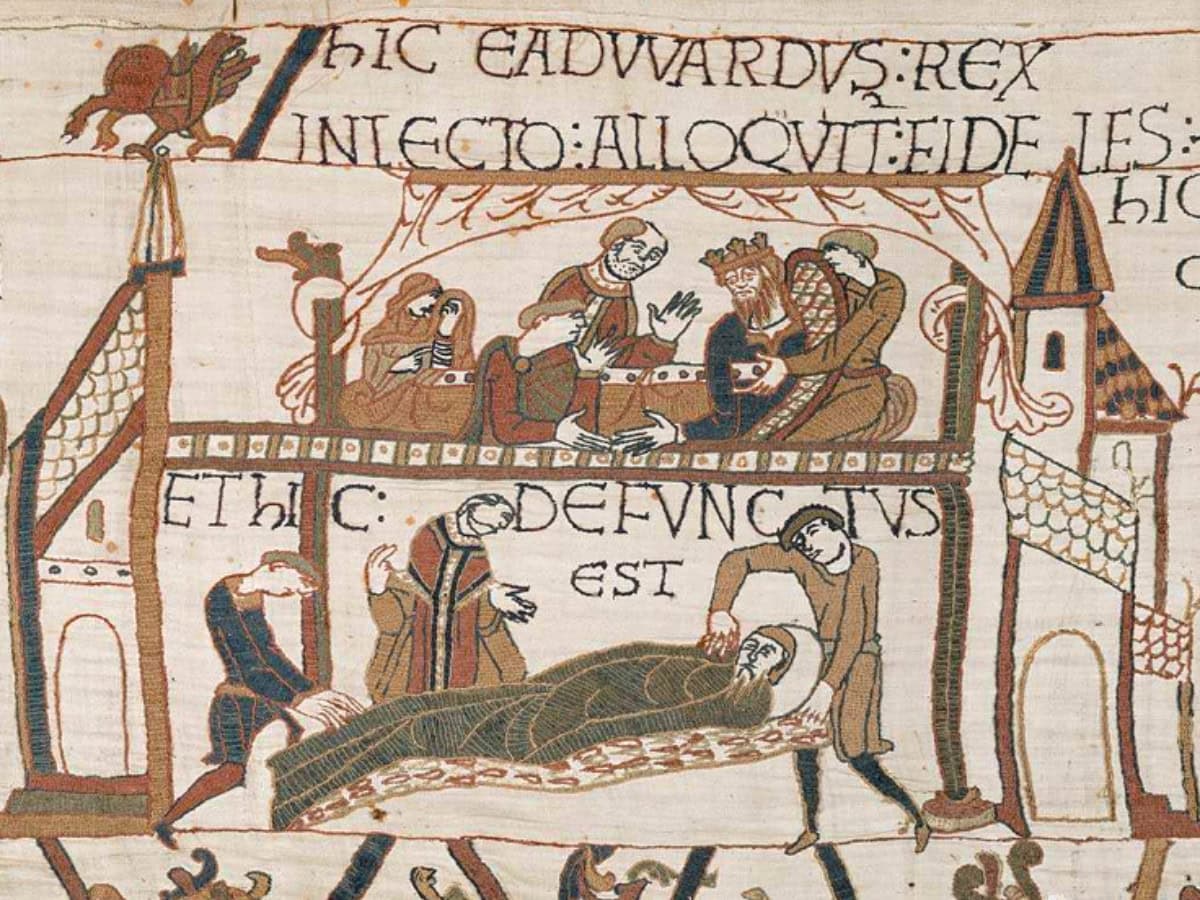
On 5 January 1066, Edward the Confessor died at Westminster.
He had ruled England for more than twenty-three years. But his marriage to Edith of Wessex had produced no children, and there was no son waiting to inherit the Anglo-Saxon throne.
That absence now became critical.
Harold Godwinson was not Edward’s son. Nor was he the direct dynastic heir of the royal house descended from Alfred the Great. But he was the most powerful earl in England, an experienced military leader and deeply involved in the government of the kingdom.
According to the Vita Ædwardi Regis, Edward entrusted Edith and the kingdom to Harold shortly before his death. The Anglo-Saxon Chronicle also records that Harold succeeded according to Edward’s wishes.
England’s leading nobles accepted Harold as king.
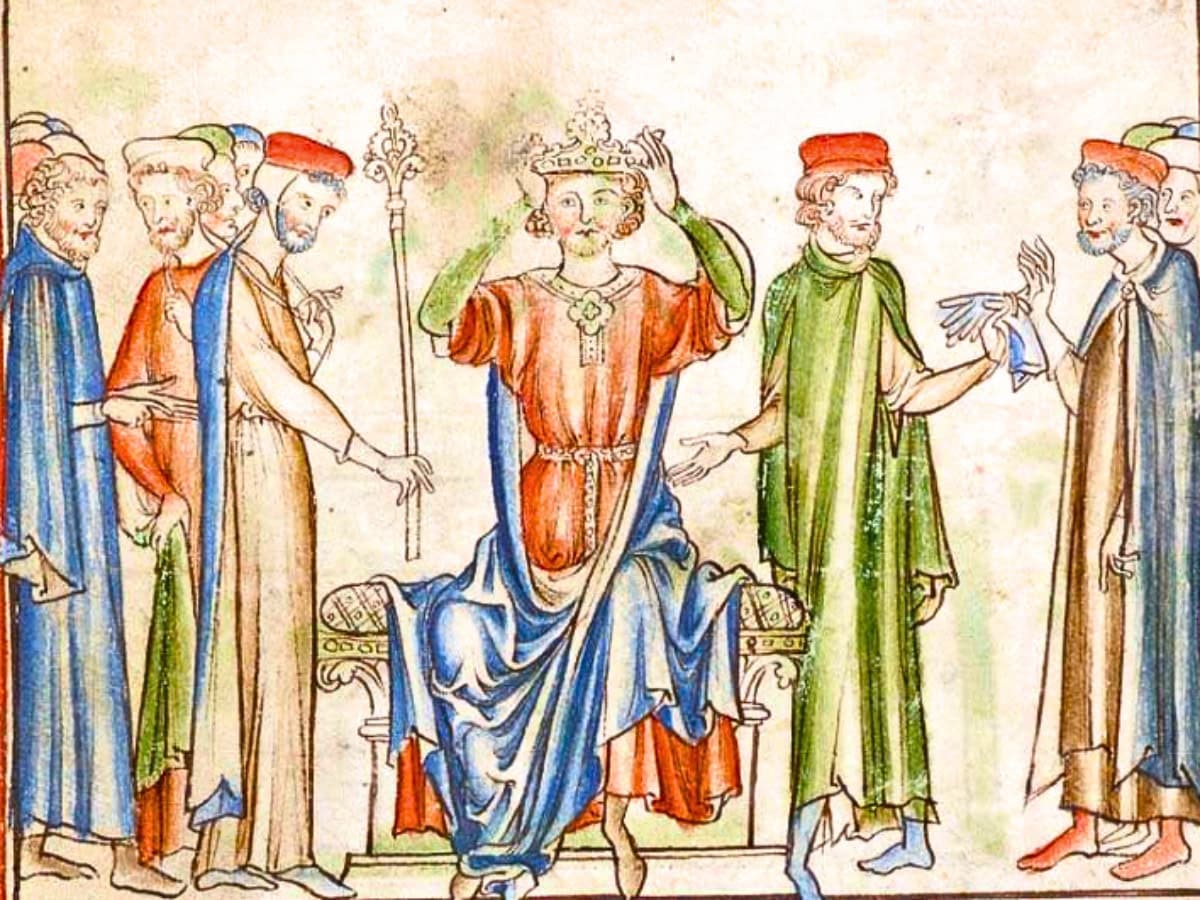
On 6 January 1066, Harold Godwinson was crowned.
For Edith of Wessex, the change was extraordinary. Within a matter of days, she had gone from being the wife of one English king to the sister of another.
But Harold’s succession did not settle the question of who had the right to rule England.
William, Duke of Normandy, claimed that Edward had previously promised him the throne and that Harold had sworn to support his claim. Across the North Sea, Harald Hardrada of Norway pursued another claim to the English crown.
And then there was Edith’s own brother, Tostig Godwinson.
Once Earl of Northumbria, Tostig had been driven into exile after a rebellion against his rule. In 1066, he joined Hardrada in an invasion of England — placing one of Gytha’s sons against another.
The struggle for the throne had become a struggle within the family itself.
Harold defeated Hardrada and Tostig at the Battle of Stamford Bridge on 25 September 1066. Both men were killed.
But there was little time to celebrate.
Three days later, William landed in Sussex.
Harold marched his army south, and on 14 October 1066, the English and Norman forces met near Hastings.
By the end of the battle, Harold Godwinson was dead.
The last Anglo-Saxon king of England had ruled for little more than nine months.
For the women whose lives had been tied to the throne, 1066 was more than a change of ruler. Edith of Wessex had lost her husband and her brother within the same year. Gytha had lost sons at both Stamford Bridge and Hastings. The family that had risen so dramatically under Earl Godwin and carried one of his sons to the crown was collapsing around them.
Yet one of the most haunting stories associated with Harold’s death brings another woman into our history.
She was also called Edith.
Not Harold’s sister, the queen.
But Edith the Fair — Edith Swannesha — Harold’s long-term companion and the mother of several of his children.
Edith the Fair and the Last Anglo-Saxon King
Harold Godwinson and Edith Swannesha
Of all the women in this story, Edith the Fair is perhaps the most difficult to recover from the historical record.
She is often known as Edith Swannesha or Edith Swan-neck, a name attached to her in later sources.
What survives suggests that Edith was Harold Godwinson’s long-term companion and the mother of several of his children. Their relationship stretched across many years before Harold’s brief reign as England’s last Anglo-Saxon king.
Exactly how their relationship would have been understood in eleventh-century England is less straightforward. Later church law and modern ideas about marriage cannot simply be imposed upon relationships formed during this period.
What matters for our story is that Edith belonged to Harold’s personal world long before the crown came to him.
Yet when Harold became king, another woman was his wife.
Who Was Harold Godwinson’s Queen?
By the beginning of Harold’s reign, he had married Ealdgyth, widow of the Welsh ruler Gruffydd ap Llywelyn and sister of the powerful northern earls Edwin and Morcar.
The marriage was politically important, strengthening Harold’s connections with two of the leading families of Mercia and Northumbria.
When Harold became king in January 1066, Ealdgyth became Queen of England, although very little is known about her short time as queen and there is no secure evidence that she was formally crowned.
Her time as Harold’s queen was extraordinarily short. On 14 October 1066, less than ten months after taking the throne, Harold was killed at the Battle of Hastings.
The Story of Harold’s Body After Hastings
What happened to Harold’s body after the Battle of Hastings has been debated for centuries.
Contemporary and near-contemporary accounts do not give us one clear version of how his remains were found or where they were first buried.
But a later tradition brings Edith the Fair back into his story.
The account appears in the twelfth-century Waltham Chronicle, written long after the battle. According to this tradition, Harold’s body had been so badly wounded that it could not easily be recognised.
Edith was brought to identify him.
She is said to have recognised Harold by marks on his body known intimately to her.
It is one of the most haunting stories to emerge from the Norman Conquest.
It may also be just that — a story.
We cannot know whether Edith really walked among the dead at Hastings searching for the man with whom she had shared so much of her life. The surviving account was written generations later, and earlier sources tell different stories about Harold’s remains.
But the tradition endured.
And perhaps that is why Edith the Fair has a place among the women surrounding the Anglo-Saxon throne.
She was not a ruler like Æthelflæd. She was not a crowned queen like Ælfthryth, nor a queen mother navigating rival dynastic interests like Emma.
Her importance here is more human.
At the end of a story dominated by kingdoms, succession and conquest, later generations remembered a woman who knew the fallen king not by his crown, but by the man beneath it.
What the Women Behind the Anglo-Saxon Throne Reveal About Power
Across almost two centuries, the position of women in Anglo-Saxon England changed alongside the kingdom itself.
There was no single path to influence.
For Æthelflæd, royal birth and marriage placed her within two ruling houses, but circumstances allowed her to exercise something far more unusual: direct authority over Mercia.
Ælfthryth stood closer to the emerging English monarchy. She was crowned and anointed beside Edgar, possessed considerable wealth and became mother to a future king. Her story also reveals how easily a politically important woman could acquire a darker reputation when succession turned violent.
Ælfgifu of Northampton followed another path. Her relationship with Cnut and her role as the mother of Harold Harefoot placed her at the heart of competing claims after Cnut’s death. She had exercised authority in Norway, and her political importance continued when her son secured the English throne.
Emma of Normandy crossed dynastic boundaries altogether. Wife to an Anglo-Saxon king and then a Danish king, she survived regime change and promoted the interests and legitimacy of her children. Two of her sons would become kings of England.
Edith of Wessex had no child through whom to secure her position. Her influence rested instead upon queenship, property, patronage and the extraordinary power of the Godwin family.
Around them stood women such as Gytha Thorkelsdóttir, whose influence was rooted in family and aristocratic connections, and Edith the Fair, whose surviving story takes us into the private world behind kingship.
Female power had not disappeared as England developed.
Its form had changed.
It could come through land and wealth. Through marriage or motherhood. Through family networks, patronage and proximity to the king. Occasionally, as Æthelflæd demonstrated, a woman could rule in her own right.
The structures surrounding the Anglo-Saxon throne remained overwhelmingly male. Yet the women closest to those structures were never simply watching events unfold.
They were part of them.
1066: The End of the Anglo-Saxon Throne — But Not the Women Behind It
The Battle of Hastings ended Harold Godwinson’s reign.
It did not immediately end the stories of the women around him.
Edith of Wessex survived both her husband and her brother. As Edward the Confessor’s widow, she retained considerable wealth and status after the Norman Conquest and remained an important royal widow until her death in 1075.
Her mother, Gytha Thorkelsdóttir, experienced the Conquest very differently.
Two of her sons had died within weeks of one another in 1066 — Tostig at Stamford Bridge and Harold at Hastings. In the years that followed, Gytha was associated with resistance to Norman rule in the West Country, particularly around Exeter. She eventually left England.
Their survival is a reminder that historical periods rarely end as neatly as the dates we give them.
England had a new king and a new ruling dynasty. William’s victory brought profound changes in landholding, aristocratic power and England’s relationship with continental Europe.
But the world that existed before Hastings did not simply vanish overnight.
Some of the women who had lived closest to the Anglo-Saxon throne survived long enough to see what replaced it.
And behind the familiar succession of kings, their stories leave us with another history: of marriages that created alliances, mothers who defended dynasties, queens who controlled estates and families that competed for influence.
There are quieter human stories too — including the later tradition of Edith the Fair searching for Harold among the dead at Hastings.
By the evening of 14 October 1066, the political world these women had inhabited was changing beyond recognition.
The Anglo-Saxon throne had come to an end.
The story of England had not.
Continue Exploring Britain’s Royal History
If the remarkable women behind the Anglo-Saxon throne have drawn you deeper into Britain’s royal past, continue through the kings, queens, royal families and rival dynasties that shaped the centuries that followed. From Anglo-Saxon England and the Norman Conquest to Tudor history, royal succession and the stories held within the Tower of London, these related articles take you further into the people, places and events behind Britain’s remarkable royal history.
Resources and Further Reading
The stories of women in Anglo-Saxon England survive through medieval chronicles, royal charters, manuscripts and later accounts, although the evidence is often fragmentary and shaped by the writers who recorded it. Modern historians continue to examine these sources to understand the roles of queens, royal mothers, noblewomen and female rulers, and the different ways women could exercise power and influence around the Anglo-Saxon throne.


