
Harthacnut: The Last Danish King of England
When Harthacnut died suddenly in 1042, Danish rule in England died with him.
He had been King of England for barely two years. Yet Harthacnut’s death brought to a close the Danish royal dynasty his grandfather, Sweyn Forkbeard, had fought to establish and his father, Cnut the Great, had turned into a powerful North Sea kingdom.
Harthacnut inherited an impressive royal legacy, but not an easy one. Cnut’s death in 1035 left competing sons, divided loyalties and kingdoms separated by the North Sea. While Harthacnut remained occupied with his position in Denmark, his half-brother Harold Harefoot gained control of England.
By the time Harthacnut finally became King of England in 1040, the kingdom he inherited was very different from the one his father had ruled. His reign would prove short, costly and unpopular.
So, who was Harthacnut, England’s last Danish king? We’ll follow his complicated path to the throne, the troubles of his brief reign and his sudden death — and see why 1042 marked the end of an extraordinary chapter in England’s royal story.

Disclosure
Timeless Travel Steps is supported by our readers. If you purchase through an affiliate link on my site, at no cost to you, I may earn a commission from qualifying purchases. Additionally, Timeless Travel Steps is a participant in the Amazon Services LLC Associates Program. As an Amazon Associate, I earn from qualifying purchases at no extra cost to you. Please read our Disclosure for further information.
Who Was Harthacnut?
Harthacnut was the son of Cnut the Great and Emma of Normandy. He succeeded his father as King of Denmark in 1035 and became King of England in 1040, following the death of his half-brother Harold Harefoot. His own death in 1042 made him the last Danish king of England.
Born around 1018 or 1019, Harthacnut belonged to two powerful royal worlds. Through his father, Cnut, he was part of the Danish dynasty that had conquered England. Through his mother, Emma, he was connected to England’s earlier royal dynasty and to the ruling family of Normandy.
Harthacnut spent much of his youth in Denmark. During Cnut’s reign, he was placed there to rule on his father’s behalf, giving the young prince an important role within Cnut’s Scandinavian realm.
When Cnut died in 1035, Harthacnut succeeded him in Denmark. Claiming his father’s English crown, however, proved far more difficult.
His responsibilities and difficulties in Scandinavia kept him away from England while another of Cnut’s sons, Harold Harefoot, strengthened his position at home.
Harthacnut at a Glance
- Born: c.1018/19
- Father: Cnut the Great
- Mother: Emma of Normandy
- King of Denmark: 1035–1042
- King of England: 1040–1042
- Predecessor: Harold Harefoot
- Successor: Edward the Confessor
- Died: 8 June 1042
- Place of death: Lambeth, England
- Age at death: around 23–24
- Children: none known
- Dynasty: House of Denmark
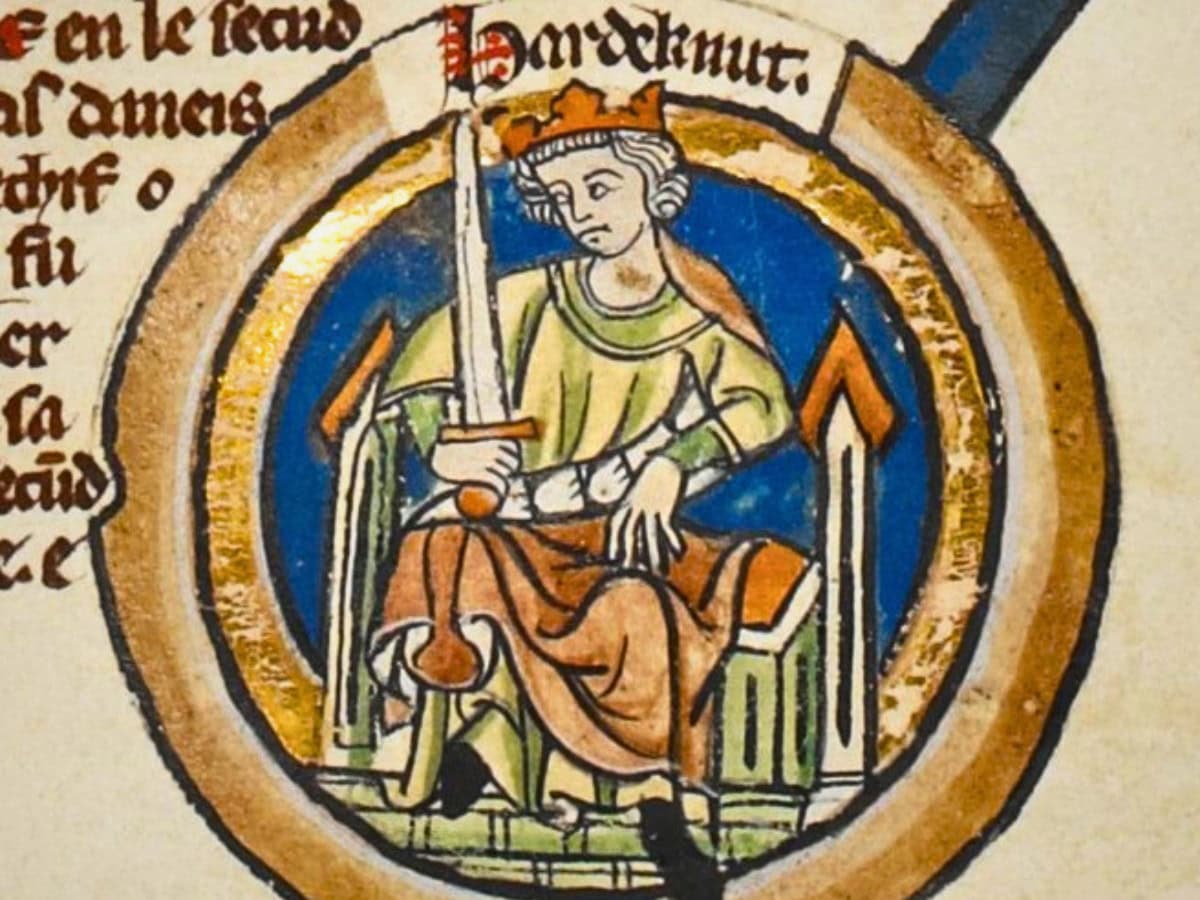
Why Was Harthacnut’s Claim to England Contested?
When Cnut died in 1035, Harthacnut had a strong claim to his father’s English crown. He was Cnut’s son by Emma of Normandy, Cnut’s queen, but succession was not automatic. Another of Cnut’s sons, Harold Harefoot, was already in England and had powerful supporters of his own.
Cnut’s Death and a Divided Succession
When Cnut the Great died on 12 November 1035, he left behind an extraordinary legacy. He had ruled England for almost twenty years and built a realm stretching across the North Sea. Yet the king who had successfully held several kingdoms together left no simple path for one son to inherit them all.
Harthacnut’s position as the son of Cnut and Queen Emma gave him a powerful claim to England. But royal succession in the eleventh century was not governed by strict primogeniture. Royal blood mattered, but so did political support, military strength and a claimant’s ability to secure the kingdom.
And Harthacnut had a problem.
He was in Denmark when his father died. Norway had broken away from Cnut’s wider Scandinavian realm, and relations with its young king, Magnus the Good, demanded Harthacnut’s attention. Leaving Denmark to pursue the English crown could therefore threaten his position closer to home.
Meanwhile, his older half-brother Harold Harefoot, another of Cnut’s sons, was in England and gathering support.
Cnut had held his kingdoms together through his own authority. After his death, competing interests began to pull his North Sea realm apart — and Harthacnut could not be everywhere at once.
Why Did Harold Harefoot Rule England Before Harthacnut?
Harold Harefoot gained power in England after Cnut’s death because Harthacnut remained in Denmark, while Harold was already in England with powerful supporters of his own. What began as a disputed succession eventually ended with Harold being recognised as king throughout England by 1037.
The Disputed Settlement After Cnut’s Death
After Cnut died in 1035, England’s leading men gathered at Oxford to decide how the kingdom should be governed. The Anglo-Saxon Chronicle records disagreement over the succession, with Earl Godwine and leading men of Wessex supporting Harthacnut, while Harold found considerable support elsewhere.
A compromise followed. Harold was chosen to exercise authority in England, while Emma of Normandy remained at Winchester with Harthacnut’s household. The surviving accounts differ in some details, but one thing was clear: Harthacnut’s claim had not disappeared, and England’s political settlement remained unsettled.
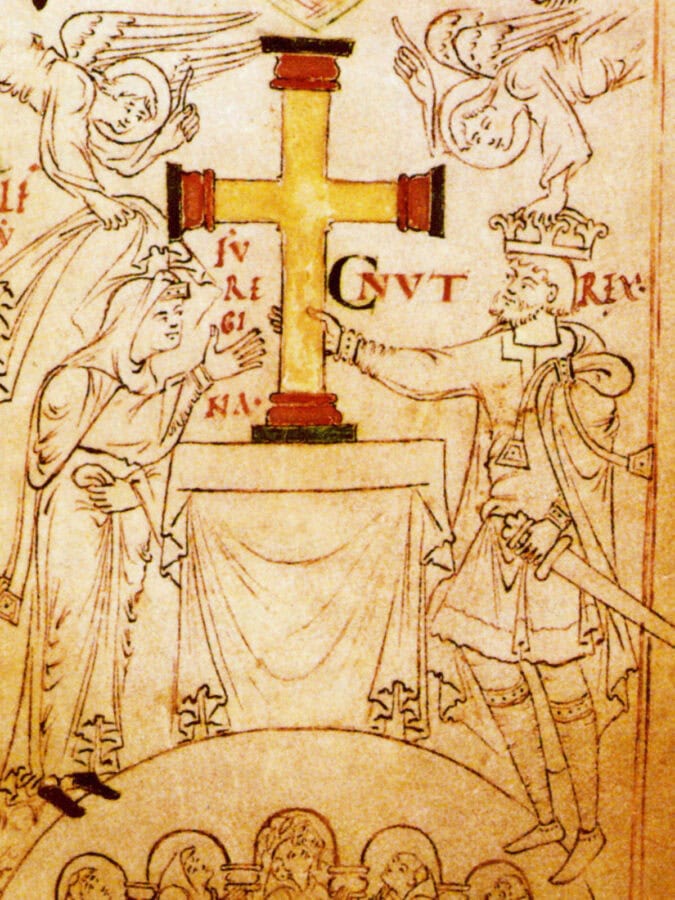
Harold Harefoot Takes the English Crown
Harthacnut’s continued absence gradually worked in Harold’s favour.
The struggle took a darker turn in 1036 when Alfred Ætheling, Emma’s son by Æthelred the Unready and therefore Harthacnut’s maternal half-brother, returned to England. Alfred was seized, blinded and later died from his injuries. Medieval sources disagree over responsibility, so the circumstances surrounding his capture and death remain disputed.
By 1037, Harold’s position had strengthened enough for him to be recognised as king throughout England. Emma could no longer maintain Harthacnut’s cause from Winchester and went into exile in Flanders.
For the moment, Harthacnut had lost the English crown without ever reaching England to fight for it.
Then, in March 1040, Harold unexpectedly died.

How Did Harthacnut Become King of England?
Harthacnut became King of England after Harold Harefoot died at Oxford on 17 March 1040. With his half-brother gone, the English sent for Harthacnut, who was then with his mother, Emma of Normandy, in Bruges. He arrived at Sandwich on 17 June 1040 and was accepted as king.
Harthacnut did not come alone. According to the Anglo-Saxon Chronicle, he arrived with a fleet of sixty ships and was received by both the English and the Danes.
It was a very different accession from those of his father and grandfather. There was no rival king left to defeat and no great battle for the crown. Harold’s death had removed the man who had kept Harthacnut from the English throne for several years.
But Harthacnut had not forgotten their bitter rivalry.
Harthacnut’s Treatment of Harold Harefoot
Harold had been buried at Westminster, but Harthacnut ordered his half-brother’s body to be exhumed. The Anglo-Saxon Chronicle records that it was then thrown into a ditch.
Later medieval tradition says Harold’s remains were recovered and reburied at St Clement Danes in London, although his final resting place has never been securely identified. Medieval writers added more dramatic details to the story, but these should be treated cautiously.
The Chronicle’s earlier account is stark enough and reveals just how bitter Cnut’s disputed succession had become.
Unlike his father and grandfather, Harthacnut did not have to conquer England to become its king. Sweyn Forkbeard and Cnut had fought for the English crown. Harthacnut finally gained it when his rival died.
What Was Harthacnut Like as King?
Harthacnut’s reign in England was brief and troubled. He arrived with the military strength to secure his position, but maintaining that strength came at a considerable cost. Heavy taxation quickly damaged his popularity, while his harsh response to resistance at Worcester left a darker mark on his two years as king.
A King Who Needed an Expensive Fleet
Harthacnut had arrived in England with around sixty ships, but keeping a large fleet in royal service was expensive. The Anglo-Saxon Chronicle records that a tax was imposed to support 62 ships, at a rate of eight marks for each steersman.
The burden did not end there. The Chronicle records a payment of £21,099 to the army, followed by another £11,048 for 32 ships. These were enormous sums for eleventh-century England.
The fleet may have strengthened Harthacnut’s position, but paying for it came at a political price. The Chronicle, openly hostile to his government, suggests that support for the new king quickly faded as the financial burden became clear.
The Worcester Tax Collectors and Harthacnut’s Revenge
That resentment turned violent at Worcester in 1041.
Two members of Harthacnut’s household were collecting the heavy tax when townspeople killed them inside the minster. Harthacnut responded with severity.
According to the Anglo-Saxon Chronicle, the king ordered Worcestershire to be laid waste in retaliation. Later accounts describe royal forces burning and plundering Worcester, while many inhabitants escaped to an island in the River Severn.
The episode helps explain Harthacnut’s troubled reputation. His taxes were deeply resented, but his willingness to punish resistance so severely made matters worse.
For a king whose English reign lasted barely two years, it was a damaging legacy to leave behind.
Why Was Harthacnut Unpopular?
Harthacnut’s unpopularity was closely connected to the heavy taxation required to support his fleet and the harsh measures used against resistance during his short reign.
The enormous payments demanded from England placed an immediate burden on his subjects, while the violent events at Worcester further damaged his reputation.
His timing hardly helped. Harthacnut had finally gained the English crown after years of uncertainty, but he arrived with a large military force that had to be paid.
The Anglo-Saxon Chronicle records exceptionally heavy payments to support his ships and army. It also describes the period as a difficult one, marked by poor harvests and the loss of livestock.
For ordinary people already facing hardship, the king’s demands must have been particularly unwelcome.
Was Harthacnut Really a Cruel King?
It is easy to turn Harthacnut into a simple picture of a harsh Danish ruler. The surviving evidence deserves more care.
The Anglo-Saxon Chronicle gives us an unfavourable picture of his reign, particularly through its accounts of taxation and the retaliation against Worcestershire after two royal tax collectors were killed. Later medieval writers also helped cement his reputation for severity.
Yet Harthacnut had inherited an insecure political world. His father’s North Sea realm had fractured, his claim to England had been contested, and military strength remained central to maintaining royal authority.
None of that makes the punishment of Worcester less severe. But it does provide context.
Harthacnut’s reign was undoubtedly troubled, but reducing him to a brutal Danish king oversimplifies both the man and the difficult kingdom he inherited.
How Did Harthacnut Die?
Harthacnut died suddenly at Lambeth on 8 June 1042 while attending a wedding feast. According to the Anglo-Saxon Chronicle, the young king was standing at his drink when he suddenly fell to the ground in a violent convulsion. He never spoke again and died shortly afterwards, aged only around 23 or 24.
His death was as sudden as his reign had been short.
The Wedding Feast at Lambeth
Harthacnut was attending the wedding of Tovi the Proud, one of the leading Danish figures at his court, to Gytha, daughter of Osgod Clapa. The celebration was taking place at Lambeth, across the Thames from London.
During the feast, Harthacnut was standing and drinking when he suddenly collapsed. Those nearby caught hold of him, but the Anglo-Saxon Chronicle records that he never spoke afterwards.
The precise cause of Harthacnut’s death is unknown.
His sudden collapse has led to later suggestions of a stroke, seizure or another underlying illness. Drinking has also featured in retellings of his death, while some accounts have speculated about poisoning. None can be established from the surviving contemporary evidence.
What we do know is that Harthacnut died unexpectedly, still a young man and without children.
After all the struggles surrounding Cnut’s succession, the Danish dynasty in England had come to an abrupt end — not on a battlefield, but at a wedding feast in Lambeth.

Did Harthacnut Have a Wife or Children?
There is no known record of Harthacnut marrying, and he left no known children. When he died unexpectedly in June 1042, therefore, there was no son or daughter to continue his branch of Cnut’s royal dynasty.
Harthacnut was still a young man, probably only around 23 or 24, so his childlessness would not necessarily have seemed remarkable during his lifetime. His sudden death made it politically significant.
Without a direct heir, the English crown could not simply pass from Harthacnut to another generation of Cnut’s family. Instead, attention turned to a prince who was already in England and had his own powerful claim to the throne: Harthacnut’s maternal half-brother, Edward, son of Æthelred the Unready and Emma of Normandy.
Who Succeeded Harthacnut?
Harthacnut was succeeded by his maternal half-brother Edward the Confessor, son of Æthelred the Unready and Emma of Normandy. Edward became king in 1042, bringing the English crown back to the royal house that had ruled before the Danish conquest.
Edward’s succession was not entirely unexpected. He had spent many years in exile in Normandy, but in 1041 he returned to England during Harthacnut’s reign.
The Anglo-Saxon Chronicle records that Edward remained at his half-brother’s court and, in one version, that he was sworn as king while Harthacnut was still alive.
His position therefore appears to have been established before the king’s sudden death.
The Return of the House of Wessex
When Harthacnut died suddenly on 8 June 1042, he left no known children. Edward was already closely connected to the English court and had a strong claim through his father, Æthelred II.
The transition happened remarkably quickly. The Anglo-Saxon Chronicle records that Edward was chosen king in London before Harthacnut had even been buried. His coronation followed at Winchester on Easter Day, 3 April 1043.
There was another remarkable connection between the two kings: their mother.
Emma of Normandy had been queen consort to two English kings, Æthelred II and Cnut, and was now mother to both England’s last Danish king and the king who restored the House of Wessex.
With Edward’s accession, England’s old royal line had returned to the throne.

Why Did Danish Rule in England End?
Danish royal rule in England ended in 1042 because Harthacnut died without a direct heir and Edward the Confessor was chosen as king. Cnut’s remarkable North Sea realm had already begun to fragment after his death, and neither of his sons succeeded in preserving the political structure he had created.
That tells us something important about Cnut’s achievement.
His power had stretched across England and Scandinavia, but these territories had not become a single, permanently united kingdom. Much depended upon Cnut’s own authority and his ability to command support on both sides of the North Sea. After 1035, competing claims and political interests quickly pulled his realm apart.
Harold Harefoot died in 1040 without establishing a lasting dynasty. Two years later, Harthacnut also died young and without known children.
Edward the Confessor offered something different. He was the son of Æthelred II and belonged through his father to the old English royal house. He was also already known at Harthacnut’s court and was swiftly chosen as king after his half-brother’s death.
But 1042 was not a clean break between an entirely Danish past and an English future.
Danish kingship ended in 1042. Scandinavian influence in England did not.
Decades of settlement, political connections and cultural exchange had already woven the Scandinavian world deeply into England’s story.
Harthacnut’s Legacy: The Last Danish King of England
Harthacnut is remembered less for what he built than for what ended with him. His death in 1042 closed the brief period in which England had been ruled by the Danish dynasty established through the conquests of his grandfather and father.
Sweyn Forkbeard had fought his way to the English throne in 1013, although he lived only weeks after becoming king. Cnut the Great returned, conquered England and achieved something far more difficult: he learned how to rule the kingdom successfully.
Harthacnut inherited that extraordinary legacy, but not the political world that had made it possible.
His English reign lasted barely two years. Heavy taxation and the violence at Worcester damaged his reputation, while his sudden death left no direct heir to continue his branch of the dynasty.
Edward the Confessor’s accession restored the House of Wessex, but it did not bring England’s succession troubles to an end. Edward himself would die childless in January 1066, opening a far greater struggle for the English crown.
And perhaps that is where Harthacnut’s place in the story becomes clearest.
Harthacnut ruled England for barely two years, yet his death closed one chapter of English history and quietly opened another. Within twenty-four years, the question of who should rule England would once again bring armies across the sea.

Please take a moment…
Before you go, I’m excited to share some news—Timeless Travel Steps was awarded Best Slow Travel & Heritage Travel Blog 2026! Please take a moment to read our story and discover the passion behind our journeys.
For more travel insights and tips, consider following Georgina from Timeless Travel Steps on BlueSky, Instagram, Facebook and Pinterest. Don’t miss out on her latest adventures and expert advice. Subscribe to stay updated and join a community of fellow travel enthusiasts eager to explore the world.
Continue Exploring Britain’s Royal History
If you enjoyed the story of Harthacnut, you may also like these related guides exploring Britain’s monarchs, royal prisoners and the places where history unfolded.


