
Battle of Edington 878: How Alfred Returned to Defeat Guthrum
In the first weeks of 878, Alfred, King of Wessex, must have wondered how much longer his kingdom could survive.
A sudden Viking attack had driven him from Chippenham. Much of Wessex was overrun. Alfred retreated into the marshes of Somerset with only a small group of loyal followers. His four elder brothers were dead. Three had been kings before him. Now Alfred carried the burden of Wessex alone. For a family that had spent years resisting Viking armies, this was perilously close to disaster.
Yet only a few months later, the story had changed.
Alfred emerged from his refuge, summoned his fighting men and marched towards an army commanded by the Viking leader Guthrum. The confrontation between Alfred and Guthrum would culminate at the Battle of Edington in 878, traditionally associated with Edington in Wiltshire.
What followed became one of the defining moments of Alfred’s reign.
The victory helped preserve Wessex at a time when its future had been seriously threatened and ultimately forced Guthrum into a settlement with Alfred.
Perhaps most remarkable is the speed of Alfred’s recovery.
In January, he was a king driven into hiding.
By late spring, he had gathered an army and defeated the man who had come dangerously close to breaking his kingdom.
So how did Alfred turn the darkest moment of his reign into victory at Edington — and what happened when the fighting was over?
What Was the Battle of Edington?
The Battle of Edington was fought in the spring of 878, generally dated to May, between Alfred, King of Wessex, and a Viking army led by Guthrum.
It came at a critical moment in Alfred’s reign.
Earlier that year, Guthrum’s surprise attack on Chippenham had forced Alfred into the Somerset marshes. By spring, Alfred had regrouped and gathered fighting men from Somerset, Wiltshire and part of Hampshire.
The confrontation between Alfred and Guthrum came at Ethandun, traditionally identified as Edington in Wiltshire.
Alfred won a decisive victory. Guthrum’s army fled to its stronghold, but Alfred pursued and besieged them for around two weeks. Eventually, the Vikings sought peace, gave hostages and promised to leave Alfred’s kingdom. Guthrum also agreed to accept Christian baptism.
Edington did not end Viking power in England. Large areas remained under Scandinavian control.
But the victory secured something crucial: the survival of Wessex under Alfred.
For a king who had been forced into the marshes only months earlier, the change in fortune was remarkable.
Wessex on the Brink — What Happened Before Edington?
To understand why the Battle of Edington mattered so much, we need to return to the beginning of 878.
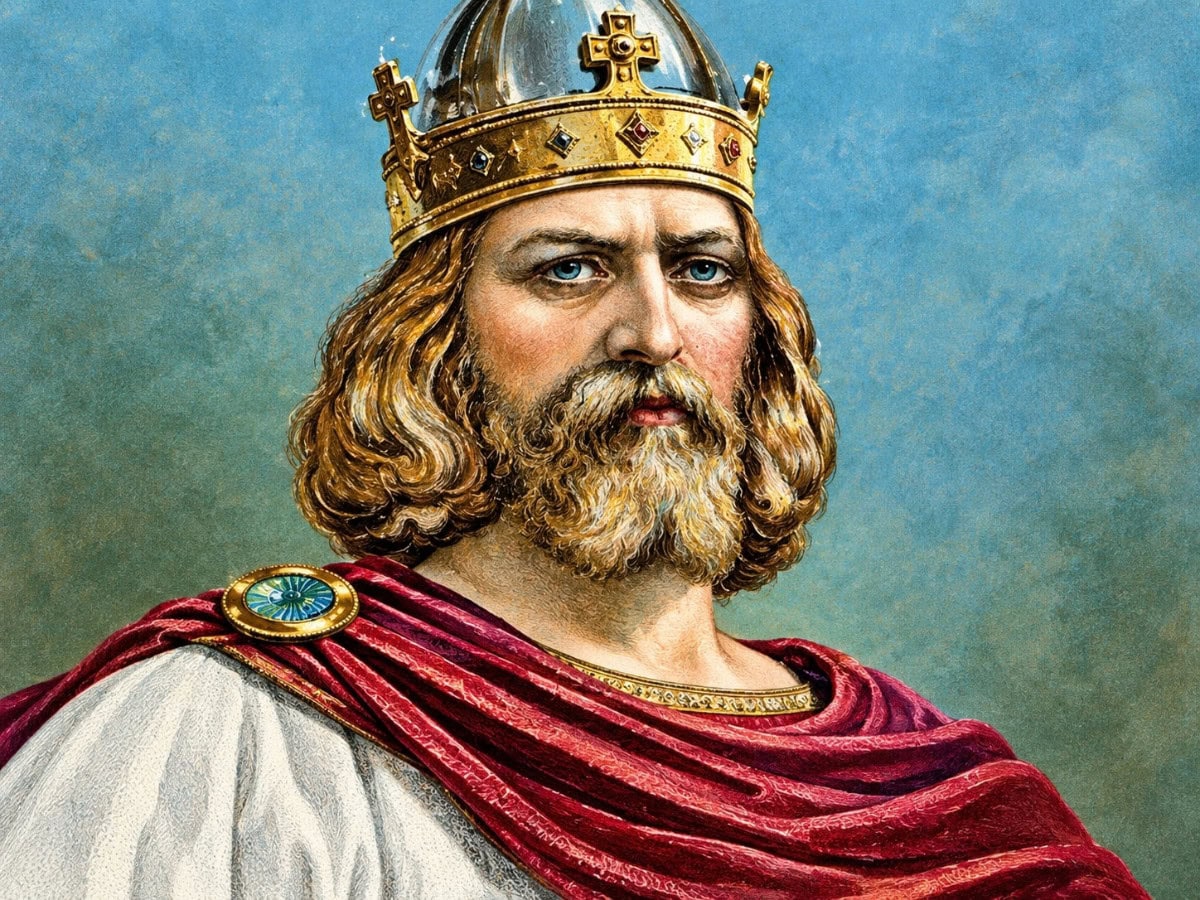
Alfred had been King of Wessex since 871. His reign had already been shaped by years of conflict with Viking armies.
By the time Guthrum threatened Wessex, the political landscape of [Anglo-Saxon England] had changed dramatically. Northumbria and East Anglia had fallen to Viking armies, while Mercia had been weakened and divided.
Wessex remained the major Anglo-Saxon kingdom still resisting.
Then came the attack that brought Alfred’s kingdom dangerously close to collapse.
Guthrum’s Surprise Attack on Chippenham
Soon after Twelfth Night in January 878, Guthrum’s Viking army made a sudden move against Chippenham in Wiltshire, an important royal centre in Wessex.
The timing was devastating.
Rather than waiting for the traditional campaigning season, Guthrum struck in the depths of winter and caught Alfred unprepared. The Anglo-Saxon Chronicle records that the Viking army occupied the land and drove many of its people overseas, while others submitted to them.
Alfred did neither.
He escaped with a small group of followers and was forced into the woods and marshes of Somerset.
For the King of Wessex, this was more than another setback in a long war.
His brothers were gone. Other Anglo-Saxon kingdoms had already fallen or been weakened by Viking conquest. Now Guthrum had established himself inside Alfred’s own kingdom and had come dangerously close to removing the resistance of Wessex altogether.
Yet Alfred was still free.
And while the king remained free, the struggle was not over.
Alfred Retreats to the Somerset Marshes
Alfred withdrew into the woods and marshlands of Somerset, where the wetlands offered some protection from Guthrum’s forces.
The Anglo-Saxon Chronicle allows us to follow what happened over the next few months.
By Easter, Alfred had established a fortified stronghold at Athelney, an island amid the Somerset marshes. From there, he and his small force continued to attack the Viking army, supported by men from Somerset.
Alfred, then, was not simply hiding.
Athelney became a base of resistance.
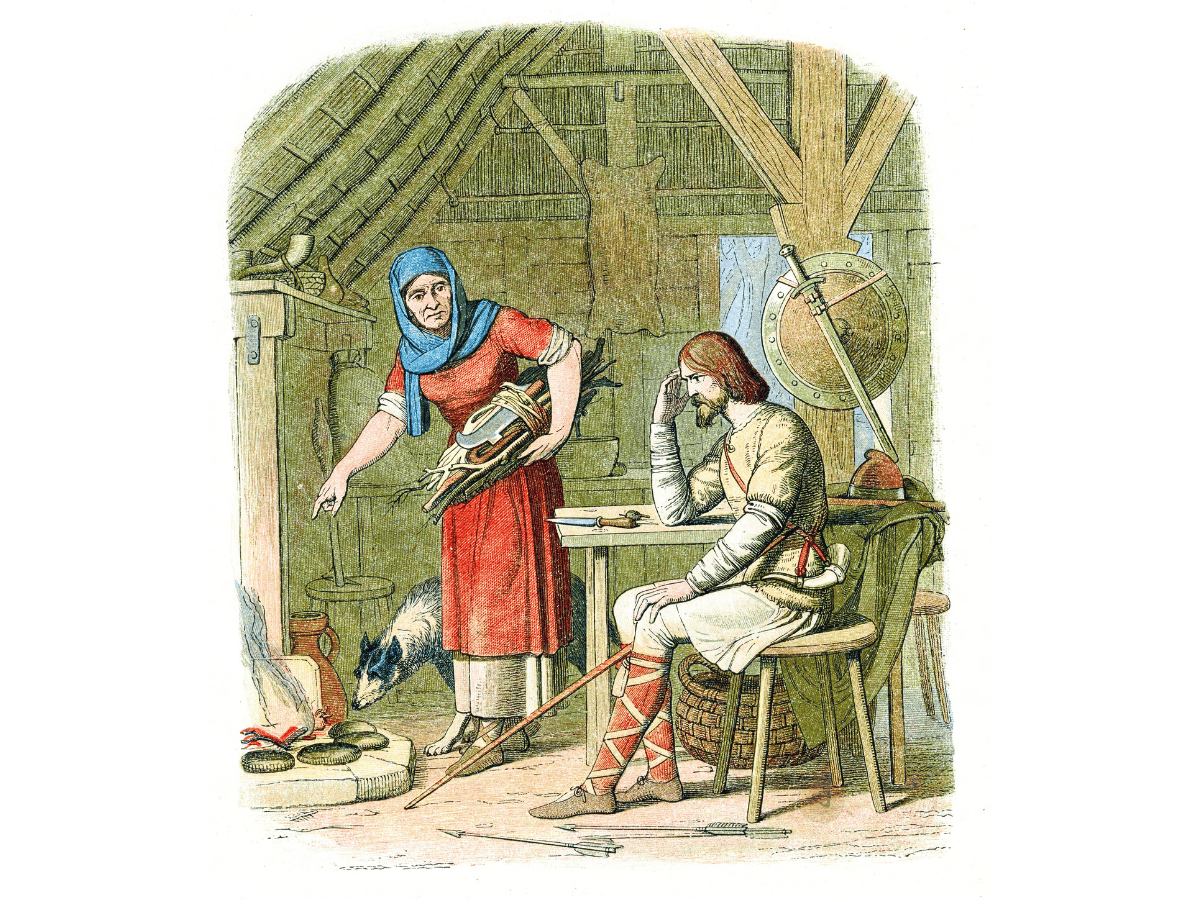
The famous story of Alfred and the burnt cakes was later set during this period, although it does not appear in Asser’s contemporary account of Alfred’s life. I tell that story more fully in my biography of Alfred the Great.
The historical events are compelling enough.
From the shock of Chippenham in January to his fortified base at Athelney around Easter, Alfred had survived several precarious months. Guthrum had taken the initiative, but he had not succeeded in eliminating the King of Wessex.
Then, in the seventh week after Easter, Alfred was ready to emerge from the marshes.
He rode to Egbert’s Stone, east of Selwood, where fighting men from Somerset, Wiltshire and part of Hampshire gathered to meet him.
The Anglo-Saxon Chronicle preserves one small but wonderfully human detail.
They rejoiced to see him.
Alfred was no longer simply a king surviving in the marshes. He had an army again.
And the road to Edington had begun.
What Happened at the Battle of Edington?
From Egbert’s Stone, Alfred marched his army towards Iley Oak, where they camped for the night. At dawn the following morning, they moved towards Edington.
There, Alfred and Guthrum finally met in battle.
Neither the Anglo-Saxon Chronicle nor Asser tells us how many men stood on either side. Alfred had summoned fighting men from Somerset, Wiltshire and part of Hampshire, but any precise number attached to his army — or Guthrum’s — remains an estimate.
What Asser does preserve is something more immediate.
Alfred vs Guthrum at Edington
The confrontation between Alfred vs Guthrum was no brief encounter.
Asser describes Alfred’s army fighting fiercely and persistently in a close shield-wall against Guthrum’s entire Viking force. The struggle continued for some time before the West Saxons finally broke their opponents.
His description is stark.
The Vikings were defeated with “great slaughter”.
The Anglo-Saxon Chronicle is less dramatic, simply recording that Alfred fought against the whole Viking army at Edington and put it to flight.
We do not know how long the battle lasted, how many men died, or precisely how Alfred broke Guthrum’s line.
But Asser’s account leaves little doubt that this was a hard and bloody encounter.
For Alfred’s men, many of whom had gathered around a king driven into the marshes only months earlier, Edington ended with the Viking army running from the battlefield.
Alfred’s Victory — and the Pursuit
Alfred did not allow Guthrum’s defeated army simply to withdraw.
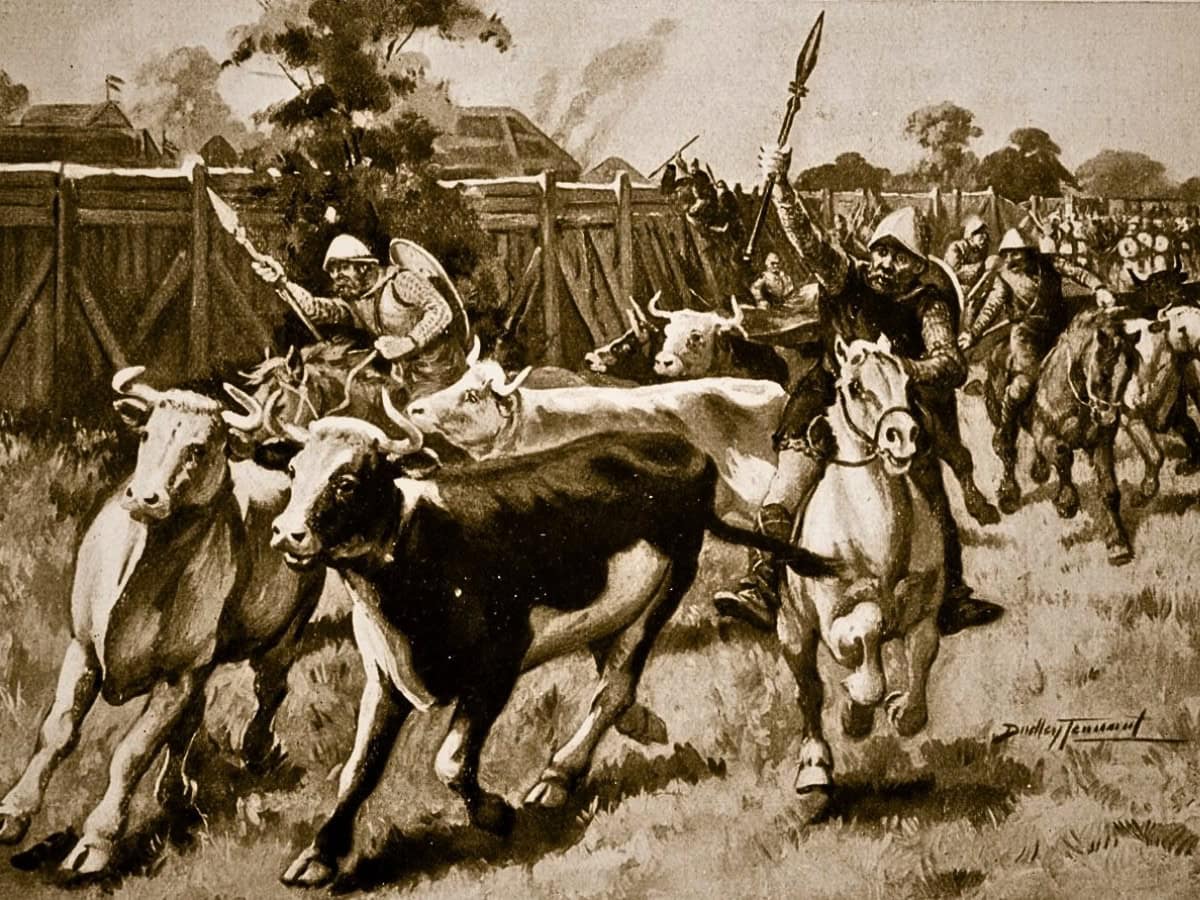
The West Saxons pursued the fleeing Vikings back to their stronghold. Asser describes men caught outside the fortification being killed, while horses, cattle and anything else of value were seized.
Then Alfred surrounded the stronghold.
For fourteen days, Guthrum and the survivors of his army remained trapped inside.
The ordeal became increasingly desperate. Asser describes them suffering from hunger, cold and fear, until eventually despair set in.
Only then did Guthrum seek peace.
The battle itself was over.
But Alfred’s victory at Edington was about to lead to one of the most remarkable encounters between an Anglo-Saxon king and a Viking leader.
Guthrum’s Surrender — What Happened After Edington?
After fourteen days under siege, Guthrum’s position had become desperate.
Asser describes the Vikings suffering from hunger, cold and fear before finally seeking peace. Guthrum’s army offered Alfred hostages and swore solemn oaths that they would leave his kingdom.
The terms reveal how completely the balance of power had shifted.
Earlier that year, Alfred had been driven from Chippenham with only a small group of followers. Now it was Guthrum who was trapped, surrounded and asking Alfred for peace.
The Vikings provided hostages, but Alfred did not give hostages in return. Asser regarded this as significant, remarking that they had never previously made peace on such terms.
There was another remarkable condition.
Guthrum agreed to become a Christian.
Guthrum’s Baptism — From Enemy to Alfred’s Godson
Several weeks after Edington, Guthrum travelled with around thirty leading men from his army to Aller in Somerset, close to Alfred’s former stronghold at Athelney.
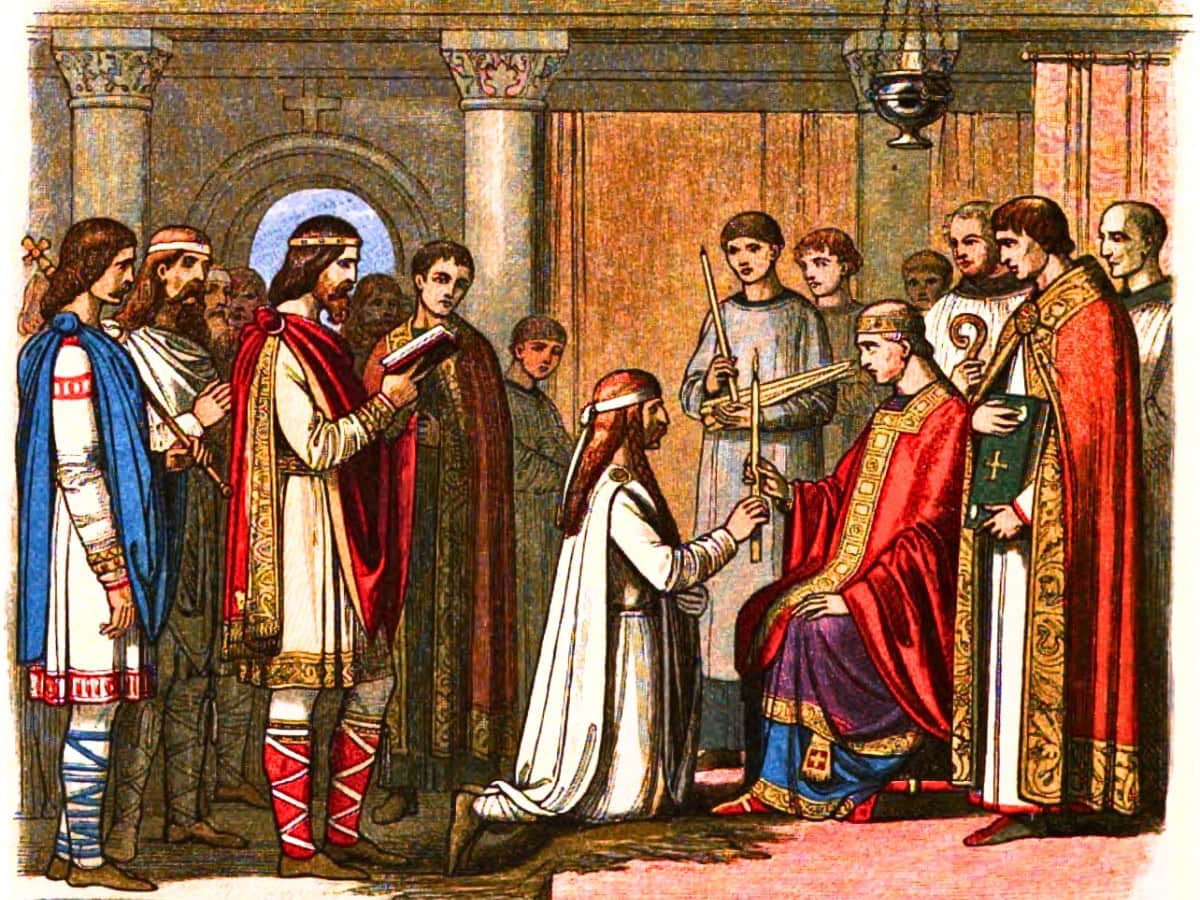
There, Guthrum was baptised.
Alfred himself stood as his sponsor, effectively becoming Guthrum’s spiritual father. Asser describes Alfred receiving the defeated Viking leader as an adopted son.
Guthrum took the Christian name Æthelstan.
The symbolism was extraordinary.
Only weeks earlier, Alfred and Guthrum had faced one another as enemies at Edington. Now Alfred stood beside the Viking leader at one of the most important ceremonies of the Christian faith.
Eight days later came the ceremony known as the chrism-loosing, when the baptismal headband or cloth associated with the rite was removed. This took place at Alfred’s royal estate at Wedmore.
Guthrum then remained with Alfred for twelve nights. The king honoured Guthrum and his companions with generous gifts before they eventually parted.
This was more than a defeated commander being allowed to leave.
Baptism created a new personal and religious relationship between Alfred and Guthrum, while the exchange of oaths and hostages helped secure Guthrum’s withdrawal from Wessex.
But Guthrum did not immediately disappear from the story.
His army subsequently left Chippenham for Cirencester and, by 880, had moved into East Anglia, where Guthrum established himself as king.
The Viking leader who had almost brought Alfred’s kingdom to its knees would now rule elsewhere as a Christian king.
And the relationship established after Edington would eventually be followed by another important agreement between Alfred and Guthrum — one that would help define the political landscape of Anglo-Saxon and Viking England.
Did the Battle of Edington Create the Danelaw?
The Battle of Edington is often closely associated with the creation of the Danelaw, but the story is more complicated than a single battle followed by the division of England.
Edington secured Alfred’s position in Wessex and forced Guthrum to make peace. Guthrum later established himself as king in East Anglia, while Scandinavian rule and settlement remained firmly established across large areas of northern and eastern England.
The territorial division associated with Alfred and Guthrum was formalised in a separate agreement known as the Treaty of Alfred and Guthrum. Its exact date is uncertain, although it was made sometime after Edington and during Guthrum’s lifetime.
The treaty established a boundary between their territories. It ran along the River Thames, up the River Lea to its source, then towards Bedford and along the River Ouse to Watling Street.
But the agreement concerned more than a line on a map.
It also set out rules governing relations between English and Danish communities, including compensation for killings, the taking of oaths, trade across the boundary and measures intended to prevent people moving between the two sides without permission.
The treaty therefore reveals two rulers trying to manage a political landscape in which Anglo-Saxon and Scandinavian communities now lived alongside one another.
Today, the territories under Scandinavian rule and influence are commonly known as the Danelaw.
Edington was crucial to that developing settlement, but it did not create the Danelaw overnight. Instead, Alfred’s victory ensured the survival of Wessex while recognising the political reality that Viking power remained firmly established elsewhere in England.
The struggle over those territories would continue long after Alfred and Guthrum were gone.
Where Was the Battle of Edington Fought?
The Battle of Edington is generally associated with Edington in Wiltshire, close to the western edge of Salisbury Plain.
The Anglo-Saxon Chronicle calls the battlefield Ethandun, while Asser uses a Latinised form of the same place-name. Over the centuries, historians have tried to match that early medieval name with the modern landscape.
Edington in Wiltshire has become the generally accepted identification, although the precise site of the battlefield remains uncertain.
One long-standing tradition places the fighting around Bratton Camp, an Iron Age hillfort on the high ground above the surrounding countryside. Nearby is the striking Westbury White Horse, which has also become associated with Alfred’s victory.
But the landscape can be deceptive.
The present white horse is not an Anglo-Saxon memorial to Edington. Records suggest that a horse was first cut into the hillside in the late 17th century, probably to commemorate the supposed site of Alfred’s victory. The figure visible today was later remodelled and eventually preserved in white-painted concrete.
Another place connected with Alfred’s march has also proved difficult to identify.
Before Edington, the Anglo-Saxon Chronicle tells us that Alfred gathered his army at Egbert’s Stone, east of Selwood. Its exact location has since been lost, and several sites have been proposed.
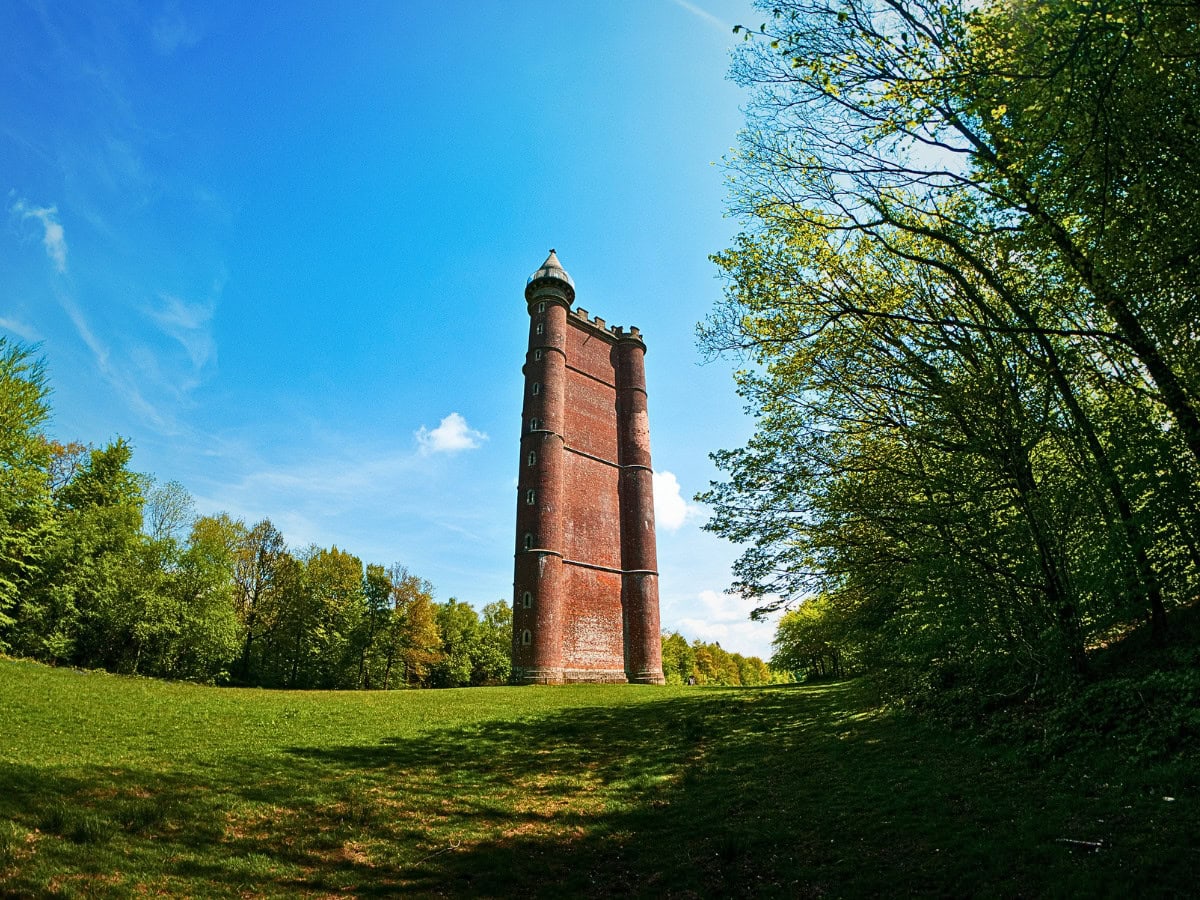
One traditional location lies near Stourhead, on the Somerset–Wiltshire border. Today, King Alfred’s Tower rises above the surrounding landscape. The tower is associated with the tradition that Alfred rallied his army in this area before Edington, but it does not prove the location of Egbert’s Stone.
The tower itself came much later. Designed by Henry Flitcroft for Henry Hoare II in 1772, the 18th-century folly commemorates Alfred’s victory as well as the accession of George III and the end of the Seven Years’ War.
These later monuments show how strongly Alfred’s victory became attached to the Wiltshire and Somerset landscape, even when the precise locations described in the ninth-century sources can no longer be identified with certainty.
What we can follow is the broad direction of Alfred’s campaign.
After emerging from the Somerset marshes, he gathered his forces at Egbert’s Stone, marched to Iley Oak, and then advanced towards Ethandun.
Somewhere within this landscape, in the spring of 878, the armies of Alfred and Guthrum met.
More than eleven centuries later, the precise battlefield may be uncertain, but the surrounding landscape still offers a tangible connection to one of the defining moments in Alfred’s story.
Why Was the Battle of Edington So Important?
The importance of the Battle of Edington lies first in something remarkably simple: Wessex survived.
At the beginning of 878, that survival was far from certain. Guthrum had seized Chippenham, many West Saxons had submitted or fled, and Alfred had been forced into the Somerset marshes.
By the end of the campaign, the balance had changed.
Alfred remained King of Wessex. Guthrum had surrendered and agreed to leave his kingdom. Viking power remained firmly established elsewhere in England, but Wessex had escaped the fate that had already transformed Northumbria, East Anglia and much of Mercia.
Edington also gave Alfred something equally valuable: time to strengthen his kingdom.
In the years that followed, Alfred developed a network of fortified settlements known as burhs. He also reorganised military service so that forces could be available without leaving the kingdom permanently stripped of men needed at home.
These changes were designed to make another sudden Viking advance much harder to achieve.
Their importance became clear when major Viking armies returned in the 890s. Alfred’s Wessex was by then better organised to withstand them.
But the consequences of Edington reached beyond Alfred’s lifetime.
His son Edward the Elder and daughter Æthelflæd, Lady of the Mercians, later used fortified centres and military campaigns to push into territories under Scandinavian control. Alfred’s grandson Æthelstan would take that expansion further, eventually ruling a much larger English kingdom.
Edington did not create a united England in 878. Nor did Alfred know exactly what his descendants would achieve.
What his victory did was preserve the kingdom from which much of that later story would unfold.
For Alfred, Edington was a victory after one of the darkest periods of his reign.
For Wessex, it was survival.
And for the developing Story of England, it was a turning point whose consequences would continue long after the battlefield had fallen quiet.
Battle of Edington 878 — A Turning Point in Alfred’s Story
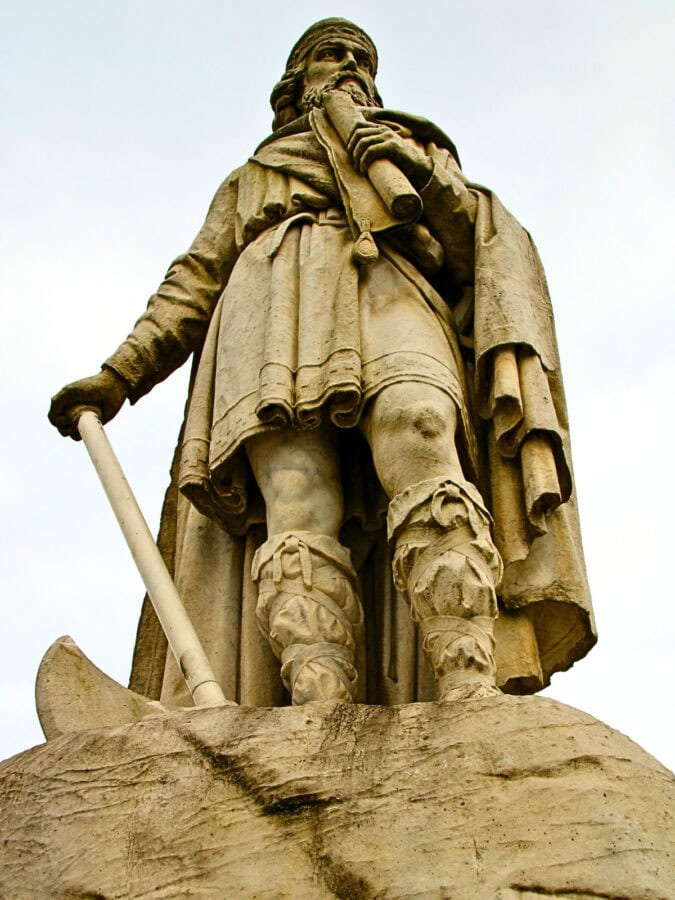
The Battle of Edington stands as one of the defining moments of Alfred’s reign.
It did not end Viking power or create a united England. What it did was secure the survival of Wessex at a critical point in its history and give Alfred the opportunity to strengthen the kingdom he had almost lost.
The wider story of England would take generations to unfold.
But in 878, one thing had changed profoundly: Alfred had survived his greatest crisis and emerged from it with his kingship secure.
I hope this closer look at the Battle of Edington has added another perspective to your understanding of Alfred’s story and the events that helped shape the wider Story of England.
Continue reading the remarkable story of Alfred the Great, from a younger son who was never expected to become king to the ruler whose legacy would help shape the future of England.
Continue the Story of England
If the Battle of Edington has drawn you deeper into Anglo-Saxon England, the story continues through the rulers, kingdoms and conflicts that followed Alfred’s victory.
Trace the generations after Alfred as Wessex grew stronger and the struggle for control of England continued. Follow the changing relationship between Anglo-Saxon and Viking rulers, through periods of Danish rule and towards the upheaval of 1066.
Then continue into the Norman Conquest and the kings and queens who followed. Or follow the complete Story of England through the rulers, battles and turning points that shaped England across the centuries.
Please take a moment…
Before you go, I’m excited to share some news—Timeless Travel Steps was awarded Best Slow Travel & Heritage Travel Blog 2026! Please take a moment to read our story and discover the passion behind our journeys.
For more travel insights and tips, consider following Georgina from Timeless Travel Steps on BlueSky, Instagram, Facebook and Pinterest. Don’t miss out on her latest adventures and expert advice. Subscribe to stay updated and join a community of fellow travel enthusiasts eager to explore the world.
References and Further Reading
If you would like to explore the Battle of Edington, Alfred the Great and Guthrum in greater depth, the following sources provide useful starting points.


